 Back
Chapter 18 part 2/2
Study Guide - Smart Notes
 Tailored notes based on your materials, expanded with key definitions, examples, and context.
Gene Regulation
Overview of Gene Expression
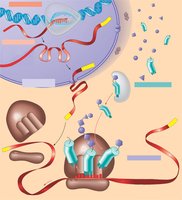
Gene expression is the process by which information from a gene is used to synthesize functional gene products, typically proteins. This process involves multiple steps, including transcription, RNA processing, and translation. Regulation of gene expression allows cells to respond to internal and external signals and to differentiate into specialized cell types.
Transcription: The synthesis of RNA from a DNA template by RNA polymerase.
RNA Processing (in eukaryotes): Includes capping, addition of a poly-A tail, and splicing to remove introns.
Translation: The synthesis of a polypeptide using the information in the mRNA sequence.
Regulation of Gene Expression
Cells typically use only a small fraction of their genes at any given time. The selection of active genes depends on cell type, internal conditions, stage in the cell cycle, nutrient availability, physical environment, and signals from other cells.
Cell Type: For example, muscle cells express genes for muscle proteins.
Internal Conditions: Such as the cell cycle stage (e.g., cyclin genes).
Nutrient Availability: Genes for amino acid synthesis are regulated based on nutrient levels.
External Signals: Such as heat shock proteins or growth factors.
Major Points of Regulation
1. Controlling Enzyme Activity
Enzyme activity can be regulated directly, such as by feedback inhibition. For example, in the tryptophan (trp) synthesis pathway, the end product (tryptophan) inhibits the first enzyme in the pathway when its concentration is high.
Feedback Inhibition: The end product of a metabolic pathway inhibits an enzyme involved early in the pathway.
2. Controlling Transcription (TXN)
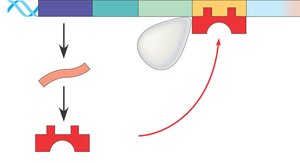
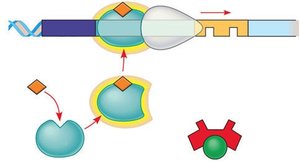
Transcriptional regulation is a major control point for gene expression. Genes can be regulated positively (requiring stimulation for transcription) or negatively (default is "on" but can be blocked).
Positive Regulation: Transcription requires stimulation, often by transcription factors. Example: MyoD in muscle cell differentiation.
Negative Regulation: Transcription is blocked by a repressor protein. Example: trp operon in bacteria.
Operons in Prokaryotes
Definition and Structure
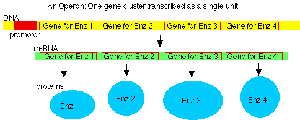
An operon is a group of genes with a related function that are transcribed together from a single promoter, producing a single mRNA. Operons are common in prokaryotes and allow coordinated regulation of gene clusters.
Promoter: DNA sequence where RNA polymerase binds to initiate transcription.
Operator: DNA segment where a repressor protein can bind to block transcription.
Structural Genes: Genes that code for proteins with related functions.
trp Operon (Repressible Operon)
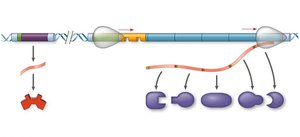
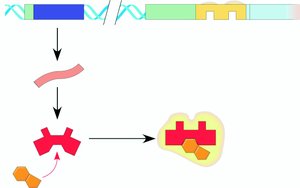
The trp operon contains genes for enzymes involved in tryptophan synthesis. It is regulated by a repressor protein that can block transcription when tryptophan is abundant.
Low Tryptophan: Repressor is inactive, operon is transcribed, enzymes are produced.
High Tryptophan: Tryptophan binds to the repressor, activating it. The active repressor binds the operator, blocking transcription.
Summary Table: Repressible vs. Inducible Operons
Type | Default State | Regulation | Example | Pathway Type |
|---|---|---|---|---|
Repressible | ON | Can be turned OFF by repressor | trp operon | Anabolic (biosynthetic) |
Inducible | OFF | Can be turned ON by inducer | lac operon | Catabolic (degradative) |
lac Operon (Inducible Operon)
The lac operon contains genes for enzymes that metabolize lactose. It is regulated by both a repressor protein and an activator (CRP/cAMP complex), allowing the cell to use lactose only when glucose is scarce.
Low Lactose: Repressor is active and binds the operator, blocking transcription.
High Lactose: Allolactose (an isomer of lactose) binds the repressor, inactivating it. RNA polymerase can transcribe the operon if glucose is also low.
High Glucose: Low cAMP, CRP is inactive, and transcription is low even if lactose is present.
Low Glucose: High cAMP, CRP is active, and transcription is stimulated if lactose is present.
Restriction Enzymes
Definition and Function
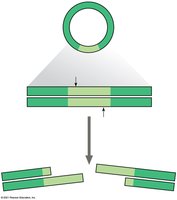
Restriction enzymes are proteins produced by bacteria that cut DNA at specific nucleotide sequences, known as restriction sites. These enzymes are used as a defense mechanism against viruses and foreign DNA.
Restriction Site: A specific, short DNA sequence recognized and cut by a restriction enzyme. Often palindromic.
Sticky Ends: Single-stranded overhangs produced by staggered cuts, useful for DNA cloning.
Example: EcoRI recognizes and cuts the sequence GAATTC.
Applications
Restriction enzymes are essential tools in molecular biology for gene cloning, DNA mapping, and genetic engineering.
They allow scientists to cut and paste DNA fragments for recombinant DNA technology.
Key Terms and Concepts
Transcription (TXN): Synthesis of RNA from DNA.
Translation (TLN): Synthesis of protein from mRNA.
Operon: Cluster of genes under control of a single promoter.
Repressor: Protein that binds to the operator to block transcription.
Inducer: Molecule that inactivates a repressor to allow transcription.
cAMP: Cyclic AMP, a signaling molecule involved in positive regulation of the lac operon.
CRP: cAMP receptor protein, an activator of transcription in the lac operon.
Restriction Enzyme: Enzyme that cuts DNA at specific sequences.
Summary
Gene expression is tightly regulated at multiple levels, especially transcription.
Prokaryotic operons allow coordinated regulation of gene clusters.
Repressible operons (e.g., trp) are usually ON but can be turned OFF; inducible operons (e.g., lac) are usually OFF but can be turned ON.
Restriction enzymes are molecular scissors that cut DNA at specific sites, enabling genetic engineering.
