 Back
Gene Regulation in Prokaryotes: Operons, Inducible and Repressible Systems
Study Guide - Smart Notes
 Tailored notes based on your materials, expanded with key definitions, examples, and context.
Gene Regulation in Prokaryotes
Introduction to Gene Regulation
Gene regulation is the process by which cells control the timing, location, and amount of gene expression. In prokaryotes, gene regulation is essential for conserving energy and resources, allowing bacteria to adapt to changing environments by producing proteins only when needed.
Gene expression: The process by which information from a gene is used to synthesize a functional gene product, typically a protein.
Gene regulation: The mechanisms that control whether a gene is expressed or not, and to what extent.
Prokaryotes and eukaryotes use different systems for gene regulation.
Example: E. coli only produces lactase when lactose is present in the environment.
Operons: The Basic Unit of Prokaryotic Gene Regulation
Structure and Function of Operons
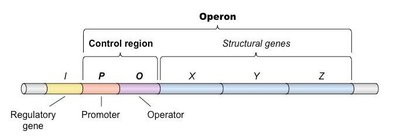
An operon is a cluster of genes under the control of a single promoter and operator, allowing coordinated regulation of gene expression in prokaryotes. Operons enable bacteria to efficiently regulate groups of genes with related functions.
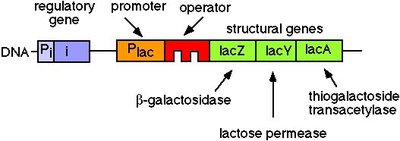
Promoter: DNA sequence where RNA polymerase binds to initiate transcription.
Operator: DNA segment that acts as a switch, controlling access of RNA polymerase to the genes.
Structural genes: Genes that code for proteins with related functions.
Regulatory gene: Encodes a repressor protein that can bind to the operator to block transcription.
Types of Operons
Inducible and Repressible Operons
Operons can be classified based on their regulatory mechanisms. The two main types are inducible operons and repressible operons, each responding to different environmental signals.
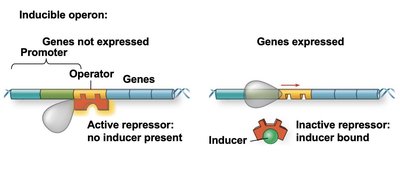
Inducible operons: Usually off, but can be turned on (induced) when a specific molecule is present.
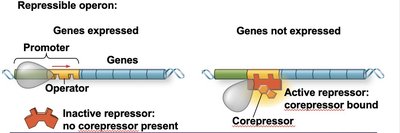
Repressible operons: Usually on, but can be turned off (repressed) when a specific molecule is present.
Inducible Operons: The lac Operon
Mechanism and Example
The lac operon in E. coli is a classic example of an inducible operon. It controls the breakdown of lactose by producing enzymes only when lactose is available.
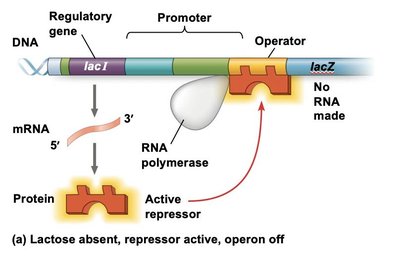
Default state: Off (no transcription or translation occurs unless lactose is present).
The repressor protein binds to the operator, blocking RNA polymerase from transcribing the genes.
When lactose is present, it acts as an inducer by binding to the repressor, changing its shape so it can no longer bind the operator.
RNA polymerase can then transcribe the genes, leading to the production of enzymes needed to metabolize lactose.
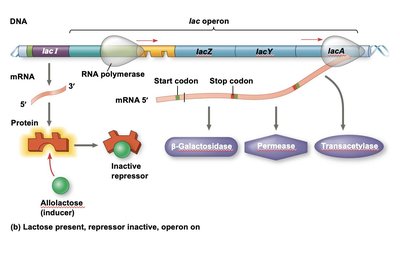
Summary: Inducible operons are off until needed. The cell synthesizes enzymes only when the substrate (e.g., lactose) is present.
Repressible Operons: The trp Operon
Mechanism and Example
The trp operon in E. coli is a classic example of a repressible operon. It controls the synthesis of tryptophan, an amino acid, and is typically active unless tryptophan is abundant.
Default state: On (genes are transcribed and tryptophan is synthesized).
The repressor protein is inactive and does not bind the operator unless tryptophan is present.
When tryptophan is present, it acts as a corepressor by binding to the repressor, activating it.
The active repressor binds to the operator, blocking RNA polymerase and stopping transcription of the genes.
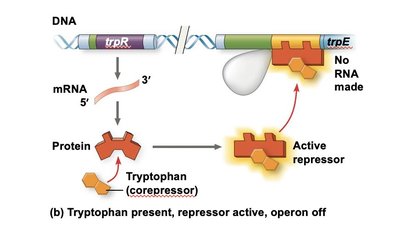
Summary: Repressible operons are on unless not needed. The cell stops synthesizing the product (e.g., tryptophan) when it is already present in sufficient quantities.
Key Concepts and Applications
Importance of Gene Regulation
Gene regulation allows prokaryotes to adapt quickly to environmental changes, conserve energy, and efficiently manage cellular resources. The operon model is a foundational concept in molecular biology, illustrating how gene expression can be controlled at the transcriptional level.
Operons are found primarily in prokaryotes, but similar regulatory principles apply in eukaryotes.
Understanding operons provides insight into genetic engineering, biotechnology, and the development of antibiotics targeting bacterial gene regulation.
Summary Table: Inducible vs. Repressible Operons
Feature | Inducible Operon (e.g., lac) | Repressible Operon (e.g., trp) |
|---|---|---|
Default State | Off | On |
Regulation Mechanism | Inducer inactivates repressor | Corepressor activates repressor |
When Genes Are Expressed | When substrate is present | When product is absent |
Example | lac operon (lactose metabolism) | trp operon (tryptophan synthesis) |
Review Questions
How does the presence of lactose affect the lac operon in E. coli?
What is the role of the operator in an operon?
Compare and contrast inducible and repressible operons.
Why is gene regulation important for prokaryotes?
Additional info: Epigenetic regulation, such as DNA methylation, can also affect gene expression in eukaryotes, but is less common in prokaryotes. The operon model is a key example of transcriptional regulation in bacteria.
