 Back
Gene Structure, mRNA Processing, and Translation
Study Guide - Smart Notes
 Tailored notes based on your materials, expanded with key definitions, examples, and context.
Gene Structure and mRNA Processing
Organization of a Eukaryotic Gene
Eukaryotic genes are composed of coding and non-coding regions that are transcribed and processed to produce mature mRNA. Understanding the structure of genes is essential for grasping how genetic information is expressed.
Exons: Coding regions that are retained in mature mRNA.
Introns: Non-coding regions that are removed during RNA processing.
5′ Untranslated Region (5′ UTR): Sequence upstream of the coding region, important for regulation.
3′ Untranslated Region (3′ UTR): Sequence downstream of the coding region, also involved in regulation.
Example: A gene with 3 exons and 2 introns, where the 5′ UTR spans the first exon and part of the second exon, and the 3′ UTR is within the third exon. 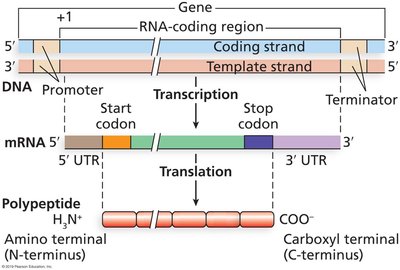
Pre-mRNA and Mature mRNA Calculation
The size of pre-mRNA includes all exons, introns, and UTRs, while mature mRNA contains only exons and UTRs after introns are removed.
Pre-mRNA: Sum of all exons, introns, and UTRs.
Mature mRNA: Sum of exons and UTRs (introns are spliced out).
Formula:
Pre-mRNA length = 5′ UTR + 1st exon + 1st intron + 2nd exon + 2nd intron + 3rd exon + 3′ UTR
Mature mRNA length = 5′ UTR + 1st exon + 2nd exon + 3rd exon + 3′ UTR
Messenger RNA and Translation
mRNA Structure and Function
Messenger RNA (mRNA) carries genetic information from DNA to the ribosome, where it is translated into protein.
Start Codon: Defines the beginning of translation (usually AUG).
Stop Codon: Defines the end of translation.
5′ UTR and 3′ UTR: Regions outside the coding sequence, not translated into protein.
Codons and Anticodons
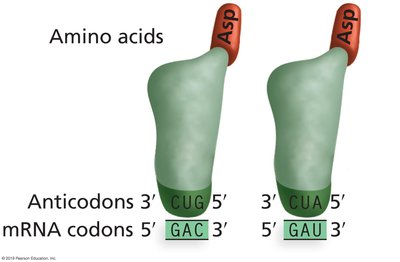
Codons are three-nucleotide sequences in mRNA that specify amino acids. Anticodons are complementary sequences on tRNA molecules.
Isoaccepting tRNAs: Different tRNAs with distinct anticodons that carry the same amino acid.
Complementary Base Pairing: Ensures correct amino acid incorporation during translation.
Translating the mRNA Code
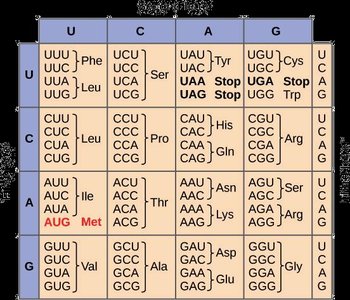
The genetic code is used to translate mRNA codons into amino acids.
20 Amino Acids: Each specified by one or more codons.
Start Codon (AUG): Codes for methionine and initiates translation.
Stop Codons (UAA, UAG, UGA): Signal termination of translation.
Amino Acid Structure and Classification
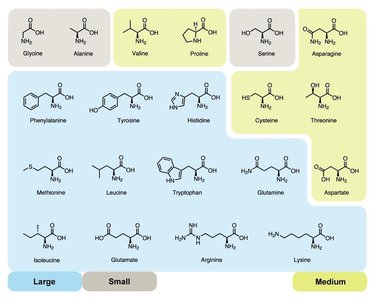
Amino acids are classified based on their size and chemical properties.
Large, Medium, Small: Categories based on molecular structure.
Examples: Glycine (small), Methionine (large), Aspartate (medium).
Ribosome Structure and Function
Ribosome Active Sites
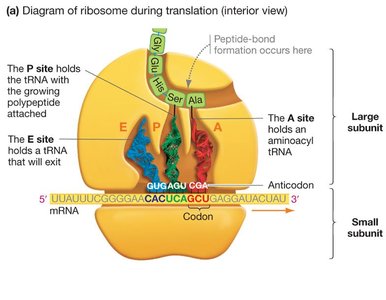
Ribosomes are the molecular machines responsible for protein synthesis. They consist of two subunits and three active sites.
P site (Peptidyl site): Holds the tRNA with the growing polypeptide chain.
A site (Aminoacyl site): Binds incoming tRNA with an amino acid.
E site (Exit site): Releases tRNA after its amino acid is added.
Ribosome Assembly and Initiation
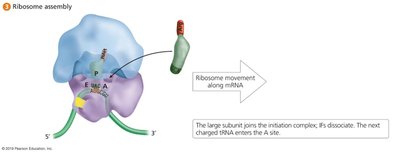
Translation begins when the large ribosomal subunit joins the small subunit, forming the complete ribosome.
Initiation Complex: Includes mRNA, initiator tRNA, and ribosomal subunits.
Movement: Ribosome moves along mRNA during translation.
Translation: Elongation and Termination
Elongation Cycle
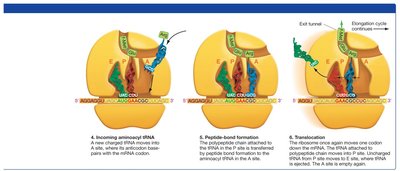
During elongation, the ribosome moves along the mRNA, adding amino acids to the growing polypeptide chain.
Translocation: Ribosome shifts one codon at a time toward the 3′ end.
Steps:
Incoming aminoacyl tRNA enters the A site.
Peptide bond forms between amino acids.
Ribosome translocates, moving tRNAs and opening the A site for the next tRNA.
Termination of Translation
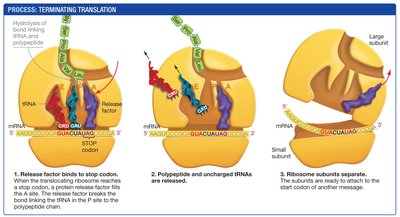
Translation ends when a stop codon is reached.
Release Factor: Binds to stop codon, causing release of polypeptide and dissociation of ribosome.
Polypeptide Release: Newly synthesized protein is released for folding and function.
Protein Synthesis in Cells
Location of Protein Synthesis
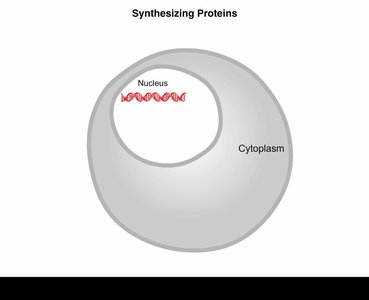
In eukaryotes, transcription occurs in the nucleus, and translation occurs in the cytoplasm.
Nucleus: Site of DNA and RNA synthesis.
Cytoplasm: Site of protein synthesis by ribosomes.
Gene Structure and mRNA Processing Example
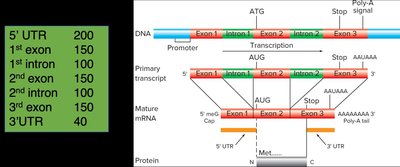
Gene Region Lengths and mRNA Processing
The diagram below illustrates the relationship between gene regions, transcription, and mRNA processing.
Primary Transcript: Contains exons, introns, and UTRs.
Mature mRNA: Contains only exons and UTRs after splicing.
Protein: Translated from the coding region of mature mRNA.
Transcription, RNA Processing, and Translation: Bacteria vs. Eukaryotes
Comparison Table
The processes of transcription, RNA processing, and translation differ between bacteria and eukaryotes.
Process | Bacteria | Eukaryotes |
|---|---|---|
Transcription | One RNA polymerase; promoter with -35 and -10 boxes; sigma factor | Three RNA polymerases; variable promoters with TATA box; many transcription factors |
RNA Processing | Rare | Extensive: 5′ cap, splicing, 3′ poly(A) tail |
Translation | Initiation and termination less complex; elongation similar | Initiation and termination more complex; elongation similar |
Additional info: Eukaryotic mRNA undergoes extensive processing before translation, including capping, splicing, and polyadenylation, which are not common in bacteria. ----------------------------------------
