Back
General Biology 1: Exam I Study Guide (Chapters 1–6)
Study Guide - Smart Notes
 Tailored notes based on your materials, expanded with key definitions, examples, and context.
Exam I Study Guide: General Biology 1
Overview
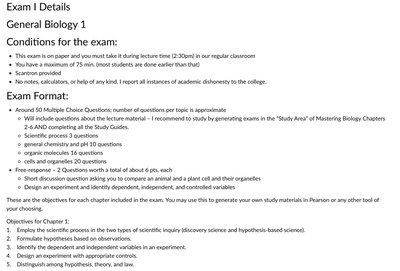
This study guide covers the foundational topics for General Biology 1, focusing on chapters 1 through 6. It includes key concepts, definitions, and objectives to help students prepare for the exam, which consists of multiple-choice, scientific process, and concept questions.
Chapter 1: Introduction to Biology
Scientific Inquiry and Hypothesis-Based Science
Biology is the scientific study of life, using both discovery science and hypothesis-based science to explore living systems.
Discovery Science: Involves observing and describing nature without manipulating variables.
Hypothesis-Based Science: Uses experiments to test predictions derived from hypotheses.
Variables: Independent variable is manipulated; dependent variable is measured; controlled variables are kept constant.
Scientific Method: Steps include observation, hypothesis formation, experimentation, data collection, and conclusion.
Hypothesis vs. Theory: A hypothesis is a testable explanation; a theory is a broader, well-supported explanation.
Chapter 2: Chemistry of Life
Biologically Important Elements and Atomic Structure
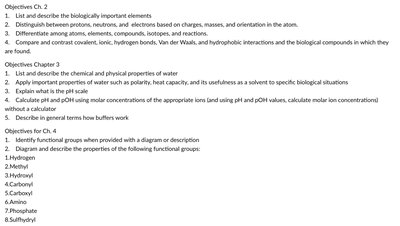
Living organisms are composed of a limited set of elements, primarily carbon, hydrogen, oxygen, nitrogen, phosphorus, and sulfur.
Atoms: Consist of protons (positive), neutrons (neutral), and electrons (negative).
Atomic Number: Number of protons; Mass Number: Protons + neutrons.
Isotopes: Atoms of the same element with different numbers of neutrons.
Orientation: Electron arrangement determines chemical reactivity.
Types of Chemical Bonds and Interactions
Covalent Bonds: Atoms share electrons.
Ionic Bonds: Atoms transfer electrons, forming charged ions.
Hydrogen Bonds: Weak attractions between partially charged atoms.
Van der Waals Interactions: Weak, transient attractions between molecules.
Comparison of Biological Compounds
Biological compounds differ in their bonding and interactions, affecting their function and location in cells.
Chapter 3: Water
Chemical and Physical Properties of Water
Water is essential for life due to its unique properties.
Polarity: Water molecules have a partial positive and negative charge, enabling hydrogen bonding.
Heat Capacity: Water absorbs and releases heat slowly, stabilizing temperatures.
Solvent Properties: Water dissolves many substances, facilitating biological reactions.
pH and Buffers
pH Scale: Measures hydrogen ion concentration; acidic (pH < 7), neutral (pH = 7), basic (pH > 7).
Calculating pH:
Buffers: Substances that minimize changes in pH by absorbing or releasing H+ ions.
Water in Biological Contexts
Water's properties are crucial for maintaining cell structure, transporting substances, and facilitating reactions.
Chapter 4: Biomolecules
Functional Groups
Functional groups are specific clusters of atoms within molecules that determine their chemical properties and reactivity.
Methyl (-CH3)
Hydroxyl (-OH)
Carbonyl (C=O)
Phosphate (-PO4)
Amino (-NH2)
Sulfhydryl (-SH)
Identification and Properties
Each functional group imparts specific properties, such as polarity, acidity, or reactivity, to biomolecules.
Chapter 5: Cell Components and Biomolecules
Bonding in Biomolecules
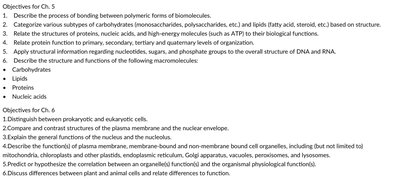
Polymerization: Monomers are joined by covalent bonds to form polymers (e.g., proteins, nucleic acids).
Carbohydrates and Lipids
Carbohydrates: Monosaccharides, disaccharides, polysaccharides; energy storage and structural roles.
Lipids: Fatty acids, steroids; energy storage, membrane structure.
Proteins and Nucleic Acids
Proteins: Structure and function depend on primary, secondary, tertiary, and quaternary organization.
Nucleic Acids: DNA and RNA store and transmit genetic information.
Structure and Function Relationships
Biomolecule structure determines function, such as enzyme activity or membrane formation.
Chapter 6: The Membrane and Cell Structure
Prokaryotic vs. Eukaryotic Cells
Prokaryotes: Lack a nucleus and membrane-bound organelles.
Eukaryotes: Have a nucleus and membrane-bound organelles.
Plasma Membrane and Nuclear Envelope
Plasma Membrane: Composed of a phospholipid bilayer with embedded proteins; regulates transport.
Nuclear Envelope: Double membrane surrounding the nucleus; contains nuclear pores.
Cell Organelles
Membrane-Bound Organelles: Mitochondria, endoplasmic reticulum, Golgi apparatus, vacuoles, peroxisomes, lysosomes.
Non-Membrane-Bound Organelles: Ribosomes.
Plant vs. Animal Cells
Plant Cells: Have cell walls, chloroplasts, and large central vacuoles.
Animal Cells: Lack cell walls and chloroplasts; have smaller vacuoles.
Optimal Physiological Functions
Cell structure is adapted to optimize physiological functions, such as energy production and transport.
Summary Table: Cell Types and Organelles
Cell Type | Nucleus | Membrane-Bound Organelles | Cell Wall | Chloroplasts |
|---|---|---|---|---|
Prokaryote | No | No | Yes | No |
Plant Cell | Yes | Yes | Yes | Yes |
Animal Cell | Yes | Yes | No | No |
Relevant Images