 Back
General Biology 1A Final Exam Study Guidance
Study Guide - Smart Notes
 Tailored notes based on your materials, expanded with key definitions, examples, and context.
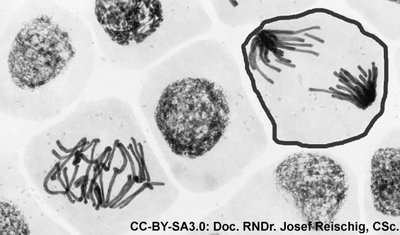
Q15. At what stage of the cell cycle is the circled cell in the micrograph of a Vicia faba root tip?
Background
Topic: Cell Cycle and Mitosis
This question tests your ability to identify stages of mitosis using a micrograph of plant cells. Recognizing the arrangement and appearance of chromosomes and spindle fibers is key to distinguishing between stages such as prophase, metaphase, anaphase, and telophase.
Key Terms:
Prophase: Chromosomes condense and become visible; spindle fibers begin to form.
Metaphase: Chromosomes align at the cell's equator.
Anaphase: Sister chromatids are pulled apart toward opposite poles.
Telophase: Chromatids reach poles and nuclear envelope reforms.
Interphase: Cell is not dividing; DNA is less condensed.
Step-by-Step Guidance
Observe the circled cell in the image and note the arrangement of the chromosomes and the presence of spindle fibers.
Recall the visual characteristics of each mitotic stage: for example, in anaphase, chromosomes are visibly separating and moving toward opposite poles.
Compare the circled cell to the descriptions: Are the chromosomes aligned, separating, or fully separated? Are there visible spindle fibers pulling chromatids apart?
Eliminate stages that do not match the observed features (e.g., if chromosomes are not aligned at the center, it is not metaphase).
Try solving on your own before revealing the answer!
Final Answer: d) Anaphase
The circled cell shows chromosomes being pulled toward opposite poles, which is characteristic of anaphase. The spindle fibers are clearly visible, and the chromatids are separating, confirming this stage.
Q16. Highly repetitive regions of DNA that kinetochore proteins bind to are called:
Background
Topic: Chromosome Structure and Function
This question tests your understanding of chromosome anatomy, specifically the region where spindle fibers attach during cell division.
Key Terms:
Centromere: The region of a chromosome where the kinetochore forms and spindle fibers attach during mitosis and meiosis.
Kinetochore: A protein complex assembled on the centromere that mediates chromosome movement.
Chromatid: One of two identical halves of a duplicated chromosome.
Step-by-Step Guidance
Recall the function of the kinetochore and where it binds on the chromosome.
Review the definitions of centromere, chromatid, chromosome, centriole, and centrosome.
Identify which structure is composed of highly repetitive DNA and serves as the attachment site for kinetochore proteins.
Try solving on your own before revealing the answer!
Final Answer: d) Centromeres
Centromeres are the highly repetitive DNA regions where kinetochores assemble and spindle fibers attach during cell division.
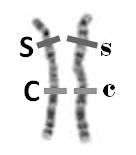
Q29. The image shows the genotype of an F1 individual produced by crossing two pure-breeding parents. Which one of the following statements is true?
Background
Topic: Mendelian Genetics and Chromosome Behavior
This question tests your understanding of genotype, gamete formation, and inheritance patterns in the F1 and F2 generations, especially with linked genes.
Key Terms:
Genotype: The genetic makeup of an organism (here, heterozygous for two genes).
Pure-breeding: Homozygous for a trait.
Recombination: The exchange of genetic material between homologous chromosomes during meiosis.
Step-by-Step Guidance
Examine the image: The F1 individual has one chromosome with S and C alleles, and the other with s and c alleles.
Recall what types of gametes can be produced by an individual with this genotype, considering the arrangement of alleles (linked or unlinked).
Think about what happens in the F2 generation after self-crossing the F1 individual: Will all F2 individuals be pure-breeding? Will recombination occur?
Consider which statements about the F2 generation and gamete types are supported by the genotype shown.
Try solving on your own before revealing the answer!
Final Answer: a) Some individuals in the F2 generation will also have this genotype.
When the F1 individual self-crosses, some F2 offspring will inherit the same combination of alleles (S C / s c) as the F1 parent, so this genotype can reappear in the F2 generation.
