 Back
General Biology: Bond Types, Electronegativity, and pH Effects on Biomolecules
Study Guide - Smart Notes
 Tailored notes based on your materials, expanded with key definitions, examples, and context.
Q1. What atoms are involved in the bond indicated by the arrow? What is the electronegativity difference between the bonded atoms? What is the charge on each atom in this bond? What type of bond is shown by the arrow?
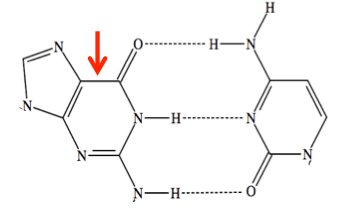
Background
Topic: Chemical Bonds in Biomolecules
This question tests your understanding of how to identify atoms in a chemical bond, calculate electronegativity differences, and determine the type and polarity of the bond. This is fundamental for understanding molecular interactions in biology, such as those in DNA.
Key Terms and Formulas
Electronegativity: A measure of an atom's ability to attract electrons in a bond.
Bond Types: Non-polar covalent, polar covalent, ionic.
Electronegativity Difference Formula:
If the difference is < 0.5: Non-polar covalent
0.5–1.7: Polar covalent
> 1.7: Ionic
Step-by-Step Guidance
Identify the two atoms involved in the bond indicated by the arrow. Use the structure and the number of bonds each atom forms to deduce their identities (e.g., carbon, nitrogen, etc.).
Look up the electronegativity values for each atom (C = 2.5, N = 3.04, O = 3.44, H = 2.1, P = 2.19).
Calculate the electronegativity difference using the formula: .
Use the difference to determine the type of bond (refer to the scale above).
Assign partial charges (δ+ or δ-) to each atom based on which is more electronegative.
Try solving on your own before revealing the answer!
Final Answer:
Atoms in the bond: Carbon (C) and Nitrogen (N).
Electronegativity difference:
Charges: Nitrogen is δ- (more electronegative), Carbon is δ+ (less electronegative).
Type of bond: Polar covalent bond.
This is a typical bond found in the backbone of nucleic acids, where the difference in electronegativity leads to partial charges and contributes to the molecule's chemical properties.
Q2. What atoms are involved in the bond by arrow? What is the electronegativity difference between the bonded atoms? What is the charge on each atom in this bond? What type of bond is this?
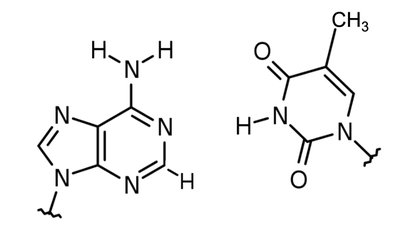
Background
Topic: Bond Types in Biomolecules
This question continues to test your ability to identify atoms in a bond, calculate electronegativity differences, and classify the bond type, which is essential for understanding molecular structure and function in biology.
Key Terms and Formulas
Electronegativity values (see above).
Bond type scale (see above).
Step-by-Step Guidance
Identify the two atoms involved in the bond indicated by the arrow (use the molecular structure and bonding patterns).
Find the electronegativity values for each atom.
Calculate the electronegativity difference: .
Determine the type of bond using the scale provided.
Assign partial charges based on electronegativity.
Try solving on your own before revealing the answer!
Final Answer:
Atoms in the bond: Nitrogen (N) and Hydrogen (H).
Electronegativity difference:
Charges: Nitrogen is δ-, Hydrogen is δ+.
Type of bond: Polar covalent bond.
This bond is common in amino groups and contributes to the molecule's polarity and reactivity.
Q3. What atoms are involved in the bond by arrow? What is the charge on each atom in this bond? What type of bond is this?
Background
Topic: Bond Polarity and Charge Assignment
This question focuses on identifying the atoms in a bond, assigning charges, and classifying the bond type, which is important for understanding molecular interactions.
Key Terms and Formulas
Electronegativity and partial charges (δ+ and δ-).
Bond type classification.
Step-by-Step Guidance
Identify the two atoms in the bond (use the molecular structure and bonding patterns).
Determine which atom is more electronegative and assign partial charges accordingly.
Classify the bond as non-polar covalent, polar covalent, or ionic based on the electronegativity difference.
Try solving on your own before revealing the answer!
Final Answer:
Atoms in the bond: Oxygen (O) and Hydrogen (H).
Charges: Oxygen is δ-, Hydrogen is δ+.
Type of bond: Polar covalent bond.
This bond is typical in water and many biological molecules, leading to hydrogen bonding and high polarity.
Q4. What type of bond is this? (dotted line) Are these atoms sharing electrons with each other? How do you know? How is this bond similar to an ionic bond? How is this bond different from an ionic bond? Label the charges by all atoms connected with dotted lines.
Background
Topic: Hydrogen Bonds and Non-covalent Interactions
This question tests your understanding of hydrogen bonds, how they differ from covalent and ionic bonds, and their role in biological molecules.
Key Terms and Formulas
Hydrogen bond: A weak bond between a hydrogen atom (attached to an electronegative atom) and another electronegative atom.
Partial charges: δ+ and δ- indicate partial positive and negative charges.
Step-by-Step Guidance
Identify the type of bond represented by the dotted line (usually a hydrogen bond in biological diagrams).
Determine if electrons are shared (covalent) or not (non-covalent).
Compare the similarities and differences between this bond and an ionic bond (e.g., both involve charge, but one is a full transfer and the other is a weak attraction).
Label the partial charges on the atoms involved in the dotted line bond.
Try solving on your own before revealing the answer!
Final Answer:
Type of bond: Hydrogen bond (dotted line).
Are electrons shared? No, electrons are not shared; the bond is due to attraction between partial charges.
Similarity to ionic bond: Both involve electrostatic attraction between charges.
Difference: Ionic bonds involve full charges and electron transfer; hydrogen bonds involve partial charges and no electron transfer.
Charges: The atom bonded to hydrogen (usually O or N) is δ-, hydrogen is δ+.
Q5. Draw the hydrogen bonds that connect these two molecules.
Background
Topic: Hydrogen Bonding in Biomolecules
This question asks you to identify and draw hydrogen bonds between two molecules, a key concept in understanding DNA base pairing and protein structure.
Key Terms and Formulas
Hydrogen bond: Attraction between a hydrogen atom (attached to O or N) and another electronegative atom (O or N).
Step-by-Step Guidance
Identify all possible hydrogen bond donors (N-H or O-H groups) and acceptors (N or O atoms with lone pairs) on both molecules.
Draw dashed lines between donors and acceptors to represent hydrogen bonds.
Ensure that each hydrogen bond follows the correct orientation (H attached to donor, lone pair on acceptor).
Try solving on your own before revealing the answer!
Final Answer:
Hydrogen bonds should be drawn as dashed lines between the N-H or O-H groups of one molecule and the N or O atoms of the other molecule. In DNA, for example, adenine forms two hydrogen bonds with thymine, and guanine forms three with cytosine.
Q6. Using your own words, explain the steps needed to determine a bond type. What concept(s) became more clear after this assignment? What remaining questions do you have?
Background
Topic: Determining Bond Types and Reflecting on Learning
This question asks you to summarize the process for determining bond types and reflect on your understanding, which is important for metacognition and deeper learning.
Key Terms and Formulas
Electronegativity, bond type classification, partial charges.
Step-by-Step Guidance
List the steps: Identify the atoms, find their electronegativities, calculate the difference, use the scale to classify the bond, and assign charges.
Reflect on which concepts became clearer (e.g., how to use electronegativity to predict bond type).
Note any remaining questions or confusions for group discussion.
Try solving on your own before revealing the answer!
Final Answer:
Steps: 1) Identify the atoms in the bond. 2) Find their electronegativity values. 3) Subtract to find the difference. 4) Use the difference to determine if the bond is non-polar covalent, polar covalent, or ionic. 5) Assign partial charges based on which atom is more electronegative.
Concepts that may become clearer: How electronegativity differences relate to bond polarity; how to assign partial charges; the importance of bond type in biological molecules.
Remaining questions: How to identify atoms in complex structures; how to apply these concepts to larger biomolecules.
Q7. Impact of pH on Proteins: Functional Groups and Protein Structure
Background
Topic: pH Effects on Functional Groups and Protein Structure
This question explores how pH affects the charge state of functional groups (like R-COOH and R-NH2) and how this impacts protein folding and function.
Key Terms and Formulas
pH: Measure of hydrogen ion concentration.
Functional groups: R-COOH (carboxyl), R-NH2 (amino).
Acid/base behavior: Acids donate H+, bases accept H+.
Step-by-Step Guidance
Recall that R-COOH is a carboxyl group (acid) and R-NH2 is an amino group (base).
Determine what happens to each group when added to water (does it donate or accept H+?).
Relate changes in pH to changes in [H+]: Lower pH = more H+, higher pH = less H+.
Use the table to predict the charge state of each group at different pH values.
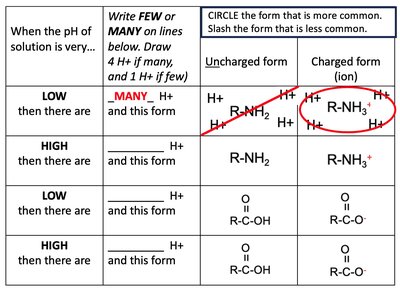
Try solving on your own before revealing the answer!
Final Answer:
a. R-COOH is a carboxyl group and is an acid. It donates H+ to the solution.
b. R-NH2 is an amino group and is a base. It accepts H+ from the solution.
c. When pH is decreased, [H+] is increased in the solution.
d. When pH is increased, [H+] is lowered in the solution.
Q8. How does pH alter the form of functional groups? (Table logic and explanation)
Background
Topic: pH-Dependent Ionization of Functional Groups
This question asks you to explain your reasoning for predicting the charge state of functional groups at different pH values, which is key for understanding protein structure and function.
Key Terms and Formulas
Ionization, acid/base behavior, pH effects.
Step-by-Step Guidance
Recall that acids (like R-COOH) lose H+ at high pH and become negatively charged (R-COO-).
Bases (like R-NH2) gain H+ at low pH and become positively charged (R-NH3+).
Use the table to match pH conditions to the most common form of each group.
Try solving on your own before revealing the answer!
Final Answer:
At low pH, there are many H+ ions, so amino groups are protonated (R-NH3+) and carboxyl groups are uncharged (R-COOH). At high pH, there are few H+ ions, so amino groups are uncharged (R-NH2) and carboxyl groups are deprotonated (R-COO-).
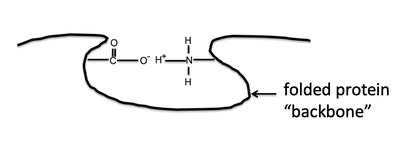
Q9. Protein Structure and pH: What type of bond is shown between these two functional groups? Are the O- and H+ sharing electrons? What happens to these groups and the bond at very low or very high pH?
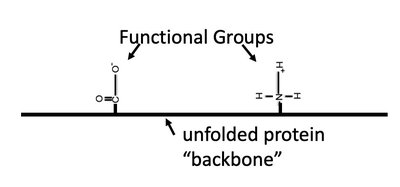
Background
Topic: Protein Folding and Ionic Interactions
This question examines how ionic bonds (salt bridges) form between charged side chains in proteins and how pH changes can disrupt these bonds, affecting protein structure and function.
Key Terms and Formulas
Ionic bond (salt bridge): Attraction between fully charged side chains (e.g., COO- and NH3+).
Protein folding: Driven by interactions between side chains, including ionic, hydrogen, and hydrophobic interactions.
Step-by-Step Guidance
Identify the functional groups involved in the bond (e.g., COO- and NH3+).
Determine if the bond is covalent, ionic, or hydrogen (look for full charges and electron sharing).
Predict what happens to the charges and the bond at low pH (more H+) and high pH (less H+).
Relate these changes to protein folding and function.
Try solving on your own before revealing the answer!
Final Answer:
a. The bond is an ionic bond (salt bridge) between fully charged side chains (COO- and NH3+).
b. O- and H+ are not sharing electrons; the bond is due to electrostatic attraction.
c. At very low pH, both groups may become uncharged, disrupting the bond and causing the protein to unfold.
d. At very high pH, both groups may lose their charges, also disrupting the bond and protein structure.
Q10. What are 2 factors that can impact protein structure? Will the proteins in 3c and 3d have the same function as the original, folded protein?
Background
Topic: Protein Structure and Function
This question asks you to identify factors that affect protein structure and to relate changes in structure to changes in function, a central concept in biology.
Key Terms and Formulas
Protein structure, denaturation, environmental factors (pH, temperature).
Step-by-Step Guidance
List two factors that can alter protein structure (e.g., pH, temperature, salt concentration).
Explain how changes in structure (unfolding or misfolding) affect protein function.
Compare the function of proteins in altered states (3c and 3d) to the original, folded protein.
Try solving on your own before revealing the answer!
Final Answer:
Two factors that impact protein structure are pH and temperature. Proteins in 3c and 3d (unfolded or misfolded due to pH changes) will not have the same function as the original, properly folded protein, because structure determines function.
