 Back
General Biology Chapter 1: Evolution, Themes, and Scientific Inquiry – Guided Study Notes
Study Guide - Smart Notes
 Tailored notes based on your materials, expanded with key definitions, examples, and context.
Q1. Use examples to illustrate each theme of this book.
Background
Topic: Unifying Themes of Biology
This question is testing your understanding of the major themes that connect all areas of biology, such as organization, information, energy and matter, interactions, and evolution. Recognizing these themes helps you see the big picture in biology and how different concepts are interrelated.
Key Terms:
Organization: The hierarchy of biological structures, from molecules to the biosphere.
Information: The role of genetic information in living systems.
Energy and Matter: How organisms obtain and use energy and matter.
Interactions: How organisms interact with each other and their environment.
Evolution: The process that accounts for the unity and diversity of life.
Step-by-Step Guidance
Identify each major theme of biology as outlined in your textbook (e.g., organization, information, energy and matter, interactions, evolution).
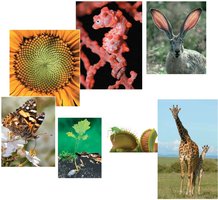
For each theme, think of a specific example from nature or your textbook that illustrates the concept. For example, for organization, you might use the structure of a sunflower or the arrangement of cells in a tissue.
Briefly describe how your chosen example demonstrates the theme. For instance, explain how the sunflower's structure shows organization, or how a butterfly's life cycle demonstrates growth and development.
Repeat this process for each theme, ensuring you use a different example for each one.
Review the images in your textbook (such as Figure 1.2) to help you match examples to each theme.
Try solving on your own before revealing the answer!
Final Answer:
Order: The sunflower's spiral pattern shows organized structure.
Reproduction: The mother and baby giraffe illustrate reproduction.
Regulation: The jackrabbit's large ears help regulate body temperature.
Response to the environment: The Venus flytrap closes in response to touch.
Energy processing: The butterfly obtains energy from nectar.
Growth and development: The sapling growing into a tree shows development.
Evolutionary adaptation: The pygmy seahorse's camouflage is an adaptation to its environment.
Each example matches a property of life, as illustrated in the image and described in your textbook.
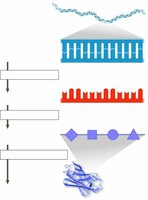
Q2. Label the gene, DNA, RNA, amino acids, and protein on the figure below. Next, label the three steps in the process and describe each.
Background
Topic: The Flow of Genetic Information (Central Dogma of Molecular Biology)
This question is testing your understanding of how genetic information flows from DNA to RNA to protein, a fundamental concept in biology known as the central dogma.
Key Terms and Steps:
Gene: A segment of DNA that codes for a specific protein.
DNA: The molecule that stores genetic information.
RNA: A molecule transcribed from DNA that carries the code for protein synthesis.
Amino acids: The building blocks of proteins.
Protein: A functional molecule made of one or more polypeptides.
Key Process:
Transcription: The process of copying a gene's DNA sequence into RNA.
RNA Processing (in eukaryotes): Modifying the RNA transcript before translation.
Translation: The process where the RNA sequence is used to build a protein from amino acids.
Step-by-Step Guidance
Identify the DNA double helix at the top of the figure. This represents the genetic material containing genes.
Locate the process where a segment of DNA is used as a template to synthesize a complementary RNA strand. This is transcription.
Find the RNA strand in the figure. This RNA will be used in the next step.
Follow the arrow to the next step, where the RNA sequence is read to assemble a chain of amino acids. This is translation.
Identify the chain of amino acids, which folds into a functional protein at the bottom of the figure.
Try solving on your own before revealing the answer!
Final Answer:
Gene: A specific region on the DNA double helix at the top.
Step 1 – Transcription: DNA is used as a template to make RNA.
Step 2 – RNA Processing (if eukaryotic): The RNA transcript is modified.
Step 3 – Translation: The RNA sequence is used to assemble amino acids into a polypeptide chain, which folds into a protein.
Labels: DNA (top), RNA (middle), amino acids (shapes), protein (folded structure at the bottom).
This process explains how genetic information is expressed as functional proteins in all living organisms.
