 Back
BackGeneral Biology Chapter 1 Study Guidance: Evolution, Themes, and Scientific Inquiry
Study Guide - Smart Notes
 Tailored notes based on your materials, expanded with key definitions, examples, and context.
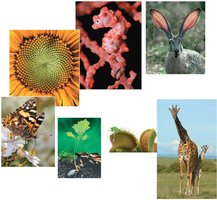
Q1. Label the seven properties of life illustrated in the figure and give a different example of each.
Background
Topic: Properties of Life
This question tests your understanding of the fundamental characteristics that define living organisms. These properties are central to biology and help distinguish living things from non-living matter.
Key Terms:
Order
Evolutionary adaptation
Regulation
Energy processing
Growth and development
Response to the environment
Reproduction
Step-by-Step Guidance
Examine the figure and identify each property of life shown. For example, look for structural patterns (order), adaptations (evolutionary adaptation), and so on.
For each property, write a brief definition. For instance, 'Order' refers to the highly organized structure found in living things.
Think of a unique example for each property that is different from the one shown in the figure. For example, for 'Order,' you might use the arrangement of cells in a leaf.
Match each property to the correct image in the figure, and then list your example next to it.
Review your definitions and examples to ensure they accurately reflect the property described.
Try solving on your own before revealing the answer!
Final Answer:
Order: Highly organized structure (e.g., sunflower pattern). Example: The arrangement of cells in a leaf.
Evolutionary adaptation: Traits that enhance survival (e.g., pygmy seahorse camouflage). Example: Polar bear's white fur for Arctic camouflage.
Regulation: Maintaining internal balance (e.g., jackrabbit's ears regulate temperature). Example: Human sweating to cool down.
Energy processing: Using energy for activities (e.g., butterfly drinking nectar). Example: Humans eating food for energy.
Growth and development: Organisms grow and develop (e.g., oak seedling). Example: Tadpole developing into a frog.
Response to the environment: Reacting to stimuli (e.g., Venus flytrap closing). Example: Plants bending toward light.
Reproduction: Producing offspring (e.g., giraffes). Example: Bacteria dividing by binary fission.
Each property is illustrated in the figure and can be matched to a unique example from nature.
Q2. What are emergent properties? Give two examples.
Background
Topic: Emergent Properties
This question explores the concept of emergent properties, which are characteristics that arise from the arrangement and interaction of parts within a system.
Key Terms:
Emergent properties: New properties that arise at each level of biological organization, not present in the preceding level.
Step-by-Step Guidance
Define emergent properties in your own words, focusing on how they result from interactions among components.
Think of examples where the whole is more than the sum of its parts. For instance, consider how individual cells form tissues with new functions.
List two examples, such as the heart's ability to pump blood (not present in individual heart cells) or the consciousness arising from neural networks.
Try solving on your own before revealing the answer!
Final Answer:
Emergent properties: Characteristics that arise from the arrangement and interaction of parts within a system.
Example 1: The heart can pump blood, but individual heart cells cannot.
Example 2: Consciousness arises from the interactions of neurons in the brain.
These properties are not found in the individual components but emerge when those components work together.
Q3. Life is organized on many scales. Define each level of biological organization.
Background
Topic: Levels of Biological Organization
This question tests your understanding of the hierarchical structure of life, from the largest scale (biosphere) to the smallest (molecules).
Key Terms:
Biosphere, Ecosystem, Community, Population, Organism, Organ/Organ System, Tissue, Cell, Organelle, Molecule
Step-by-Step Guidance
List each level in order from largest to smallest.
Write a brief definition for each level, focusing on what distinguishes it from the others.
Think of an example for each level, such as 'Biosphere: Earth' or 'Cell: neuron.'
Review your definitions to ensure clarity and accuracy.
Try solving on your own before revealing the answer!
Final Answer:
Biosphere: All life on Earth and the places where life exists.
Ecosystem: All living and nonliving things in a particular area.
Community: All organisms in an ecosystem.
Population: All individuals of a species in a specific area.
Organism: An individual living thing.
Organ/Organ System: Body parts with specific functions.
Tissue: Groups of cells with a common function.
Cell: Basic unit of life.
Organelle: Functional components within cells.
Molecule: Chemical structure consisting of two or more atoms.
Each level represents a step in the hierarchy of biological organization.
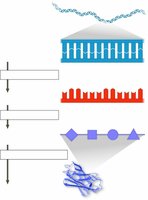
Q6. Label the gene, DNA, RNA, amino acids, and protein in the figure. Next, label the three steps in the process and describe each.
Background
Topic: Gene Expression
This question tests your understanding of how genetic information is used to produce proteins, a process central to molecular biology.
Key Terms and Formulas:
Gene: Segment of DNA encoding a protein.
DNA: Deoxyribonucleic acid, carrier of genetic information.
RNA: Ribonucleic acid, messenger molecule.
Amino acids: Building blocks of proteins.
Protein: Functional molecule made of amino acids.
Transcription: DNA to RNA.
Translation: RNA to amino acid chain.
Protein folding: Amino acid chain forms functional protein.
Step-by-Step Guidance
Identify the gene as a segment of DNA in the figure.
Label the DNA, noting its double-stranded structure.
Find the RNA strand produced from DNA via transcription.
Locate the chain of amino acids formed during translation.
Label the final folded protein, which is the functional product.
Describe each step: transcription (DNA to RNA), translation (RNA to amino acids), and protein folding (amino acids to protein).
Try solving on your own before revealing the answer!
Final Answer:
Gene: Section of DNA encoding a protein.
DNA: Double-stranded molecule with genetic code.
RNA: Single-stranded messenger produced by transcription.
Amino acids: Linked together during translation.
Protein: Folded chain of amino acids, functional molecule.
Steps:
Transcription: DNA is copied to RNA.
Translation: RNA is used to build a chain of amino acids.
Protein folding: Amino acid chain folds into a functional protein.
This process is essential for cells to produce proteins from genetic instructions.
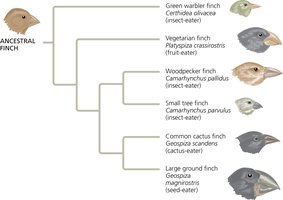
Q14. Study the evolutionary tree diagram. What is indicated by each twig? What do the branch points represent? Label the branch point that represents the ancestral point for all species of finch.
Background
Topic: Evolutionary Trees (Phylogeny)
This question tests your ability to interpret evolutionary trees, which show relationships among species and their common ancestors.
Key Terms:
Twig: Represents a current species.
Branch point: Represents a common ancestor where lineages diverge.
Ancestral point: The origin of all species in the tree.
Step-by-Step Guidance
Examine the tree diagram and identify the twigs at the ends of branches.
Note that each twig corresponds to a distinct species of finch.
Find the branch points, which indicate where evolutionary lineages split from a common ancestor.
Locate the first branch point, which represents the ancestral finch for all Galapagos finches.
Label the branch point and twigs according to their evolutionary relationships.
Try solving on your own before revealing the answer!
Final Answer:
Each twig: Represents a current species of finch.
Branch points: Indicate where lineages diverged from a common ancestor.
Ancestral point: The first branch point is the origin of all Galapagos finch species.
The tree shows how different finch species evolved from a common ancestor, with each branch point marking a divergence.
