 Back
General Biology Exam 1 Practice Guidance
Study Guide - Smart Notes
 Tailored notes based on your materials, expanded with key definitions, examples, and context.
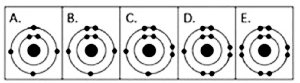
Q19. Which drawing in the figure above depicts an atom that would be expected to be able to form two covalent bonds?
Background
Topic: Atomic Structure and Covalent Bonding
This question tests your understanding of how atoms form covalent bonds based on their electron configuration, specifically the number of valence electrons.
Key Terms and Concepts:
Valence electrons: Electrons in the outermost shell of an atom, which are involved in bonding.
Covalent bond: A chemical bond formed when two atoms share one or more pairs of electrons.
Octet rule: Atoms tend to form bonds in order to have eight electrons in their valence shell (except for hydrogen and helium).
Step-by-Step Guidance
Examine each atom in the figure and count the number of electrons in the outermost shell (valence electrons).
Recall that atoms form covalent bonds to achieve a full valence shell (usually 8 electrons for most elements).
Determine how many electrons each atom needs to complete its valence shell. The number of covalent bonds an atom can form is equal to the number of electrons it needs to reach a full shell.
Identify the atom that needs two more electrons to complete its valence shell. This atom would be expected to form two covalent bonds.
Review the figure and match your reasoning to the correct atom (A, B, C, D, or E).
Try solving on your own before revealing the answer!
Final Answer: Atom D
Atom D has six valence electrons, so it needs two more to complete its octet. Therefore, it would be expected to form two covalent bonds.
This is characteristic of oxygen, which forms two covalent bonds in molecules like H2O.
