 Back
General Biology Exam 1 Review: Foundations, Chemistry, Cells, and Biomolecules
Study Guide - Smart Notes
 Tailored notes based on your materials, expanded with key definitions, examples, and context.
Introduction to Biology
Scientific Process and Method
The scientific method is a systematic approach used to investigate natural phenomena. It involves making observations, forming questions, developing hypotheses, making predictions, conducting experiments, and analyzing results. - Observation: Noticing a pattern or phenomenon. - Question: Asking why or how something occurs. - Hypothesis: A testable explanation for the observation. - Prediction: What you expect to happen if the hypothesis is correct. - Experiment: Testing the prediction under controlled conditions. - Test/Repeat: Analyzing results and repeating as needed. Example: Students attending review sessions perform better on exams; a hypothesis could be that review sessions improve exam scores.
Graph Analysis
Understanding graphs is essential for interpreting scientific data. - Independent Variable: Plotted on the x-axis; the variable you change. - Dependent Variable: Plotted on the y-axis; the outcome measured. Example: Exam score (dependent) vs. time spent studying (independent).
Chemistry
Atoms and Bonds
Atoms are the basic units of matter, consisting of protons, neutrons, and electrons. Electrons occupy energy levels (shells) around the nucleus. - First shell: Holds 2 electrons. - Subsequent shells: Hold up to 8 electrons. - Valence shell: Outermost shell; determines chemical reactivity. Covalent bonds form when atoms share electrons. The number of bonds an atom can form is determined by its valence electrons (HONCP rule: Hydrogen-1, Oxygen-2, Nitrogen-3, Carbon-4, Phosphorus-5).
Types of Chemical Bonds
Chemical bonds are classified based on electron sharing and charge. - Polar Covalent Bond: Uneven sharing of electrons; partial charges. - Non-Polar Covalent Bond: Even sharing; no partial charges. - Hydrogen Bond: Attraction between H and O/N in polar molecules. - Ionic Bond: Full charge; attraction between ions. Electronegativity determines bond type. The difference in electronegativity between atoms predicts whether a bond is non-polar, polar, or ionic.  Example: CH (non-polar), NH (polar), KCl (ionic).
pH and [H+] Concentration
pH measures the acidity or basicity of a solution, based on hydrogen ion concentration. - Acidic: pH < 7, high [H+]. - Neutral: pH = 7. - Basic: pH > 7, low [H+]. Formula: 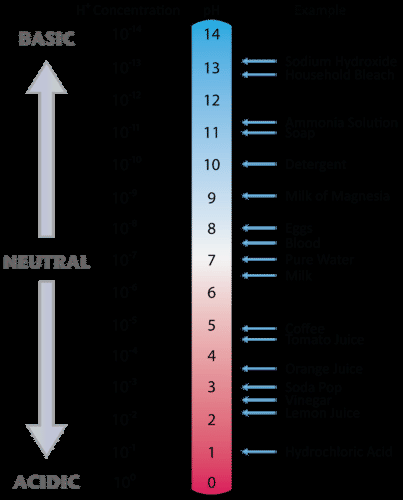 Example: A solution with [H+] = 0.0001 has pH = 4 (acidic). If pH = 9, [H+] = 10-9 (basic).
Cell Components
Prokaryotic vs. Eukaryotic Cells
Cells are the fundamental units of life, classified as prokaryotic or eukaryotic. - Prokaryotic Cells: Simple, no nucleus or organelles; found in bacteria and archaea. - Eukaryotic Cells: Complex, with nucleus and organelles; found in animals, plants, fungi, and protists. Example: Eukaryotic cells in different tissues (heart, stomach, skin) are genetically identical except for reproductive cells.
Water and Polarity
Polarity and Hydrophilicity/Hydrophobicity
Molecules are classified by their polarity, which affects their interaction with water. - Polar: Hydrophilic (water-loving). - Nonpolar: Hydrophobic (water-fearing). Example: Water arranges itself around ions based on charge; positive ions attract the negative end of water molecules. 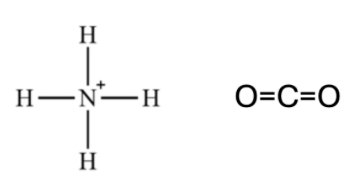
Biomolecules
Four Major Biomolecules
Biomolecules are essential for life, each with unique functions and structures.
Carbohydrates: Quick energy, energy storage, structure (e.g., plant cell walls).
Monomer: Monosaccharides (simple sugars like glucose).
Polymer: Polysaccharides (starch, glycogen, cellulose).
Lipids: Long-term energy storage, cell membranes, insulation.
Monomers: Fatty acids and glycerol (not true polymers).
Polymer-like structures: Triglycerides, phospholipids.
Proteins: Enzymes, structure, transport, movement, signaling.
Monomer: Amino acids.
Polymer: Polypeptides (proteins).
Nucleic Acids: Store and transmit genetic information.
Monomer: Nucleotides.
Polymer: DNA and RNA.
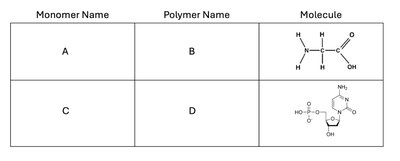
Monomer Name | Polymer Name | Molecule |
|---|---|---|
Monosaccharide | Polysaccharide | Glucose |
Nucleotide | Nucleic Acid | DNA/RNA |
Additional info: Fatty acid | Additional info: Triglyceride | Additional info: Structure not shown |
Additional info: Amino acid | Additional info: Polypeptide | Additional info: Structure not shown |
Building and Breaking Polymers
Polymers are built and broken down by specific chemical reactions. - Dehydration Synthesis: Building a polymer by releasing water. - Hydrolysis: Breaking a polymer by adding water.
Protein Structure
Proteins have four levels of structure, each critical for function. - Primary Structure: Amino acid sequence; held together by peptide bonds. - Secondary Structure: Local folding (α-helices, β-sheets); stabilized by hydrogen bonds. - Tertiary Structure: Overall 3D shape of one polypeptide; stabilized by side chain interactions. - Quaternary Structure: Assembly of multiple polypeptide chains.
Additional Study Tips
Functional Groups and Amino Acids
- Know the names, structures, and properties of functional groups. - Identify amino acids, their terminals (N and C), and side chains.
DNA Strand Matching
- A-T and G-C base pairing rules. Example: Practice drawing and matching DNA strands. Additional info: Review and practice with diagrams and tables for functional groups, amino acids, and DNA pairing for exam preparation.
