 Back
General Biology Exam 1 Study Guidance (Chapters 1–4 & Viruses)
Study Guide - Smart Notes
 Tailored notes based on your materials, expanded with key definitions, examples, and context.
Q14. In the structure of threonine, the asymmetric carbons are attached to the following functional groups EXCEPT:
Background
Topic: Amino Acid Structure & Functional Groups
This question tests your understanding of the chemical structure of amino acids, specifically threonine, and the types of functional groups attached to its asymmetric (chiral) carbon atoms.
Key Terms and Concepts:
Asymmetric (chiral) carbon: A carbon atom attached to four different groups, making it a center of chirality.
Functional groups: Specific groups of atoms within molecules that are responsible for the characteristic chemical reactions of those molecules. Common groups in amino acids include methyl (−CH3), hydroxyl (−OH), amino (−NH2), and carboxyl (−COOH).
Threonine: An essential amino acid with a side chain containing a hydroxyl group.
Step-by-Step Guidance
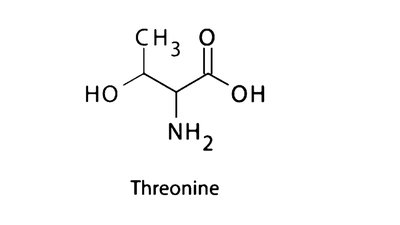
Examine the structure of threonine shown in the image. Identify the central (asymmetric) carbon atom.
List the groups attached to the asymmetric carbon: methyl (−CH3), hydroxyl (−OH), amino (−NH2), and carboxyl (−COOH).
Compare these groups to the answer choices: methyl group, hydroxyl group, amino group, and phosphate group.
Recall that phosphate (−PO4) is not a typical functional group found in standard amino acids like threonine.
Try solving on your own before revealing the answer!
Final Answer: d. Phosphate group
The asymmetric carbons in threonine are attached to methyl, hydroxyl, amino, and carboxyl groups, but not to a phosphate group.
This is confirmed by examining the structure, which does not include a phosphate functional group.
