 Back
General Biology Exam 1 Study Guide: Foundations, Evolution, and Chemistry of Life
Study Guide - Smart Notes
 Tailored notes based on your materials, expanded with key definitions, examples, and context.
Criteria for Life and Unifying Themes
What Makes Something Alive?
Biologists use several criteria to determine if something is considered alive. These ch/aracteristics are foundational to understanding biology:
Cellular Organization: All living things are made of one or more cells, the basic units of life.
Metabolism: Living organisms use energy and carry out chemical reactions to maintain life.
Homeostasis: The ability to maintain stable internal conditions despite changes in the environment.
Growth & Development: Organisms grow and develop, changing over their lifespans.
Reproduction: The ability to produce offspring, passing genetic information to the next generation.
Response to Stimuli: Living things can sense and respond to environmental changes.
Evolution: Populations of organisms change over generations through evolutionary processes.
Five Unifying Themes in Biology
Organization: Life is structured in hierarchical levels (molecules, cells, organisms, ecosystems), and structure relates to function.
Information: Living things store, use, and transmit information (DNA, RNA, proteins; signaling and regulation).
Energy and Matter: Life requires energy and materials, which are transformed and cycled.
Interactions: Organisms interact with each other and their environment.
Evolution: Populations change over time; evolution explains both the unity and diversity of life.
Levels of Biological Organization
Hierarchy of Life
Biological organization is structured from the smallest to the largest scale:
Atom: e.g., carbon, oxygen
Molecule: e.g., water, glucose
Macromolecule: e.g., DNA, protein
Organelle: e.g., nucleus, mitochondrion
Cell: e.g., neuron, muscle cell
Tissue: e.g., muscle tissue
Organ: e.g., heart
Organ System: e.g., digestive system
Organism: e.g., human
Population: All individuals of a species in an area
Community: All living species in an area
Ecosystem: Community plus nonliving factors
Biosphere: All ecosystems on Earth
Cell Types: Prokaryotes vs. Eukaryotes
Key Differences
Prokaryotes: Cells without a nucleus or membrane-bound organelles (e.g., bacteria, archaea).
Eukaryotes: Cells with a nucleus and membrane-bound organelles (e.g., plants, animals, fungi, protists).
Genetic Information and Gene Expression
Genes, Nucleotides, and Gene Expression
Genes: Specific segments of DNA that contain instructions for building proteins.
Nucleotides: The building blocks (monomers) of nucleic acids, each consisting of a phosphate group, a 5-carbon sugar, and a nitrogenous base.
Gene Expression: The process by which information from a gene is used to synthesize a functional product (usually a protein).
Transcription: The first step of gene expression; making an RNA copy of a gene using DNA as a template.
Translation: The process where the cell uses information in mRNA to assemble a protein.
Energy Flow in Ecosystems
Pathways and Transformations
Energy Flow: Sunlight → Producers (plants/algae) → Consumers → Decomposers. Energy is captured, converted, and eventually released as heat.
ATP (Adenosine Triphosphate): The cell's immediate energy carrier; energy is stored in its bonds and released when needed.
Classification of Life
Three Domains of Life
Bacteria: Single-celled prokaryotes.
Archaea: Prokaryotes often found in extreme environments, but also in normal habitats.
Eukarya: Organisms with eukaryotic cells (nucleus present).
Four Kingdoms of Eukarya
Protista: Mostly single-celled eukaryotes (e.g., Amoeba, kelp).
Fungi: Eukaryotes that absorb nutrients (e.g., yeast, mushrooms).
Plantae: Eukaryotes that perform photosynthesis (e.g., grass, sunflower).
Animalia: Eukaryotes that ingest food (e.g., humans, insects).
Evolution and Natural Selection
Darwin’s Main Points
Individuals in a population vary; no two are exactly the same.
Some variation is heritable (passed to offspring).
More offspring are produced than can survive.
There is a struggle for existence due to limited resources.
Natural Selection and Evolution
Natural Selection: The process where heritable traits that enhance survival and reproduction become more common in a population over time.
Evolution: The change in inherited traits of populations over generations.
Relationship: Natural selection is a primary mechanism of evolution, but evolution can also occur via mutation, genetic drift, and gene flow.
Phylogenetic Trees
Understanding Phylogeny
Phylogenetic trees are diagrams that depict evolutionary relationships among organisms, showing how species are related through common ancestors.
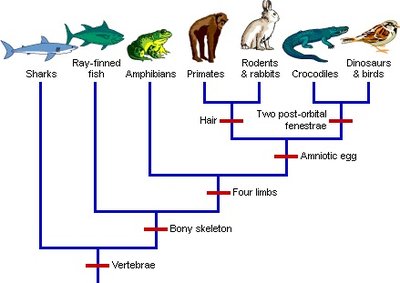
Example: The tree above shows how vertebrates are related, with key evolutionary traits (e.g., vertebrae, bony skeleton, four limbs) marking major branches.
The Scientific Method
Steps and Logic
The scientific method is a systematic, evidence-based process for answering questions about the natural world:
Observation
Question
Hypothesis (testable explanation)
Prediction
Experiment
Analysis
Conclusion (support or refute hypothesis)
Example: The Oldfield mice study used the scientific method to test how coat color affects survival in different habitats.
Atoms, Elements, and Chemical Bonds
Subatomic Particles and Chemical Reactions
Electrons (specifically valence electrons) are involved in chemical reactions.
Calculating Protons, Neutrons, and Electrons
Protons: Equal to the atomic number.
Neutrons: Mass number minus atomic number.
Electrons: Equal to protons in a neutral atom; adjust for charge (+ means missing electrons, - means extra electrons).
Electron Shells
First shell: 2 electrons
Second shell: 8 electrons
Third shell: 8 (or up to 18 in advanced cases)
Cis and Trans Isomers
Cis: Important groups are on the same side.
Trans: Important groups are on opposite sides.
Applications of Unstable Isotopes
Cancer treatment
Medical imaging
Biological research tracers
Sterilization and food safety
Chemical Bonds
Covalent: Atoms share electrons (e.g., water, organic molecules).
Ionic: Electron transfer creates charged ions (e.g., NaCl).
Hydrogen Bonds: Weak attractions involving partial charges (e.g., between water molecules).
Van der Waals: Very weak attractions from temporary charge differences.
Polarity
Polar: Unequal sharing of electrons, resulting in partial charges (e.g., water).
Nonpolar: Equal sharing of electrons.
Properties of Water
Key Characteristics
Cohesion/Adhesion: Water molecules stick to each other and to other surfaces.
Temperature Moderation: Water absorbs/releases heat with little temperature change.
Expansion Upon Freezing: Ice is less dense than liquid water.
Solvent Ability: Water dissolves many substances.
Specific Heat Formula for Water
The amount of heat required to change the temperature of water is calculated as:
Q = heat energy
m = mass
c = specific heat
ΔT = temperature change
Evaporative Cooling
The fastest (highest-energy) water molecules escape as vapor, cooling the remaining liquid.
Acids, Bases, and pH
Definitions
Acid: Increases H+ concentration; pH below 7.
Base: Decreases H+ (or increases OH-); pH above 7.
Neutral: pH = 7.
Ocean Acidification
Extra atmospheric CO2 dissolves in seawater, forms carbonic acid, lowers pH, and reduces carbonate needed by corals and shell-building organisms. This makes it harder for marine life to build shells.
Organic Chemistry and Carbon
Importance of Carbon
Carbon has 4 valence electrons and can form 4 stable covalent bonds, allowing for chains, branches, and rings.
Forms strong covalent bonds with itself and other elements (O, H, N, C).
Typical bonds: O (2), H (1), N (3), C (4) — "HONC 1-2-3-4".
Functional Groups
Hydroxyl, carbonyl, carboxyl, amino, sulfhydryl, phosphate, methyl.
ATP
Adenosine triphosphate is the cell's immediate energy carrier, acting as a rechargeable energy source.
Stanley Miller Experiment
Simulated early Earth conditions to demonstrate that organic molecules could form from inorganic components under prebiotic conditions.
Macromolecules and Polymers
Major Groups
Carbohydrates, proteins, nucleic acids (all polymers)
Lipids (not true polymers)
Dehydration vs. Hydrolysis
Dehydration: Builds larger molecules by removing water.
Hydrolysis: Breaks molecules apart by adding water.
Carbohydrates
Types
Monosaccharides: One sugar unit
Disaccharides: Two sugar units
Polysaccharides: Many sugar units
Aldoses vs. Ketoses
Aldose: Carbonyl group at the end of the carbon chain (aldehyde).
Ketose: Carbonyl group within the chain (ketone).
Asymmetric Carbon
A carbon atom attached to four different groups, creating mirror-image forms called enantiomers.
