 Back
General Biology Exam 1 Study Guide: Key Concepts and Visuals
Study Guide - Smart Notes
 Tailored notes based on your materials, expanded with key definitions, examples, and context.
Q1. What kind of reaction is shown in the diagram, and what kind of bonds are formed?
Background
Topic: Macromolecule Synthesis & Chemical Reactions
This question tests your understanding of how biological polymers are built from monomers, specifically focusing on the type of chemical reaction involved and the bonds formed during this process.
Key Terms and Formulas
Dehydration Reaction: A chemical reaction in which two molecules are joined together by removing a molecule of water.
Polymer: A large molecule made up of repeating subunits (monomers).
Covalent Bond: A type of chemical bond where atoms share electrons.
Step-by-Step Guidance
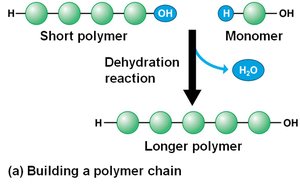
Observe the diagram: It shows a short polymer and a monomer combining to form a longer polymer, with water () released.
Identify the reaction type: When water is released as two molecules join, this is called a dehydration (or condensation) reaction.
Consider the bond formed: The monomer and polymer are joined by a covalent bond, which is typical in the formation of biological macromolecules.
Think about the importance: This reaction is essential for building proteins, carbohydrates, and nucleic acids in living organisms.
To complete the answer, specify the exact bond type (e.g., glycosidic, peptide, or phosphodiester) depending on the molecules involved.
Try solving on your own before revealing the answer!
Final Answer:
The reaction shown is a dehydration reaction (also called a condensation reaction), where a monomer and a polymer join to form a longer polymer and release water ().
The bond formed is a covalent bond between the monomer and the polymer. In carbohydrates, this would be a glycosidic bond; in proteins, a peptide bond; in nucleic acids, a phosphodiester bond.
This process is fundamental for building biological macromolecules.
Q2. What kind of biological molecule is shown in the diagram, and where are the polar and non-polar regions?
Background
Topic: Lipid Structure & Function
This question tests your ability to identify the structure of a lipid molecule and distinguish between its polar (hydrophilic) and non-polar (hydrophobic) regions.
Key Terms and Formulas
Lipid: A class of biological molecules that includes fats, oils, phospholipids, and steroids.
Hydrophilic: "Water-loving"; polar regions that interact with water.
Hydrophobic: "Water-fearing"; non-polar regions that repel water.
Phospholipid: A lipid with a polar head and non-polar tails, key component of cell membranes.
Step-by-Step Guidance
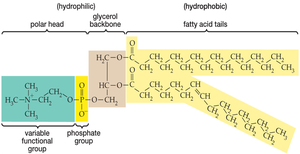
Examine the diagram: It shows a molecule with a distinct head and long tails.
Identify the parts: The head contains a phosphate group and other functional groups, while the tails are long hydrocarbon chains.
Determine polarity: The head is polar (hydrophilic), and the tails are non-polar (hydrophobic).
Relate to function: This structure allows phospholipids to form bilayers in cell membranes, with heads facing water and tails facing inward.
To finish, label the specific regions and explain their biological significance.
Try solving on your own before revealing the answer!
Final Answer:
The molecule shown is a phospholipid. The polar (hydrophilic) region is the head, which includes the phosphate group and variable functional group. The non-polar (hydrophobic) regions are the fatty acid tails.
This arrangement is crucial for forming cell membranes, as the hydrophilic heads face outward toward water, and the hydrophobic tails face inward, away from water.
Q3. Name the parts of this amino acid and identify the bond indicated by the red box in the peptide diagram.
Background
Topic: Amino Acid Structure & Peptide Bond Formation
This question tests your knowledge of amino acid structure and the type of bond formed when two amino acids join to make a peptide.
Key Terms and Formulas
Amino Acid: The building block of proteins, consisting of a central carbon, amino group, carboxyl group, hydrogen, and side chain (R group).
Peptide Bond: A covalent bond formed between the carboxyl group of one amino acid and the amino group of another via a dehydration reaction.
Step-by-Step Guidance
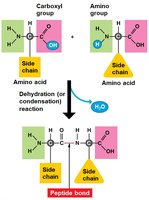
Look at the diagram: It shows two amino acids joining, with a water molecule released.
Identify the parts: Each amino acid has a central carbon, amino group (), carboxyl group (), hydrogen, and side chain (R group).
Focus on the bond: The red box highlights the bond formed between the carboxyl group of one amino acid and the amino group of another.
Recognize the reaction: This is a dehydration reaction, forming a peptide bond and releasing water.
To complete, name the bond and label the amino acid parts in the diagram.
Try solving on your own before revealing the answer!
Final Answer:
The parts of an amino acid are: central carbon (alpha carbon), amino group (), carboxyl group (), hydrogen atom, and side chain (R group).
The bond indicated by the red box is a peptide bond, formed by a dehydration reaction between the carboxyl group of one amino acid and the amino group of another.
This bond is essential for linking amino acids together to form proteins.
Q4. What is the significance of hydrothermal vents in the context of biogenesis?
Background
Topic: Origin of Life & Hydrothermal Vents
This question explores the role of hydrothermal vents in theories about the origin of life, particularly the iron-sulfur world hypothesis.
Key Terms and Concepts
Hydrothermal Vents: Deep-sea structures where mineral-rich water is released from the Earth's crust.
Biogenesis: The process by which life arises from non-living matter.
Iron-Sulfur World Hypothesis: Suggests that life may have originated at hydrothermal vents, where minerals catalyzed the formation of organic molecules.
Step-by-Step Guidance
Consider the environment: Hydrothermal vents provide heat, minerals, and chemical gradients.
Think about the chemistry: Minerals at vents can catalyze reactions, potentially forming organic molecules.
Relate to biogenesis: These conditions may have supported the formation of protocells and early life forms.
To finish, explain how vents could have contributed to the origin of life and why they are significant in scientific hypotheses.
Try solving on your own before revealing the answer!
Final Answer:
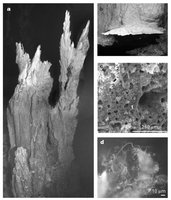
Hydrothermal vents are significant because they provide a unique environment with heat, minerals, and chemical gradients that could catalyze the formation of organic molecules. The iron-sulfur world hypothesis proposes that life may have originated at these vents, where minerals facilitated the synthesis of complex molecules necessary for biogenesis.
This theory helps explain how life could have started in the absence of sunlight, using chemical energy from the Earth's interior.
