 Back
General Biology Exam 4 Study Guidance: Cell Structure, Membranes, Cell Cycle, and Genetics
Study Guide - Smart Notes
 Tailored notes based on your materials, expanded with key definitions, examples, and context.
Q1. Which protein is not made at the rough ER?
Background
Topic: Protein Synthesis and Cellular Compartments
This question tests your understanding of where different types of proteins are synthesized in the cell, specifically the distinction between proteins made at the rough endoplasmic reticulum (ER) and those made in the cytosol.
Key Terms:
Rough ER: Organelle studded with ribosomes, site of synthesis for secreted, membrane-bound, and some organelle-targeted proteins.
Cytosolic proteins: Proteins synthesized by free ribosomes in the cytoplasm, often destined for the nucleus, mitochondria, or cytosol itself.
Step-by-Step Guidance
Recall which types of proteins are synthesized at the rough ER (secreted, membrane-bound, or organelle-targeted).
Identify which answer choices are secreted or membrane proteins versus those that function in the cytosol or nucleus.
Consider the destination of each protein: is it secreted, embedded in a membrane, or does it function inside the nucleus?
Eliminate options that are clearly secreted or membrane proteins, and focus on those that are not.
Try solving on your own before revealing the answer!
Final Answer: D. protein that enters the nucleus to bind with DNA
Proteins that function in the nucleus (such as transcription factors) are typically synthesized by free ribosomes in the cytosol, not at the rough ER.
Q2. For lipids to be fluid at room temperature, they should have ________.
Background
Topic: Membrane Structure and Fluidity
This question tests your knowledge of the structural features of lipids that influence membrane fluidity, such as chain length and the presence of double bonds.
Key Terms:
Cis double bonds: Introduce kinks in fatty acid chains, preventing tight packing and increasing fluidity.
Chain length: Shorter chains increase fluidity; longer chains decrease it.
Step-by-Step Guidance
Recall how double bonds (especially cis) affect the packing of lipid tails in the membrane.
Consider the effect of chain length and saturation (single vs. double bonds) on membrane fluidity.
Evaluate each answer choice for its impact on fluidity at room temperature.
Try solving on your own before revealing the answer!
Final Answer: C. a higher number of cis double bonds
Cis double bonds introduce kinks, preventing tight packing and increasing membrane fluidity at room temperature.
Q3. What is the most common pathway taken by a newly synthesized protein that will become a transmembrane protein on the plasma membrane?
Background
Topic: Endomembrane System and Protein Trafficking
This question tests your understanding of the secretory pathway for membrane proteins, including the roles of the rough ER, Golgi apparatus, and transport vesicles.
Key Terms:
Transmembrane protein: A protein that spans the lipid bilayer of a membrane.
Secretory pathway: The route taken by proteins destined for secretion or for membranes.
Step-by-Step Guidance
Recall the sequence of organelles involved in the secretory pathway (rough ER → Golgi → vesicle → plasma membrane).
Identify which answer choice matches this pathway.
Eliminate options that include incorrect destinations (e.g., nucleus, lysosome).
Try solving on your own before revealing the answer!
Final Answer: A. rough ER → Golgi → transport vesicle → plasma membrane
This is the classic pathway for proteins destined for the plasma membrane.
Q5. How do phospholipids interact with water molecules?
Background
Topic: Membrane Structure and Amphipathic Molecules
This question tests your understanding of the amphipathic nature of phospholipids and how their structure determines their interaction with water.
Key Terms:
Amphipathic: Molecules with both hydrophilic (water-loving) and hydrophobic (water-fearing) regions.
Phospholipid bilayer: The fundamental structure of cell membranes, formed by phospholipids aligning so that their hydrophilic heads face water and hydrophobic tails face inward.
Step-by-Step Guidance
Recall the structure of a phospholipid: a hydrophilic (polar) head and hydrophobic (nonpolar) tails.
Think about how these molecules arrange themselves in water (e.g., bilayer formation).
Evaluate each answer choice for accuracy regarding the interaction of heads and tails with water.
Try solving on your own before revealing the answer!
Final Answer: C. The polar heads interact with water; the nonpolar tails do not.
This amphipathic property is key to membrane formation and function.
Q7. How does the ATPase act in muscle cells to maintain low cytosolic calcium concentration?
Background
Topic: Membrane Transport and Active Transport
This question tests your understanding of active transport mechanisms, specifically how ATP-powered pumps (ATPases) move ions against their concentration gradients.
Key Terms:
ATPase: An enzyme that hydrolyzes ATP to provide energy for active transport.
Concentration gradient: The difference in concentration of a substance across a membrane.
Step-by-Step Guidance
Note the direction of calcium movement: from low concentration in the cytosol to high concentration in the sarcoplasmic reticulum (SR).
Recall that moving ions against their concentration gradient requires energy (active transport).
Identify which answer choice describes active transport powered by ATP hydrolysis.
Try solving on your own before revealing the answer!
Final Answer: C. ATPase activity must be pumping calcium from the cytosol to the SR against the concentration gradient.
This is a classic example of active transport in muscle cells.
Q8. Which characteristics best describe the side chains in the part of the protein in contact with the phospholipid tails of the membrane?
Background
Topic: Membrane Proteins and Amino Acid Properties
This question tests your understanding of how the chemical properties of amino acid side chains determine their location in membrane proteins.
Key Terms:
Hydrophobic: Tending to repel or fail to mix with water; nonpolar side chains are hydrophobic.
Phospholipid tails: The nonpolar, hydrophobic part of the membrane.
Step-by-Step Guidance
Recall that the interior of the membrane is hydrophobic due to the fatty acid tails.
Consider which amino acid side chains would be stable in this environment (hydrophobic or hydrophilic?).
Match the correct property to the side chains in contact with the membrane interior.
Try solving on your own before revealing the answer!
Final Answer: C. Non-polar; hydrophobic
Non-polar, hydrophobic side chains interact favorably with the fatty acid tails of the membrane.
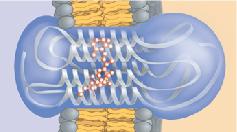
Q9. Cholesterol is a fluidity buffer of membranes in animal cells. When the temperature of the environment increases, cholesterol ________________ the mobility of the phospholipids to maintain membrane fluidity and when temperature falls, cholesterol ________________ the packing of phospholipids.
Background
Topic: Membrane Fluidity and Cholesterol
This question tests your understanding of how cholesterol modulates membrane fluidity in response to temperature changes.
Key Terms:
Cholesterol: A lipid molecule that stabilizes membrane fluidity by preventing extremes of rigidity or fluidity.
Step-by-Step Guidance
Recall how cholesterol affects membrane fluidity at high and low temperatures.
At high temperatures, does cholesterol increase or decrease phospholipid movement?
At low temperatures, does cholesterol enhance or hinder phospholipid packing?
Try solving on your own before revealing the answer!
Final Answer: B. decreases, enhances
Cholesterol decreases mobility at high temperatures and enhances packing at low temperatures, helping maintain optimal membrane fluidity.
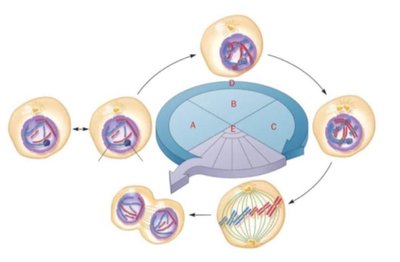
Q13. List the stages and phases of the cell cycle.
Background
Topic: Cell Cycle
This question tests your knowledge of the major stages and phases of the eukaryotic cell cycle, including interphase and mitosis.
Key Terms:
Interphase: The phase of the cell cycle when the cell grows and DNA is replicated (includes G1, S, and G2 phases).
M phase (Mitosis): The phase when the cell divides its chromosomes and cytoplasm.
Step-by-Step Guidance
Recall the two main stages of the cell cycle: interphase and M phase.
List the sub-phases of interphase: G1 (growth), S (DNA synthesis), and G2 (preparation for mitosis).
List the sub-phases of mitosis: prophase, metaphase, anaphase, telophase, and cytokinesis.
Try solving on your own before revealing the answer!
Final Answer:
The cell cycle consists of Interphase (G1, S, G2) and M phase (mitosis: prophase, metaphase, anaphase, telophase, and cytokinesis).
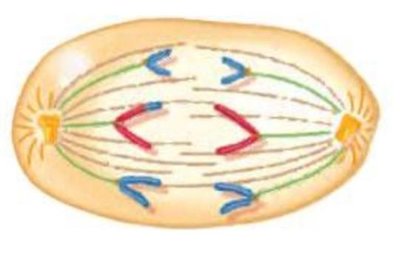
Q16. Alignment of the chromosomes at the equator occurs during which phase of mitosis?
Background
Topic: Mitosis Phases
This question tests your knowledge of the specific events that occur during each phase of mitosis, particularly chromosome alignment.
Key Terms:
Metaphase: The stage of mitosis where chromosomes align at the cell's equatorial plate.
Step-by-Step Guidance
Recall the sequence of mitotic phases: prophase, metaphase, anaphase, telophase.
Identify which phase is characterized by the alignment of chromosomes at the cell's equator.
Try solving on your own before revealing the answer!
Final Answer: METAPHASE
During metaphase, chromosomes align at the metaphase plate (equator) of the cell.
