 Back
General Biology: Foundations of Life, Cells, and Biological Molecules
Study Guide - Smart Notes
 Tailored notes based on your materials, expanded with key definitions, examples, and context.
Introduction to Life on Earth
Levels of Biological Organization
Biological systems are organized in a hierarchy, from the smallest chemical units to the entire biosphere. Understanding these levels is fundamental to studying biology.
Atoms → Molecules → Cells → Tissues → Organs → Organ Systems → Organism → Species → Population → Communities → Biosphere
Cell: The smallest unit of life capable of all life processes.
Scientific Definition of Life
To be considered alive, an entity must:
Grow and reproduce
Evolve or change over time
Acquire and utilize energy (metabolism)
Respond to stimuli
Maintain complexity (cellular organization)
Maintain homeostasis
All six criteria are required for life.
Atoms, Molecules, and Life
Atoms and Their Structure
Atoms are the smallest units of elements, composed of subatomic particles:
Protons (p+): Positively charged
Neutrons (n): No charge
Electrons (e-): Negatively charged, occupy electron shells
Atoms combine to form molecules, which are the chemical building blocks of life.
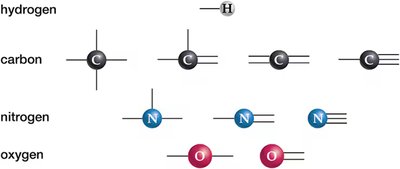
Formation of Molecules
Electrons can absorb energy and move to higher shells; when they return, they release energy as heat.
Atoms bond to fill their outer electron shells, forming molecules essential for life.
Biological Molecules
Major Classes of Biological Molecules
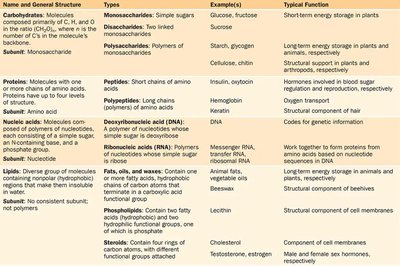
Life depends on four major classes of biological molecules: carbohydrates, proteins, nucleic acids, and lipids. Each has unique structures and functions.
Name and General Structure | Types | Example(s) | Typical Function |
|---|---|---|---|
Carbohydrates: Molecules composed primarily of C, H, and O in the ratio (CH2O)n. Subunit: Monosaccharide | Monosaccharides, Disaccharides, Polysaccharides | Glucose, sucrose, starch, glycogen, cellulose, chitin | Short- and long-term energy storage, structural support in plants and arthropods |
Proteins: Molecules with one or more chains of amino acids. Subunit: Amino acid | Peptides, Polypeptides | Insulin, oxytocin, hemoglobin, keratin | Hormones, transport, structural support, movement, defense, catalysis |
Nucleic Acids: Molecules composed of nucleotide subunits. Subunit: Nucleotide | Deoxyribonucleic acid (DNA), Ribonucleic acid (RNA) | DNA, Messenger RNA, Transfer RNA, Ribosomal RNA | Genetic information storage and transfer, protein synthesis |
Lipids: Diverse group of molecules, mostly nonpolar. No consistent subunit. | Fats, oils, waxes, phospholipids, steroids | Triglycerides, beeswax, lecithin, cholesterol, testosterone, estrogen | Energy storage, membrane structure, hormones, waterproofing |
Carbohydrates
Composed of carbon, hydrogen, and oxygen
Monomer: Monosaccharide (simple sugar)
Polymer: Polysaccharide (e.g., starch, glycogen)
Function: Short- and long-term energy storage, structural support
Proteins
Monomer: Amino acid
Peptide: Short chain of amino acids
Polypeptide: Long chain of amino acids; folds into functional protein
Functions: Structure, movement, defense, storage, signaling, catalysis
Denaturation: Loss of protein's functional shape due to environmental changes
Nucleic Acids
DNA: Deoxyribonucleic acid; stores genetic information
RNA: Ribonucleic acid; involved in protein synthesis
Monomer: Nucleotide (sugar, phosphate, nitrogenous base)
Lipids
Composed mainly of carbon, hydrogen, and oxygen
Types: Fats, oils, waxes, phospholipids, steroids
Functions: Energy storage, membrane structure, hormones
Saturated fats: All carbon bonds filled with hydrogen
Unsaturated fats: Contain double bonds, keep membranes fluid
Cell Structure and Function
Cell Theory
All living organisms are composed of cells, which arise from preexisting cells. Cells are the basic units of structure and function in living things.
Visualizing Cells
Cells and their components are visualized using various types of microscopes, each with different resolving powers.
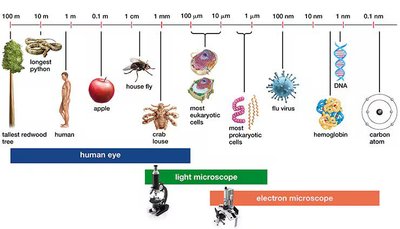
Light microscopes: Used for most eukaryotic and prokaryotic cells
Electron microscopes: Used for viruses, organelles, and molecules
Basic Attributes of Cells
All cells have a plasma membrane, cytoplasm, DNA, and ribosomes.
Cells are small to maximize surface area for exchange of materials.
Prokaryotic vs. Eukaryotic Cells
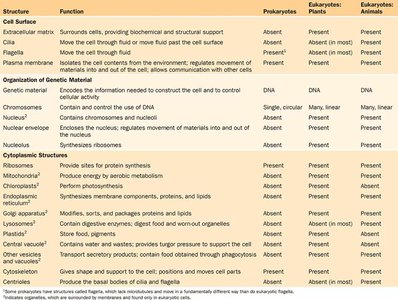
Cells are classified as prokaryotic or eukaryotic based on internal structure.
Structure | Function | Prokaryotes | Eukaryotes: Plants | Eukaryotes: Animals |
|---|---|---|---|---|
Extracellular matrix | Support, biochemical and structural support | Absent | Present | Present |
Cilia | Move cell or fluid past cell surface | Absent | Absent | Present (in most) |
Flagella | Move cell through fluid | Present (in some) | Present (in some) | Present (in some) |
Plasma membrane | Isolates cell, regulates movement, communicates | Present | Present | Present |
Genetic material | Stores information | DNA | DNA | DNA |
Chromosomes | Contain DNA | Single, circular | Many, linear | Many, linear |
Nucleus | Encloses chromosomes | Absent | Present | Present |
Nucleolus | Ribosome synthesis | Absent | Present | Present |
Ribosomes | Protein synthesis | Present | Present | Present |
Mitochondria | Energy metabolism | Absent | Present | Present |
Chloroplasts | Photosynthesis | Absent | Present | Absent |
Cell wall | Support, protection | Present (most) | Present | Absent |
Key Features of Prokaryotic Cells
Simple internal structure, no nucleus
Genetic material in nucleoid region
Cell wall (peptidoglycan in bacteria)
May have plasmids, pili, flagella
Key Features of Eukaryotic Cells
Complex internal structure with membrane-bound organelles
DNA enclosed in nucleus
Specialized organelles (mitochondria, chloroplasts, etc.)
Cell Membrane Structure and Function
Fluid Mosaic Model
The cell membrane is a dynamic structure composed of a phospholipid bilayer with embedded proteins. This arrangement allows for flexibility and selective permeability.
Phospholipid bilayer: Hydrophilic heads face water; hydrophobic tails face inward.
Proteins: Serve as enzymes, receptors, transporters, and anchors.
Carbohydrates: Attach to proteins and lipids on the extracellular surface for cell recognition.
Membrane Transport Mechanisms
Passive transport: Movement down a concentration gradient (no energy required)
Active transport: Movement against a gradient (requires energy, usually ATP)
Simple diffusion: Direct movement through the bilayer
Facilitated diffusion: Movement via channel or carrier proteins
Osmosis: Diffusion of water across a selectively permeable membrane
Endocytosis/Exocytosis: Bulk transport into/out of the cell via vesicles
Energy Flow in the Life of a Cell
Energy and Thermodynamics
Energy: Capacity to do work
Potential energy: Stored energy (e.g., chemical bonds)
Kinetic energy: Energy of movement
First Law of Thermodynamics: Energy cannot be created or destroyed
Second Law of Thermodynamics: Useful energy decreases with each transformation (entropy increases)
Chemical Reactions
Exergonic reactions: Release energy (e.g., cellular respiration)
Endergonic reactions: Require energy input (e.g., photosynthesis)
Activation energy: Energy required to initiate a reaction
ATP: The Energy Currency
ATP (adenosine triphosphate): Main energy carrier in cells
ATP → ADP + Pi releases energy for cellular work
Enzymes
Biological catalysts that lower activation energy
Highly specific for substrates
Can be regulated by competitive and noncompetitive inhibitors
Denatured by extreme pH or temperature
Photosynthesis and Cellular Respiration
Photosynthesis
Occurs in chloroplasts of autotrophs
Equation:
Redox reaction: CO2 is reduced, H2O is oxidized
Produces glucose and oxygen
Cellular Respiration
Occurs in mitochondria (eukaryotes)
Equation:
Breaks down glucose to produce ATP
Includes glycolysis, Krebs cycle, and electron transport chain
Fermentation
Occurs when oxygen is absent
Produces less ATP than aerobic respiration
Types: Lactate fermentation (produces lactic acid), alcoholic fermentation (produces ethanol and CO2)
Additional info: This guide covers foundational topics in general biology, including the chemical basis of life, cell structure and function, biological molecules, and energy flow. For further study, refer to textbook chapters on genetics, evolution, and ecology.
