 Back
General Biology I (BIOL 1406) Syllabus and Course Structure – Lone Star College North Harris
Study Guide - Smart Notes
 Tailored notes based on your materials, expanded with key definitions, examples, and context.
Course Overview
This course, Biology I for Science Majors (BIOL 1406), introduces students to the fundamental principles of living organisms, including their physical and chemical properties, organization, function, evolutionary adaptation, and classification. Key concepts include cytology, reproduction, genetics, and scientific reasoning. The course is designed for college-level students preparing for advanced studies in biological sciences.

Student Learning Outcomes
Apply scientific reasoning to investigate questions and utilize scientific tools such as microscopes and laboratory equipment to collect and analyze data.
Use critical thinking and scientific problem-solving to make informed decisions in the laboratory.
Communicate effectively the results of scientific investigations.
Describe the characteristics of life and explain the methods of inquiry used by scientists.
Compare and contrast the structures, reproduction, and characteristics of viruses, prokaryotic cells, and eukaryotic cells.
Describe the structure of cell membranes and the movement of molecules across membranes.
Identify substrates, products, and pathways in metabolism.
Identify principles of inheritance and solve classical genetic problems.
Identify chemical structures, synthesis, and regulation of nucleic acids and proteins.
Describe the unity and diversity of life and the evidence for evolution through natural selection.
Identify basic properties and requirements of substances and molecules needed for life.
Employ teamwork for a shared purpose or goal.
Required Course Materials
Textbooks and Access Codes
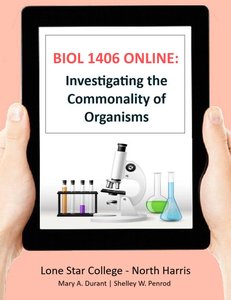
Lab Manual: BIOL 1406 Online: Investigating the Commonality of Organisms by Mary Durant and Shelley Penrod (ISBN 9781533976482). This manual provides access to lab assignments and is essential for completing laboratory activities.
Lecture Homework and E-Text: Modified Mastering Biology with Pearson eText (18 weeks for Biological Science, 8th Edition, Freeman et al., ISBN 9780138276324). This resource is required for online assignments and provides access to the e-text and study materials.
Technology Requirements
Computer (laptop or desktop) with internet connection (iPads not allowed for exams/quizzes).
Strong Wi-Fi signal, especially for exams.
Second camera (phone or tablet) for exam proctoring.
Respondus Lockdown Browser (required for all quizzes and exams).
Mastering Biology access (for online assignments).
Microsoft Word and PowerPoint (Office 365).
Microsoft Edge browser (for lab report PDFs).
Adobe Scan (for converting handwritten documents to PDF, if needed).

Course Structure and Assessment
Grading Components
Lecture Exams (4 total): 40% of final grade. Multiple choice and short response. Lowest exam score can be replaced by the final exam score (unless due to cheating).
Mastering Biology Activities: 10% of final grade. Online assignments with tutorials and exercises. Three lowest grades dropped.
Lab Quizzes: 15% of final grade. Individual, timed quizzes. Three lowest grades dropped.
Lab Reports: 15% of final grade. Team-based, collaborative reports. Three lowest grades dropped.
Final Exam: 20% of final grade. Comprehensive, required for all students.
Grade Scale
Letter Grade | Final Average (%) |
|---|---|
A | Above 89.0 |
B | 79.5 – 89.4 |
C | 69.5 – 79.4 |
D | 59.5 – 69.4 |
F | 59.4 and below |
Major Topics and Tentative Schedule
The course covers the following major topics, which align with the core chapters of a General Biology curriculum:
Introduction to Biology
Chemistry of Life
Water and Buffer Systems
Biomolecules and Food Identification
Cell Structure and Function
Cell Membranes and Movement of Molecules
Microscopy
Enzymes and Metabolism
Fermentation and Respiration
Cell Cycle and Division (including p53 and Meiosis)
Genetics and Inheritance (including χ² analysis)
DNA Structure, Extraction, and Fingerprinting
Evolution and Speciation
Labs are designed to reinforce lecture topics and provide hands-on experience with scientific methods and reasoning.
Course Policies and Success Strategies
Attendance: Weekly participation is required. Non-attendance may result in being dropped from the course.
Academic Integrity: Cheating and plagiarism are strictly prohibited and may result in severe penalties, including course failure.
Communication: Use LSC-online email for all course-related communication. Expect responses within 24–48 hours (Monday–Thursday).
Late Work: Late assignments are not accepted unless due to documented, excused absences.
Exam Proctoring: All exams and quizzes require Lockdown Browser and Respondus Monitor. Follow all proctoring instructions carefully.
Advice for Success
Read the textbook and outline chapters.
Focus on PowerPoint and lecture content.
Rewrite notes, make flashcards, and use active study techniques.
Teach the material to someone else or record yourself explaining concepts.
Student Support and College Policies
Access to tutoring, counseling, disability services, and other student resources is available through Lone Star College.
Familiarize yourself with college policies on academic integrity, conduct, withdrawal, FERPA, Title IX, and campus safety.
Tentative Weekly Schedule (Sample)
Week | Lecture Topic | Lab Activity |
|---|---|---|
1 | Orientation, Chapters 1 and 2 | Syllabus/Orientation Activity |
2 | Chapter 2 | Lab 2: Metric System |
3 | Chapters 3 and 4 | Lab 3: Buffer Systems; Lab 4: Identifying Unknown Food |
4 | Chapters 5 and 6 | Lab 5: Movement of Molecules |
5 | Exam 1: Chapter 7 | Lab 7: Microscope |
6 | Chapters 7 and 8 | Lab 8: Cell Structure and Function |
7 | Chapters 9 and 10 | Lab 9: Enzymes |
8 | Chapters 10 and 12 | Lab 10: Fermentation |
9 | Exam 2: Chapter 13 | Nothing |
10 | Chapters 13 and 14 | Lab 12: p53 and the Cell Cycle |
11 | Chapter 14 | Lab 13: Meiosis & Sexual Life Cycle |
12 | Exam 3: Chapter 15 | Lab 14: χ² Analysis |
13 | Chapter 16 | Lab 17: DNA Extraction |
14 | Chapters 17 and 20 | Lab 19: DNA Fingerprinting |
15 | Exam 4: Chapters 22 and 23 | Nothing |
16 | Final Exam | Nothing |
Additional info: This syllabus provides a comprehensive overview of the course structure, expectations, and resources for success in General Biology I. Students are encouraged to consult the official course schedule and communicate with the instructor for any updates or clarifications.
