 Back
Chapter 2 Study Guide
Study Guide - Smart Notes
 Tailored notes based on your materials, expanded with key definitions, examples, and context.
Chapter 1: Introduction to Biology
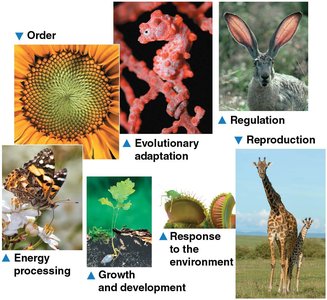
Unifying Themes in Biology
Biology is the scientific study of life, and several unifying themes help organize biological knowledge. These themes provide a framework for understanding the complexity of living organisms and their interactions with the environment.
Organization: Life is highly organized, from molecules to the biosphere.
Information: Genetic information is stored and transmitted in DNA.
Energy and Matter: Living organisms acquire, use, and transfer energy and matter.
Interactions: Organisms interact with each other and their environment.
Evolution: Evolution explains the unity and diversity of life.
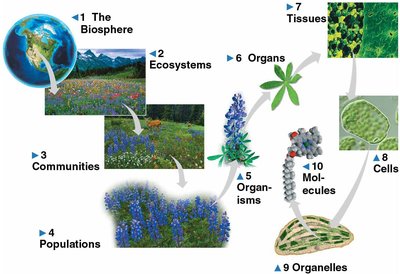
Levels of Biological Organization
Biological systems are structured in a hierarchy, from the smallest chemical units to the entire biosphere.
Molecules → Organelles → Cells → Tissues → Organs → Organisms → Populations → Communities → Ecosystems → Biosphere
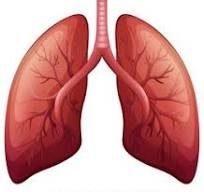
Emergent Properties
Emergent properties arise at each level of organization due to the arrangement and interaction of parts. For example, the function of lungs depends on the coordinated activity of all their cells, not just individual cells acting alone.
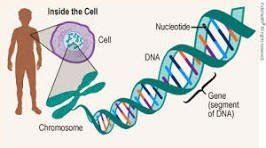
Genetic Information and DNA
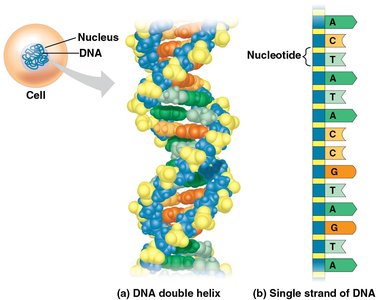
DNA (deoxyribonucleic acid) is the molecule that stores genetic information. Each chromosome contains one long DNA molecule with many genes, which encode instructions for building cellular molecules. The flow of genetic information from DNA to proteins determines the structure and function of cells.
Genomics and Proteomics
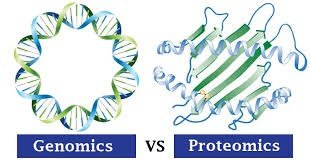
Genomics is the study of whole sets of genes (genomes) in one or more species. Proteomics is the study of the entire set of proteins (proteome) expressed by a cell, tissue, or organism. These fields help scientists understand the complexity of biological systems.
Evolution and Natural Selection
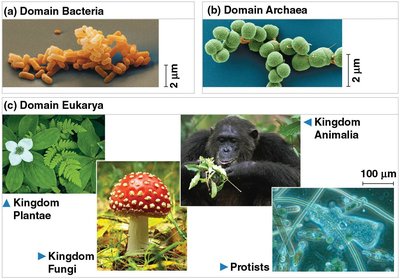
Evolution is the process by which populations change over time. Natural selection, as described by Charles Darwin, is the mechanism by which beneficial traits become more common in a population because they enhance survival and reproduction.
Experimental Design: Variables and Controls
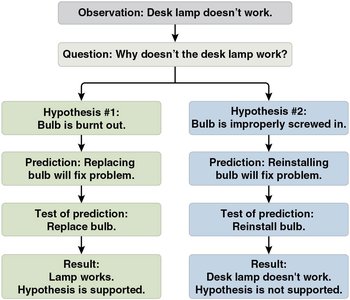
Controlled experiments compare an experimental group with a control group. The independent variable is manipulated, while the dependent variable is measured. Controls help ensure that observed effects are due to the variable being tested.
Chapter 2: The Chemical Context of Life
Concept 2.1: Matter, Elements, and Compounds
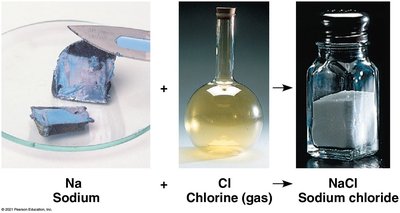
All organisms are composed of matter, which is anything that takes up space and has mass. Matter is made up of elements, substances that cannot be broken down by chemical reactions. Compounds are substances consisting of two or more elements in a fixed ratio, often with properties different from their constituent elements.
Elements Essential for Life
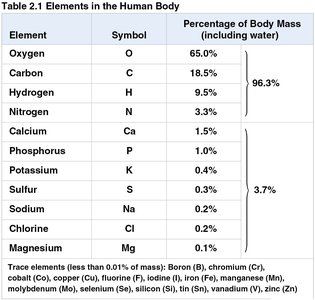
About 20–25% of the 92 natural elements are essential for life. The four most abundant elements in living organisms are carbon, hydrogen, oxygen, and nitrogen, making up about 96% of living matter. Other essential elements include calcium, phosphorus, potassium, and sulfur. Trace elements are required in very small amounts.
Element | Symbol | Percentage of Body Mass |
|---|---|---|
Oxygen | O | 65.0% |
Carbon | C | 18.5% |
Hydrogen | H | 9.5% |
Nitrogen | N | 3.3% |
Calcium | Ca | 1.5% |
Phosphorus | P | 1.0% |
Potassium | K | 0.4% |
Sulfur | S | 0.3% |
Sodium | Na | 0.2% |
Chlorine | Cl | 0.2% |
Magnesium | Mg | 0.1% |
Concept 2.2: Atomic Structure and Properties
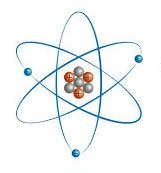
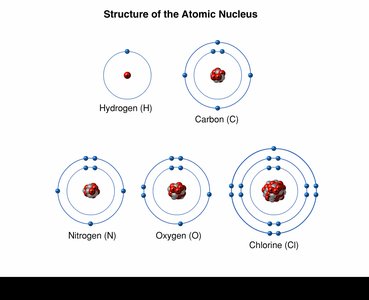
Each element consists of unique atoms, the smallest units of matter that retain the properties of the element. Atoms are composed of subatomic particles: protons (positive charge), neutrons (no charge), and electrons (negative charge). Protons and neutrons form the atomic nucleus, while electrons orbit in a cloud around the nucleus.
Atomic Number and Mass Number
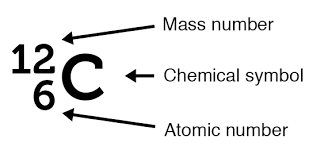
The atomic number is the number of protons in an atom's nucleus. The mass number is the sum of protons and neutrons. The atomic mass is the atom's total mass, approximately equal to the mass number.
Isotopes and Radioactivity
Isotopes are atoms of the same element with different numbers of neutrons. Some isotopes are radioactive and decay spontaneously, emitting particles and energy. Radioactive isotopes are used in radiometric dating and as tracers in medicine.
Concept 2.3: Chemical Bonds and Molecular Interactions
Atoms with incomplete valence shells can share or transfer electrons, forming chemical bonds. The main types of bonds are covalent bonds, ionic bonds, and weak interactions (hydrogen bonds and van der Waals interactions).
Covalent bonds: Sharing of electron pairs between atoms. Can be single, double, or triple bonds.
Ionic bonds: Transfer of electrons from one atom to another, resulting in oppositely charged ions (cations and anions) that attract each other.
Hydrogen bonds: Attraction between a hydrogen atom covalently bonded to an electronegative atom and another electronegative atom.
Van der Waals interactions: Weak attractions due to transient local partial charges.
Electronegativity and Bond Polarity
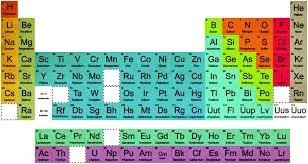
Electronegativity is an atom's attraction for electrons in a bond. In nonpolar covalent bonds, electrons are shared equally. In polar covalent bonds, electrons are shared unequally, resulting in partial charges.
Concept 2.4: Chemical Reactions
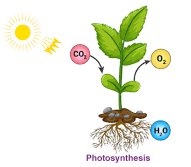
Chemical reactions involve the making and breaking of chemical bonds. The starting substances are reactants, and the resulting substances are products. All chemical reactions are reversible, and equilibrium is reached when the forward and reverse reactions occur at the same rate.
Example: Photosynthesis is a key chemical reaction in biology:
Review Questions and Applications
Which element is most prominent in the human body? Oxygen (65%)
Difference between atomic number and mass number: Atomic number is the number of protons; mass number is the total number of protons and neutrons.
Name three inert gases: Helium, neon, argon (also krypton, xenon, radon).
Molecular formula for hydrogen sulfide: H2S
Valence electrons: Electrons in the outermost shell.
Ionic bond: Attraction between cations and anions.
Salts: Compounds formed by ionic bonds.
Formic acid: HCOOH
Elements in morphine: Carbon, hydrogen, nitrogen, sulfur, oxygen.
Additional info: This guide covers foundational concepts in biology and chemistry essential for understanding life at the molecular and cellular levels. It is suitable for exam preparation and as a reference for introductory biology topics.
