 Back
General Biology II: Immunity, Reproduction, Nervous System, and Musculoskeletal System Study Guide (Ch. 35–39)
Study Guide - Smart Notes
 Tailored notes based on your materials, expanded with key definitions, examples, and context.
Chapter 35: The Immune System
Innate and Adaptive Immunity
The immune system protects animals from pathogens using two main strategies: innate immunity and adaptive immunity. Innate immunity is present in all animals and provides immediate, non-specific defense. Adaptive immunity is found only in vertebrates and provides specific, long-lasting protection.
Innate Immunity: Rapid, non-specific, present in all animals (e.g., barrier defenses, phagocytic cells).
Adaptive Immunity: Slower, highly specific, found only in vertebrates (involves B cells and T cells).
Examples: Insects and invertebrates rely solely on innate immunity, while mammals use both innate and adaptive responses.
Barrier Defenses
Barrier defenses are the first line of protection, preventing pathogens from entering the body.
Skin: Physical barrier to pathogens.
Mucous membranes: Trap and remove microbes.
Secretions: Enzymes like lysozyme in tears, saliva, and sweat destroy bacterial cell walls.
Cellular Innate Defenses
Once pathogens breach barriers, cellular defenses act quickly to neutralize them.
Phagocytic cells: Engulf and digest pathogens (e.g., neutrophils, macrophages).
Toll-like receptors (TLRs): Recognize pathogen molecules and activate immune responses.
Natural killer cells: Destroy infected or cancerous cells by inducing apoptosis.
Antimicrobial peptides and proteins: Interfere with pathogen membranes and replication.
Phagocytosis: Steps of Pathogen Removal
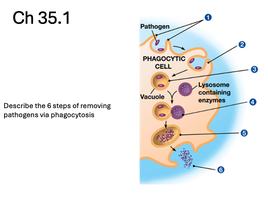
Phagocytosis is the process by which phagocytic cells ingest and destroy pathogens.
1. Pathogen is detected and adheres to the phagocytic cell.
2. The cell engulfs the pathogen, forming a vacuole.
3. The vacuole fuses with a lysosome containing digestive enzymes.
4. Enzymes break down the pathogen.
5. Debris from the pathogen is released from the cell.
Inflammatory Response
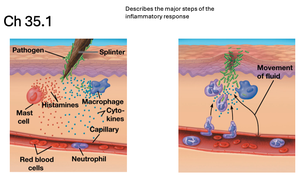
The inflammatory response is a key innate defense triggered by injury or infection. It involves the release of signaling molecules that increase blood flow, attract immune cells, and promote healing.
1. Injury introduces pathogens; mast cells release histamine.
2. Histamine causes blood vessels to dilate and become more permeable.
3. Fluid, antimicrobial proteins, and immune cells (e.g., neutrophils) move into the tissue.
4. Macrophages release cytokines to recruit more immune cells.
5. Pathogens are destroyed, and tissue repair begins.
Adaptive Immunity: B Cells and T Cells
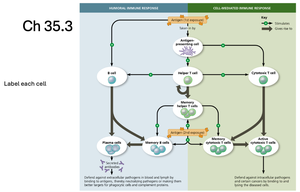
Adaptive immunity relies on lymphocytes: B cells (mature in bone marrow) and T cells (mature in thymus). These cells recognize specific antigens using unique antigen receptors.
B cells: Produce antibodies that neutralize pathogens in body fluids (humoral response).
T cells: Include helper T cells (coordinate immune response) and cytotoxic T cells (kill infected cells).
Antigen presentation: MHC molecules display antigen fragments on cell surfaces for T cell recognition.
Characteristics of the Adaptive Immune System
Diversity: Can recognize millions of different antigens.
Self-tolerance: Does not attack the body's own cells.
Proliferation: Activated lymphocytes rapidly multiply (clonal selection).
Memory: Forms memory cells for faster, stronger secondary responses.
Humoral and Cell-Mediated Responses
The adaptive immune system has two main branches:
Humoral immune response: B cells secrete antibodies to neutralize pathogens in body fluids.
Cell-mediated immune response: Cytotoxic T cells destroy infected or abnormal cells.
Chapter 36: Animal Reproduction
Asexual and Sexual Reproduction
Animals reproduce either asexually or sexually. Each method has advantages and disadvantages.
Asexual reproduction: Offspring arise from a single parent; genetically identical to parent. Methods include budding, fission, fragmentation, and parthenogenesis.
Sexual reproduction: Involves fusion of gametes (egg and sperm) to form a zygote; increases genetic diversity.
Pros and Cons: Asexual reproduction is efficient and rapid but lacks genetic diversity. Sexual reproduction increases variation but requires more energy and finding mates.
Mechanisms of Asexual Reproduction
Budding: New individuals grow from the body of the parent.
Fission: Parent splits into two or more individuals.
Fragmentation and regeneration: Body breaks into pieces, each regenerates into a new organism.
Parthenogenesis: Females produce offspring from unfertilized eggs.
Sexual Reproduction and Parental Care
Hermaphroditism: Individuals have both male and female reproductive organs.
Fertilization: Can be internal (within the body) or external (in the environment). Internal fertilization offers more protection; external is common in aquatic animals.
Parental care: Varies widely; some species provide extensive care, others none.
Major Reproductive Organs and Gametogenesis
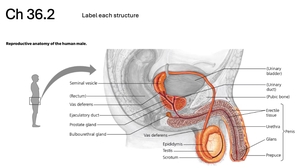
Gonads: Organs that produce gametes (testes in males, ovaries in females).
Cloaca: Common opening for digestive, urinary, and reproductive tracts in some animals.
Testes and Ovaries: Produce sperm and eggs, respectively.
Mammary glands: Produce milk in mammals.
Gametogenesis: Formation of gametes via spermatogenesis (sperm) and oogenesis (eggs).
Comparison: Spermatogenesis produces many sperm continuously; oogenesis produces fewer eggs, often cyclically.
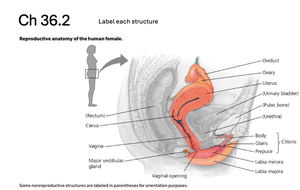
Human Reproductive Cycles
Ovarian cycle: Follicular phase, ovulation, luteal phase.
Uterine (menstrual) cycle: Growth and shedding of the endometrium.
Hormonal regulation: FSH and LH from the pituitary, estrogen and progesterone from the ovaries.
Chapter 37: Neurons, Synapses, and Signaling
Neuron Structure and Function
Neurons are specialized cells that transmit electrical and chemical signals throughout the nervous system.
Cell body: Contains nucleus and organelles.
Dendrites: Receive signals from other neurons.
Axon: Conducts impulses away from the cell body.
Synapse: Junction where neurons communicate via neurotransmitters.
Nervous System Processing
Sensory neurons: Detect stimuli and send signals to the CNS.
Interneurons: Integrate information within the CNS.
Motor neurons: Transmit signals from CNS to muscles or glands.
CNS and PNS
Central nervous system (CNS): Brain and spinal cord; processes and integrates information.
Peripheral nervous system (PNS): Sensory and motor neurons connecting CNS to the body.
Ion Pumps, Channels, and Neurotransmitters
Sodium-potassium pump: Maintains resting membrane potential by moving Na+ out and K+ into the cell.
Ion channels: Allow specific ions to flow across membranes, generating action potentials.
Neurotransmitters: Chemical messengers released at synapses to transmit signals to other cells.
Chapter 38: Nervous System Organization
Overview and Diversity of Nervous Systems
Nervous systems vary among animal groups, from simple nerve nets in cnidarians to complex brains and spinal cords in vertebrates.
Nerve net: Simple, weblike system in radially symmetric animals.
Centralization: More complex animals have CNS and PNS divisions.
Vertebrate Nervous System Organization
CNS: Brain and spinal cord.
PNS: Sensory and motor neurons; includes somatic (motor) and autonomic (involuntary) divisions.
Autonomic nervous system: Sympathetic (fight or flight), parasympathetic (rest and digest), and enteric (digestive tract control).
Chapter 39: Motor Mechanisms and Behavior
Muscle Structure and Contraction
Muscles are composed of bundles of fibers containing myofibrils, which are made of thin (actin) and thick (myosin) filaments. The sliding-filament model explains muscle contraction as the sliding of actin over myosin, shortening the sarcomere.
Hierarchy: Muscle → Muscle fiber → Myofibril → Sarcomere.
Contraction: Triggered by Ca2+ release, allowing myosin to bind actin and pull filaments past each other.
Muscle Fiber Types
Fast-twitch fibers: Rapid, powerful contractions; fatigue quickly.
Slow-twitch fibers: Sustained contractions; resist fatigue.
Skeletal Systems
Hydrostatic skeleton: Fluid-filled compartments (e.g., worms).
Exoskeleton: Hard external covering (e.g., arthropods).
Endoskeleton: Internal skeleton (e.g., vertebrates).
Bones and muscles work together as levers to produce movement.
Behavior, Altruism, and Kin Selection
Behavior: Coordinated responses to stimuli.
Altruism: Behavior that reduces individual fitness but increases the fitness of others.
Inclusive fitness: Total effect of producing own offspring and helping relatives reproduce.
Kin selection: Natural selection favoring altruism toward relatives.
