 Back
General Biology II Unit 3 Practice Assessment Study Guidance
Study Guide - Smart Notes
 Tailored notes based on your materials, expanded with key definitions, examples, and context.
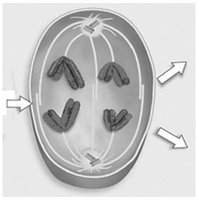
Q36. What phase of meiosis is seen in the figure to the right?
Background
Topic: Meiosis Phases
This question tests your ability to identify the stages of meiosis based on chromosome arrangement and movement within the cell.
Key Terms:
Meiosis I vs. Meiosis II: Meiosis I separates homologous chromosomes; Meiosis II separates sister chromatids.
Anaphase: The stage where chromosomes move toward opposite poles.
Metaphase: Chromosomes align at the cell's equator.
Step-by-Step Guidance
Observe the diagram: Chromosomes are being pulled toward opposite poles of the cell.
Determine if the chromosomes are homologous pairs or sister chromatids. In meiosis I, homologous chromosomes separate; in meiosis II, sister chromatids separate.
Note the number of chromosomes and their arrangement. Are they paired or single?
Recall that in anaphase I, homologous chromosomes move apart, while in anaphase II, sister chromatids move apart.
Try solving on your own before revealing the answer!
Final Answer: D) Anaphase II
The diagram shows sister chromatids separating and moving toward opposite poles, which is characteristic of anaphase II in meiosis.
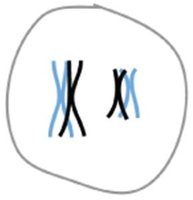
Q48. Fill in the model below showing what the cell would look like throughout meiosis. Make sure that you accurately represent whether chromosomes are unreplicated or replicated, cell ploidy level.
Background
Topic: Chromosome Behavior in Meiosis
This question tests your understanding of chromosome number, replication status, and ploidy changes during meiosis.
Key Terms:
Chromosome: DNA molecule with associated proteins, visible during cell division.
Replicated vs. Unreplicated Chromosome: Replicated chromosomes have two sister chromatids joined at the centromere; unreplicated chromosomes have only one chromatid.
Ploidy: Number of sets of chromosomes (diploid = 2 sets, haploid = 1 set).
Step-by-Step Guidance
Starting cell: Count the number of chromosomes and note if they are replicated (X-shaped) or unreplicated (single line).
Determine ploidy: Diploid cells have two sets of chromosomes (one from each parent).
End of Meiosis I: Homologous chromosomes separate, resulting in two cells. Each cell has half the original chromosome number, but chromosomes are still replicated.
End of Meiosis II: Sister chromatids separate, resulting in four cells. Chromosomes are now unreplicated, and each cell is haploid.
Try solving on your own before revealing the answer!
Final Answer:
Starting cell: 4 chromosomes, replicated, diploid.
End of Meiosis I: 2 chromosomes per cell, replicated, haploid.
End of Meiosis II: 2 chromosomes per cell, unreplicated, haploid.
The diagram shows the transition from a diploid cell with replicated chromosomes to haploid cells with unreplicated chromosomes, reflecting the reduction division and separation of chromatids.
