 Back
General Biology II Unit 3 Practice Assessment Study Guidance
Study Guide - Smart Notes
 Tailored notes based on your materials, expanded with key definitions, examples, and context.
Q36. What phase of meiosis is seen in the figure to the right?
Background
Topic: Meiosis Phases
This question tests your ability to identify the specific stage of meiosis based on the arrangement and movement of chromosomes within the cell.
Key Terms:
Meiosis: A type of cell division that reduces the chromosome number by half, producing four gamete cells.
Anaphase: The stage where chromosomes are pulled apart toward opposite poles.
Metaphase: The stage where chromosomes align at the cell's equator.
Sister chromatids: Identical copies of a chromosome connected by a centromere.
Homologous chromosomes: Chromosome pairs, one from each parent, that are similar in shape and gene content.
Step-by-Step Guidance
Observe the image and note the arrangement of chromosomes. Are they lined up at the center or being pulled apart?
Determine if the chromosomes being separated are homologous pairs or sister chromatids. This distinction is key for identifying the phase.
Recall that in Anaphase I of meiosis, homologous chromosomes are separated, while in Anaphase II, sister chromatids are separated.
Consider the number of chromosome sets and their structure to decide if this is the first or second division of meiosis.
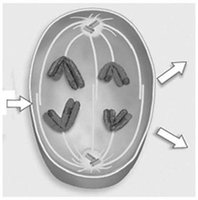
Try solving on your own before revealing the answer!
Final Answer: D) Anaphase II
The image shows sister chromatids being pulled apart to opposite poles, which is characteristic of Anaphase II in meiosis. In Anaphase I, homologous chromosomes (not sister chromatids) are separated.
Q48. Fill in the model below showing what the cell would look like throughout meiosis. Make sure that you accurately represent whether chromosomes are unreplicated or replicated, cell ploidy level.
Background
Topic: Chromosome Behavior in Meiosis
This question tests your understanding of chromosome number, replication status, and ploidy changes during the stages of meiosis.
Key Terms:
Chromosome: A DNA molecule with part or all of the genetic material of an organism.
Replicated chromosome: Consists of two sister chromatids joined at the centromere.
Unreplicated chromosome: Single chromatid.
Diploid (2n): Two sets of chromosomes.
Haploid (n): One set of chromosomes.
Step-by-Step Guidance
Examine the starting cell diagram. Count the number of chromosomes and note if they are replicated (X-shaped) or unreplicated (single line).
Determine the ploidy level: Is the cell diploid (2 sets) or haploid (1 set)? At the start, cells are typically diploid.
For the end of Meiosis I, recall that homologous chromosomes are separated, resulting in two cells. Each cell will have half the original chromosome number, but chromosomes are still replicated.
For the end of Meiosis II, sister chromatids are separated, resulting in four cells. Chromosomes are now unreplicated, and each cell is haploid.
Fill in the blanks for each stage: number of chromosomes, replicated/unreplicated, and ploidy.
Try solving on your own before revealing the answer!
Final Answer:
Starting cell: Number of chromosomes: 4 Chromosomes: Replicated Cell is: Diploid
End of Meiosis I: Number of chromosomes in each cell: 2 Chromosomes: Replicated Cell is: Haploid
End of Meiosis II: Number of chromosomes in each cell: 2 Chromosomes: Unreplicated Cell is: Haploid
This sequence shows the reduction in chromosome number and the change from replicated to unreplicated chromosomes as meiosis progresses.
