 Back
General Biology II Unit 3 Practice Assessment Study Guidance
Study Guide - Smart Notes
 Tailored notes based on your materials, expanded with key definitions, examples, and context.
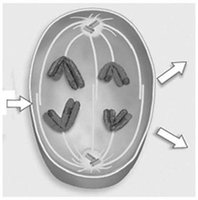
Q36. What phase of meiosis is seen in the figure to the right?
Background
Topic: Meiosis Phases
This question tests your ability to identify the specific stage of meiosis based on a diagram showing chromosome movement and cell structure.
Key Terms:
Meiosis I vs. Meiosis II: Two distinct divisions in meiosis.
Anaphase: Stage where chromosomes move toward opposite poles.
Sister chromatids: Identical copies of a chromosome joined at the centromere.
Step-by-Step Guidance
Examine the diagram: Notice the chromosomes are being pulled apart toward opposite poles.
Determine if the chromosomes being separated are homologous pairs or sister chromatids. In meiosis I, homologous chromosomes separate; in meiosis II, sister chromatids separate.
Look for the number of chromosome sets: If each chromosome is split into two chromatids moving apart, this suggests anaphase II.
Recall the defining features of anaphase II: Sister chromatids are separated, resulting in individual chromosomes moving to each pole.
Try solving on your own before revealing the answer!
Final Answer: D) Anaphase II
The diagram shows sister chromatids being pulled to opposite poles, which is characteristic of anaphase II in meiosis. In anaphase I, homologous chromosomes (not sister chromatids) are separated.
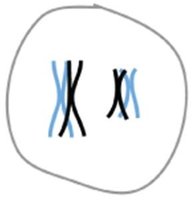
Q48. Fill in the model below showing what the cell would look like throughout meiosis. Make sure that you accurately represent whether chromosomes are unreplicated or replicated, cell ploidy level.
Background
Topic: Chromosome Behavior in Meiosis
This question tests your understanding of chromosome number, replication status, and ploidy changes during meiosis.
Key Terms:
Chromosome: DNA molecule with associated proteins.
Replicated vs. Unreplicated Chromosome: Replicated chromosomes have two sister chromatids joined; unreplicated have one chromatid.
Diploid (2n): Two sets of chromosomes; Haploid (n): One set.
Meiosis I: Homologous chromosomes separate; Meiosis II: Sister chromatids separate.
Step-by-Step Guidance
Starting cell: Count the number of chromosomes (each X shape is a replicated chromosome). Note if the cell is diploid or haploid.
End of Meiosis I: Homologous chromosomes separate, so each cell gets half the chromosome number. Chromosomes are still replicated (two chromatids).
End of Meiosis II: Sister chromatids separate, so chromosomes are now unreplicated (single chromatid). Each cell is haploid.
For each stage, record: number of chromosomes, whether they are replicated or unreplicated, and ploidy (haploid/diploid).
Try solving on your own before revealing the answer!
Final Answer:
Starting cell: 4 chromosomes, replicated, diploid
End of Meiosis I: 2 chromosomes per cell, replicated, haploid
End of Meiosis II: 2 chromosomes per cell, unreplicated, haploid
At each stage, the chromosome number and replication status change as homologous chromosomes and then sister chromatids are separated.
