 Back
General Biology Practice Exam 1 Study Guidance
Study Guide - Smart Notes
 Tailored notes based on your materials, expanded with key definitions, examples, and context.
Q1. What is the correct pathway for a protein destined to be secreted from the cell?
Background
Topic: Protein Trafficking and Secretion
This question tests your understanding of the cellular organelles involved in the synthesis, processing, and secretion of proteins.
Key Terms:
Endoplasmic Reticulum (ER): Site of protein synthesis for secreted proteins.
Golgi Apparatus: Processes and sorts proteins for secretion.
Cell Membrane: Final destination for secreted proteins.
Step-by-Step Guidance
Recall where protein synthesis begins for secreted proteins (hint: ribosomes attached to the ER).
Think about the next organelle involved in modifying and sorting these proteins (the Golgi apparatus).
Consider the final step, where the protein is transported to the cell membrane for secretion.
Compare the answer choices and eliminate any that include organelles not involved in this pathway (e.g., mitochondria, lysosome).
Try solving on your own before revealing the answer!
Final Answer: d. cytosol → endoplasmic reticulum → Golgi apparatus → cell membrane
Proteins destined for secretion are synthesized in the cytosol, enter the ER, processed in the Golgi, and then transported to the cell membrane.
Q2. Which molecule will display net movement into the cell, given the cell membrane is permeable to glycine, glucose, and glutamic acid but impermeable to fructose?
Background
Topic: Membrane Transport and Permeability
This question tests your understanding of diffusion and selective permeability of the cell membrane.
Key Terms:
Permeability: Ability of molecules to cross the membrane.
Diffusion: Movement of molecules from high to low concentration.
Step-by-Step Guidance
Identify which molecules can cross the membrane (glycine, glucose, glutamic acid).
Look at the concentration gradient for each permeable molecule (higher outside or inside?).
Recall that net movement occurs from higher to lower concentration.
Determine which molecule has a higher concentration outside the cell and can move in.
Try solving on your own before revealing the answer!
Final Answer: a. glycine
Glycine has a higher concentration outside the cell and can move in, resulting in net movement into the cell.
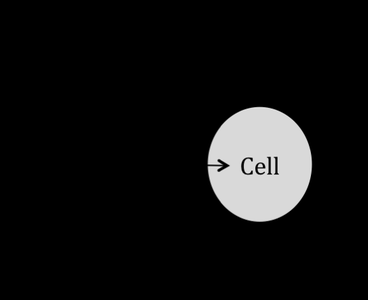
Q3. Which molecule will display net movement out of the cell, based on the figure above?
Background
Topic: Membrane Transport and Diffusion
This question tests your ability to interpret concentration gradients and membrane permeability.
Key Terms:
Concentration Gradient: Difference in concentration across the membrane.
Net Movement: Overall direction of molecule movement.
Step-by-Step Guidance
Examine the concentrations of each molecule inside and outside the cell (refer to the figure).
Identify which molecules are permeable to the membrane.
Determine which molecule has a higher concentration inside the cell and can move out.
Focus on the direction of net movement for each permeable molecule.
Try solving on your own before revealing the answer!
Final Answer: d. glutamic acid
Glutamic acid has a higher concentration inside the cell and can move out, resulting in net movement out of the cell.
Q4. In what direction will osmosis occur, based on the figure above?
Background
Topic: Osmosis and Water Movement
This question tests your understanding of osmosis, which is the movement of water across a membrane in response to solute concentration differences.
Key Terms:
Osmosis: Movement of water from low solute concentration to high solute concentration.
Solute: Substance dissolved in water.
Step-by-Step Guidance
Identify the total solute concentration inside and outside the cell (refer to the figure).
Recall that water moves toward the area with higher solute concentration.
Determine whether the inside or outside of the cell has higher solute concentration.
Predict the direction of water movement based on the concentration difference.
Try solving on your own before revealing the answer!
Final Answer: a. into the cell
Water will move into the cell if the solute concentration is higher inside, following the principles of osmosis.
Q5. What type of extracellular environment do plant cells normally live in?
Background
Topic: Plant Cell Physiology and Osmosis
This question tests your understanding of the ideal osmotic environment for plant cells.
Key Terms:
Hypotonic: Lower solute concentration outside the cell.
Isotonic: Equal solute concentration inside and outside.
Hypertonic: Higher solute concentration outside the cell.
Step-by-Step Guidance
Recall the effect of different environments on plant cell turgor pressure.
Think about which environment allows plant cells to remain firm and healthy.
Consider what happens to plant cells in isotonic and hypertonic solutions.
Identify the environment that supports normal plant cell function.
Try solving on your own before revealing the answer!
Final Answer: b. hypotonic
Plant cells thrive in a hypotonic environment, which allows water to enter and maintain turgor pressure.
Q6. How is oxygen transported across the cell membrane?
Background
Topic: Membrane Transport Mechanisms
This question tests your understanding of how small, nonpolar molecules like oxygen cross the cell membrane.
Key Terms:
Direct Diffusion: Movement of molecules directly through the lipid bilayer.
Facilitated Diffusion: Movement via transport proteins.
Active Transport: Movement against a concentration gradient using energy.
Step-by-Step Guidance
Recall the properties of oxygen (small, nonpolar).
Think about which transport mechanism is used for such molecules.
Eliminate options that require energy or transport proteins.
Focus on passive transport mechanisms.
Try solving on your own before revealing the answer!
Final Answer: b. direct diffusion across the lipid bilayer
Oxygen crosses the cell membrane by direct diffusion due to its small size and nonpolar nature.
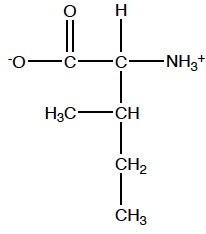
Q7. What macromolecule is shown below?
Background
Topic: Macromolecule Identification
This question tests your ability to recognize the structure of biological macromolecules.
Key Terms:
Monosaccharide: Simple sugar.
Polypeptide: Chain of amino acids.
Nucleoside: Nucleotide without phosphate group.
Amino Acid: Building block of proteins.
Fatty Acid: Component of lipids.
Step-by-Step Guidance
Examine the structure for key functional groups (amino, carboxyl, hydrocarbon chain).
Identify the presence of an amino group () and carboxyl group ().
Look for a hydrocarbon side chain characteristic of certain amino acids.
Compare the structure to known macromolecule types.
Try solving on your own before revealing the answer!
Final Answer: d. amino acid
The structure shows both an amino group and a carboxyl group, identifying it as an amino acid.
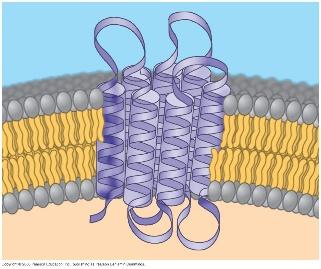
Q8. The diagram shows a membrane protein composed of a single polypeptide. What levels of structure does this protein have?
Background
Topic: Protein Structure
This question tests your understanding of the four levels of protein structure: primary, secondary, tertiary, and quaternary.
Key Terms:
Primary Structure (): Sequence of amino acids.
Secondary Structure (): Alpha helices and beta sheets.
Tertiary Structure (): Overall 3D shape.
Quaternary Structure (): Multiple polypeptide chains.
Step-by-Step Guidance
Recall that a single polypeptide can have primary, secondary, and tertiary structure.
Quaternary structure requires more than one polypeptide chain.
Examine the diagram for evidence of multiple chains or just one.
Determine which levels of structure are present based on the information given.
Try solving on your own before revealing the answer!
Final Answer: c. 1o, 2o, 3o only
A single polypeptide can have primary, secondary, and tertiary structure, but not quaternary structure.
Q9. What is the chemical formula for a tri-saccharide composed of 3 glucose (C6H12O6) molecules?
Background
Topic: Carbohydrate Chemistry
This question tests your understanding of dehydration synthesis and the formation of polysaccharides.
Key Terms:
Dehydration Synthesis: Removal of water to join monomers.
Monosaccharide: Single sugar unit.
Polysaccharide: Multiple sugar units joined together.
Step-by-Step Guidance
Calculate the total formula for three glucose molecules ().
Recall that joining sugars removes water () for each bond formed.
Determine how many water molecules are removed when forming a tri-saccharide.
Subtract the appropriate number of units from the total formula.
Try solving on your own before revealing the answer!
Final Answer: c. C18H32O16
Two water molecules are removed during the formation of a tri-saccharide, resulting in the formula C18H32O16.
Q10. Triacylglycerol will likely be liquid at room temperature if:
Background
Topic: Lipid Chemistry and Physical Properties
This question tests your understanding of how fatty acid saturation affects the physical state of lipids.
Key Terms:
Saturated Fatty Acids: No double bonds, usually solid at room temperature.
Unsaturated Fatty Acids: Double bonds, can be cis or trans.
Cis Unsaturated: Causes kinks, prevents tight packing, usually liquid.
Step-by-Step Guidance
Recall the difference between saturated and unsaturated fatty acids.
Think about how cis double bonds affect the structure and packing of fatty acids.
Consider which type of fatty acid is more likely to be liquid at room temperature.
Eliminate options that describe solid-forming fatty acids.
Try solving on your own before revealing the answer!
Final Answer: b. the fatty acids are cis unsaturated
Cis unsaturated fatty acids prevent tight packing, making triacylglycerol liquid at room temperature.
Q11. Which bond would break in a water environment at normal temperatures?
Background
Topic: Chemical Bond Stability in Water
This question tests your understanding of which types of bonds are most susceptible to breaking in aqueous environments.
Key Terms:
Ionic Bond: Attraction between charged ions, often disrupted by water.
Phosphodiester, Glycosidic, Disulfide, Peptide: Covalent bonds, generally stable in water.
Step-by-Step Guidance
Recall which bonds are covalent and which are ionic.
Think about how water interacts with ionic bonds.
Consider the stability of each bond type in aqueous environments.
Identify the bond most likely to break in water.
Try solving on your own before revealing the answer!
Final Answer: e. ionic
Ionic bonds are easily disrupted in water due to the polar nature of water molecules.
Q12. The molecule pictured is a:
Background
Topic: Macromolecule Structure Identification
This question tests your ability to identify the structure of complex biological molecules.
Key Terms:
Phospholipid: Contains a phosphate group, glycerol backbone, and fatty acid tails.
Triglyceride: Three fatty acid chains attached to glycerol.
Polysaccharide: Multiple sugar units.
Polypeptide: Chain of amino acids.
Step-by-Step Guidance
Look for the presence of a phosphate group in the structure.
Identify the glycerol backbone and fatty acid chains.
Compare the structure to known macromolecule types.
Eliminate options that do not match the structural features.
Try solving on your own before revealing the answer!
Final Answer: c. phospholipid
The molecule contains a phosphate group, glycerol backbone, and fatty acid tails, identifying it as a phospholipid.
Q13. What would happen if the nuclear lamina is disassembled by chemical treatment?
Background
Topic: Nuclear Structure and Function
This question tests your understanding of the role of the nuclear lamina in maintaining nuclear shape and integrity.
Key Terms:
Nuclear Lamina: Network of intermediate filaments lining the inner nuclear membrane.
Intermediate Filaments: Provide structural support.
Step-by-Step Guidance
Recall the function of the nuclear lamina in maintaining nuclear shape.
Consider what happens when structural support is lost.
Eliminate options unrelated to structural changes.
Focus on consequences related to nuclear morphology.
Try solving on your own before revealing the answer!
Final Answer: d. a change in the shape of the nucleus
Disassembly of the nuclear lamina would result in a change in nuclear shape due to loss of structural support.
Q14. What property can be predicted for a molecule with carboxyl groups as its predominant functional group?
Background
Topic: Functional Groups and Molecular Properties
This question tests your understanding of how functional groups affect solubility and interactions.
Key Terms:
Carboxyl Group: , polar and can form hydrogen bonds.
Solubility: Ability to dissolve in water or nonpolar solvents.
Step-by-Step Guidance
Recall the polarity of carboxyl groups.
Think about how polar groups interact with water.
Consider whether the molecule would dissolve in water or nonpolar solvents.
Eliminate options inconsistent with carboxyl group properties.
Try solving on your own before revealing the answer!
Final Answer: b. It should dissolve in water.
Carboxyl groups are polar and can form hydrogen bonds, making the molecule water-soluble.
Q15. Which key factors differentiate DNA from RNA?
Background
Topic: Nucleic Acid Structure
This question tests your understanding of the structural differences between DNA and RNA.
Key Terms:
Ribose Sugar: RNA has an oxygen on the 2nd carbon; DNA does not.
Uracil: Present in RNA, not DNA.
Phosphate Groups: Both DNA and RNA can have mono-, di-, or triphosphate groups.
Step-by-Step Guidance
Recall the structural differences in the sugar component of DNA and RNA.
Identify the presence of uracil in RNA but not DNA.
Consider the relevance of phosphate groups in distinguishing DNA and RNA.
Evaluate which answer choices correctly identify these differences.
Try solving on your own before revealing the answer!
Final Answer: d. A and C are correct
DNA lacks an oxygen on the 2nd carbon of ribose and does not contain uracil, while RNA has both.
