 Back
General Biology Quiz 1 Study Guidance
Study Guide - Smart Notes
 Tailored notes based on your materials, expanded with key definitions, examples, and context.
Q1. Acetic Acid Structure: Covalent Bonds and Molecular Interactions
Background
Topic: Chemical Bonding and Molecular Interactions
This question tests your understanding of covalent bond types (polar vs. nonpolar) and the types of molecular interactions (hydrogen bonding, hydrophobic interactions, van der Waals) that acetic acid can participate in.
Key Terms and Formulas:
Polar covalent bond: A bond where electrons are shared unequally, resulting in partial charges.
Nonpolar covalent bond: A bond where electrons are shared equally.
Hydrogen bond: An interaction between a hydrogen atom (attached to an electronegative atom) and another electronegative atom.
Hydrophobic interaction: Nonpolar molecules or regions cluster together to avoid water.
Van der Waals interaction: Weak attractions between molecules due to temporary dipoles.
Step-by-Step Guidance
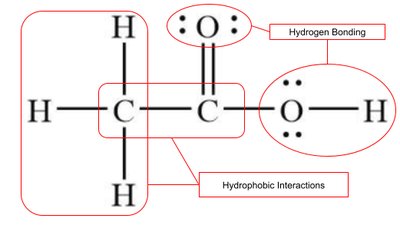
Examine the acetic acid diagram and identify all the bonds between atoms. Look for C-H, C-C, C=O, C-O, and O-H bonds.
Determine which bonds are polar covalent (typically those involving O and H, or O and C) and which are nonpolar covalent (typically C-H and C-C).
Label each site on the molecule with the strongest interaction it can participate in (hydrogen bonding, hydrophobic interactions, etc.).
Rank the interactions from strongest to weakest based on their typical strength in biological systems.
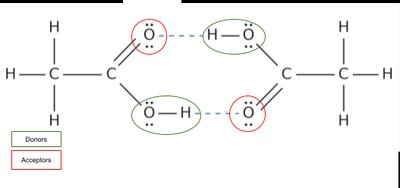
For the bonus, consider how two acetic acid molecules would pair up via hydrogen bonds. Identify which atoms act as donors and which as acceptors.
Try solving on your own before revealing the answer!
Final Answer:
a) 3 polar covalent bonds: C=O, C–O, O–H
b) 4 nonpolar covalent bonds: three C–H, one C–C
c) Hydrogen bonding at O–H and C=O; hydrophobic interactions at C–H and C–C
d) Strongest to weakest: Hydrogen bonding > Hydrophobic interactions > Van der Waals
e) BONUS: Two acetic acid molecules form a dimer via two hydrogen bonds. The O–H group acts as a donor, and the C=O group acts as an acceptor in each interaction.
The diagrams show the correct labeling and arrangement for hydrogen bond donors and acceptors.
Q2. pH Scale: Relative Acidity and Basicity
Background
Topic: Acids, Bases, and the pH Scale
This question tests your ability to interpret the pH scale and compare the relative acidity or basicity of different substances.
Key Terms and Formulas:
pH: A measure of hydrogen ion concentration; lower pH = more acidic, higher pH = more basic.
Acidic: pH < 7
Basic: pH > 7
Relative acidity/basicity: Each unit change in pH represents a tenfold change in H+ concentration.
Step-by-Step Guidance
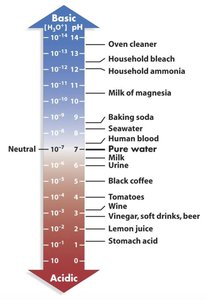
Locate pure water and household ammonia on the pH scale. Compare their pH values.
Calculate the difference in pH units between the two substances.
Recall that each pH unit is a tenfold change in acidity/basicity.
For tomatoes and lemon juice, find their pH values and calculate the difference.
Set up the calculation for the relative basicity or acidity using powers of ten.
Try solving on your own before revealing the answer!
Final Answer:
a) Pure water is 100,000 times more acidic than household ammonia.
b) Tomatoes are 100 times more basic than lemon juice.
Each pH unit difference corresponds to a tenfold change, so a difference of 5 units is 105 = 100,000 times.
