 Back
General Biology Study Guide: Bond Types, pH Effects, and Protein Structure
Study Guide - Smart Notes
 Tailored notes based on your materials, expanded with key definitions, examples, and context.
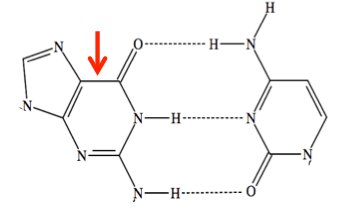
Q1. What atoms are involved in the bond indicated by the arrow? What is the electronegativity difference between the bonded atoms? What is the charge on each atom in this bond? What type of bond is shown by the arrow?
Background
Topic: Chemical Bond Types in Biomolecules
This question tests your understanding of how to identify atoms in a bond, calculate electronegativity differences, assign partial charges, and classify the bond type (non-polar covalent, polar covalent, or ionic).
Key Terms and Formulas:
Electronegativity: A measure of an atom's ability to attract electrons in a bond.
Electronegativity difference ():
Bond types:
Non-polar covalent:
Polar covalent:
Ionic:
Partial charges: (partial positive), (partial negative)
Step-by-Step Guidance
Identify the two atoms involved in the bond indicated by the arrow. Use the structure and the number of bonds to help determine the atom type.
Look up the electronegativity values for each atom (refer to the provided table: C = 2.5, N = 3.04, O = 3.44, H = 2.1).
Calculate the electronegativity difference using .
Determine the partial charges based on which atom is more electronegative (the more electronegative atom gets , the less gets ).
Use the electronegativity difference to classify the bond type according to the scale above.
Try solving on your own before revealing the answer!
Final Answer:
Atoms in the bond: Carbon and Nitrogen
Electronegativity difference:
Charges: Carbon (), Nitrogen ()
Type of bond: Polar covalent
This bond is polar covalent because the electronegativity difference falls between 0.5 and 1.7, and nitrogen is more electronegative than carbon, so it attracts the shared electrons more strongly.
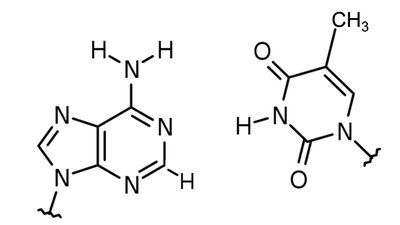
Q2. What atoms are involved in the bond indicated by the arrow? What is the electronegativity difference between the bonded atoms? What is the charge on each atom in this bond? What type of bond is this?
Background
Topic: Determining Bond Types in Biomolecules
This question asks you to identify the atoms in a specific bond, calculate the electronegativity difference, assign partial charges, and classify the bond type.
Key Terms and Formulas:
Electronegativity values: C = 2.5, N = 3.04, O = 3.44, H = 2.1
Electronegativity difference:
Bond types: Non-polar covalent, polar covalent, ionic
Partial charges: ,
Step-by-Step Guidance
Identify the two atoms involved in the bond indicated by the arrow in the molecular structure.
Find the electronegativity values for each atom from the provided table.
Calculate the electronegativity difference using .
Assign partial charges based on which atom is more electronegative.
Classify the bond type using the electronegativity difference scale.
Try solving on your own before revealing the answer!
Final Answer:
Atoms in the bond: Hydrogen and Nitrogen
Electronegativity difference:
Charges: Hydrogen (), Nitrogen ()
Type of bond: Polar covalent
This bond is polar covalent because the difference is between 0.5 and 1.7, and nitrogen is more electronegative than hydrogen.
Q3. What atoms are involved in the bond indicated by the arrow? What is the charge on each atom in this bond? What type of bond is this?
Background
Topic: Bond Types and Partial Charges
This question focuses on identifying atoms in a bond, assigning partial charges, and classifying the bond type.
Key Terms and Formulas:
Electronegativity values: C = 2.5, O = 3.44
Partial charges: ,
Bond types: Polar covalent, non-polar covalent, ionic
Step-by-Step Guidance
Identify the atoms involved in the bond (look for the arrow in the molecular diagram).
Determine which atom is more electronegative.
Assign partial charges based on electronegativity.
Classify the bond type using the electronegativity difference.
Try solving on your own before revealing the answer!
Final Answer:
Atoms in the bond: Carbon and Oxygen
Charges: Carbon (), Oxygen ()
Type of bond: Polar covalent
Oxygen is much more electronegative than carbon, so it attracts the shared electrons more strongly, resulting in a polar covalent bond.
Q4. What type of bond is this? (dotted line) Are these atoms sharing electrons with each other? How do you know? How is this bond similar to an ionic bond? How is it different? Label the charges by all atoms connected with dotted lines.
Background
Topic: Hydrogen Bonds vs. Ionic Bonds
This question tests your understanding of hydrogen bonds, how they differ from covalent and ionic bonds, and how to identify partial charges.
Key Terms and Formulas:
Hydrogen bond: An attraction between a hydrogen atom (attached to an electronegative atom) and another electronegative atom.
Ionic bond: A bond formed by the transfer of electrons, resulting in full charges.
Partial charges: ,
Step-by-Step Guidance
Identify the atoms connected by the dotted line (usually hydrogen and an electronegative atom like oxygen or nitrogen).
Determine if electrons are shared (hydrogen bonds do not involve sharing electrons).
Compare hydrogen bonds to ionic bonds: both involve attraction between charges, but hydrogen bonds involve partial charges, while ionic bonds involve full charges.
Label the partial charges on all atoms involved in the hydrogen bond.
Try solving on your own before revealing the answer!
Final Answer:
Type of bond: Hydrogen bond (dotted line)
Atoms are not sharing electrons; hydrogen bonds are attractions between partial charges ( and ).
Similar to ionic bonds because both involve attraction between charges, but hydrogen bonds involve partial charges, not full charges.
Partial charges: Hydrogen (), Oxygen/Nitrogen ()
Q5. Draw the hydrogen bonds that connect these two molecules.
Background
Topic: Hydrogen Bonding Between Molecules
This question tests your ability to identify and illustrate hydrogen bonds between two biomolecules.
Key Terms and Formulas:
Hydrogen bond: Attraction between a hydrogen atom (attached to an electronegative atom) and another electronegative atom.
Electronegative atoms: O, N
Step-by-Step Guidance
Identify hydrogen atoms attached to electronegative atoms (O or N) in both molecules.
Locate electronegative atoms (O or N) with lone pairs in the other molecule.
Draw dotted lines between the hydrogen atom and the electronegative atom to represent hydrogen bonds.
Try solving on your own before revealing the answer!
Final Answer:
Hydrogen bonds are drawn as dotted lines between the hydrogen atom (attached to N or O) in one molecule and the electronegative atom (N or O) in the other molecule.
These bonds are crucial for stabilizing the structure of biomolecules like DNA and proteins.
Q6. Using your own words, explain the steps needed to determine a bond type. What concept(s) became more clear after this assignment? What remaining questions do you have?
Background
Topic: Bond Type Determination and Reflection
This question encourages you to reflect on the process of determining bond types and your learning.
Key Terms and Formulas:
Electronegativity difference
Bond types: Non-polar covalent, polar covalent, ionic
Step-by-Step Guidance
Identify the atoms involved in the bond.
Find their electronegativity values.
Calculate the electronegativity difference.
Use the difference to classify the bond type.
Assign partial or full charges as appropriate.
Try solving on your own before revealing the answer!
Final Answer:
Steps: 1) Identify atoms, 2) Find electronegativity values, 3) Calculate difference, 4) Classify bond type, 5) Assign charges.
This assignment clarifies how electronegativity differences determine bond types and charges. Remaining questions might include how these concepts apply to larger biomolecules or in different environments.
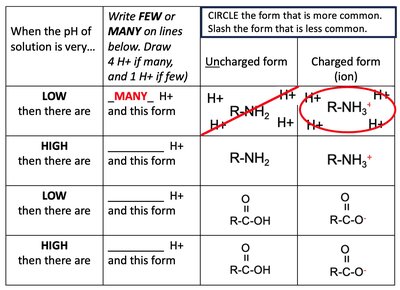
Q7. Impact of pH on Proteins: Functional Groups and Their Behavior
Background
Topic: pH Effects on Functional Groups in Biomolecules
This question tests your understanding of how pH affects the charge and behavior of functional groups (carboxyl and amino) in proteins.
Key Terms and Formulas:
pH: Measure of hydrogen ion concentration ()
Carboxyl group: R-COOH (acidic)
Amino group: R-NH2 (basic)
Charged forms: R-COO, R-NH3
Step-by-Step Guidance
Recall that low pH means high (acidic), high pH means low (basic).
Carboxyl groups (R-COOH) donate H in water, becoming R-COO.
Amino groups (R-NH2) accept H in water, becoming R-NH3.
At low pH, functional groups are more likely to be protonated (charged); at high pH, they are more likely to be deprotonated (uncharged).
Use the table to determine which form is more common at different pH values.
Try solving on your own before revealing the answer!
Final Answer:
Carboxyl group: Acidic, donates H, becomes R-COO. Amino group: Basic, accepts H, becomes R-NH3$^+$.
At low pH, more groups are protonated (charged); at high pH, more are deprotonated (uncharged).
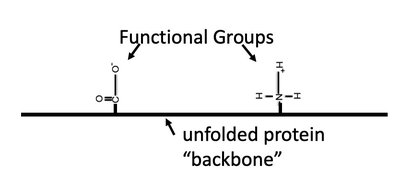
Q8. How does pH impact protein structure and function?
Background
Topic: Protein Structure and pH Effects
This question tests your understanding of how changes in pH can alter protein folding and function by affecting the charge of functional groups.
Key Terms and Formulas:
Protein structure: Primary, secondary, tertiary, quaternary
Functional groups: Carboxyl, amino
pH: Affects charge and bonding
Step-by-Step Guidance
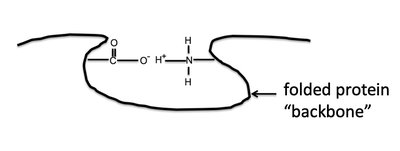
Understand that protein folding is driven by interactions between charged side chains.
At low pH, more side chains are protonated, which can disrupt ionic bonds and hydrogen bonds.
At high pH, more side chains are deprotonated, which can also disrupt bonding and folding.
Changes in folding can alter protein function.
Try solving on your own before revealing the answer!
Final Answer:
pH changes can alter the charge of functional groups, disrupting bonds that stabilize protein structure. This can cause proteins to unfold or misfold, affecting their function.
Proteins with altered structure may not function as intended, which can impact cellular processes.
