 Back
General Biology Study Guide: Cell Structure, Function, and Membrane Transport
Study Guide - Smart Notes
 Tailored notes based on your materials, expanded with key definitions, examples, and context.
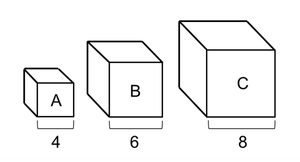
Q2. Which of the following cells have the greatest surface area to volume ratio? Which cells are more efficient at moving nutrients and waste across the cell membrane?
Background
Topic: Cell Size and Surface Area to Volume Ratio
This question tests your understanding of how the size and shape of a cell affect its ability to exchange materials with its environment. The surface area to volume ratio is a key concept in cell biology, as it influences the rate at which substances can diffuse into and out of the cell.
Key Terms and Formulas
Surface Area (SA) of a cube:
Volume (V) of a cube:
Surface Area to Volume Ratio (SA:V):
Step-by-Step Guidance
Identify the side lengths of each cube: A = 4, B = 6, C = 8.
Calculate the surface area for each cube using .
Calculate the volume for each cube using .
Determine the surface area to volume ratio for each cube using .
Compare the ratios to determine which cell has the greatest surface area to volume ratio.
Think about why a higher surface area to volume ratio makes a cell more efficient at moving materials across its membrane.
Try solving on your own before revealing the answer!
Final Answer:
Cell A (side length 4) has the greatest surface area to volume ratio. The surface area to volume ratios are:
A:
B:
C:
Cells with a higher surface area to volume ratio (like cell A) are more efficient at moving nutrients and waste across the cell membrane because there is more membrane surface available per unit of volume for exchange.
