 Back
General Biology Study Guide: Chapters 1–4 (Scientific Inquiry, Chemistry of Life, Water, and Carbon)
Study Guide - Smart Notes
 Tailored notes based on your materials, expanded with key definitions, examples, and context.
Chapter 1: Evolution, Themes of Biology, and Scientific Inquiry
Qualitative and Quantitative Data
Biologists use both qualitative and quantitative data to study life. Qualitative data are descriptive and interpretative, focusing on characteristics that cannot be measured numerically. Quantitative data are measurable and expressed in numbers, allowing statistical analysis.
Qualitative Data: Descriptive, interpretation-based (e.g., color, shape).
Quantitative Data: Numbers-based, measurable (e.g., height, weight).
Comparison: Both are important for scientific inquiry; quantitative data allow for statistical testing, while qualitative data provide context and detail.
Hypothesis vs. Theory
A hypothesis is a testable explanation for an observation, which can be supported or refuted through experimentation. A theory is a broader explanation that integrates many observations and is supported by extensive evidence.
Hypothesis: Testable, specific, can be supported or refuted.
Theory: Comprehensive, integrates wide-ranging evidence, supported by repeated testing.
Scientific Reasoning
Scientists use both inductive and deductive reasoning to draw conclusions.
Inductive Reasoning: Moves from specific observations to broader generalizations.
Deductive Reasoning: Moves from general rules to specific conclusions.
Experimental Controls
Controls are essential for ensuring the validity and reliability of experiments.
Negative Control: Used when no response is expected.
Positive Control: Used when a known response is expected.
Aspects of Life
To be considered alive, an organism must possess several characteristics:
Cellular Organization
Metabolism (energy processing)
Homeostasis
Growth and Development
Reproduction
Response to Stimuli
Adaptation and Evolution
Chapter 2: The Chemical Context of Life
Atoms and Subatomic Particles
An atom is the smallest unit of an element, composed of protons, neutrons, and electrons.
Proton: Positive charge (+1), found in nucleus, mass = 1
Neutron: No charge (0), found in nucleus, mass = 1
Electron: Negative charge (-1), orbits nucleus, mass ≈ 0
Atomic Number, Mass Number, and Isotopes
Atomic Number: Number of protons; unique for each element.
Mass Number: Sum of protons and neutrons.
Isotope: Atoms of the same element with different numbers of neutrons.
Valence Electrons and Chemical Bonds
Valence electrons are found in the outermost shell and determine chemical reactivity.
Covalent Bond: Sharing of electrons between atoms.
Nonpolar Covalent Bond: Equal sharing due to similar electronegativities.
Polar Covalent Bond: Unequal sharing due to different electronegativities.
Ionic Bond: Attraction between oppositely charged ions (cations and anions).
Hydrogen Bond: Weak interaction between a hydrogen atom and a highly electronegative atom (F, O, N).
Van der Waals Interactions: Very weak, non-covalent interactions.
Balancing Chemical Equations
To balance a chemical equation, add coefficients to ensure equal numbers of each atom on both sides. Never change subscripts.
Reactants: Starting substances (left side).
Products: New substances formed (right side).
Arrow (→): Indicates "produces" or "yields".
Chapter 3: Water and Life
Properties of Water
Water is essential for life due to its unique properties, which arise from its polarity and hydrogen bonding.
Polar Molecule: Uneven charge distribution.
Cohesion: Attraction between water molecules.
Adhesion: Attraction between water and other molecules.
Specific Heat: Amount of heat needed to change temperature; water's high specific heat stabilizes environments.
Heat of Vaporization: Heat required to convert liquid to gas.
Evaporative Cooling: Surface cools as water evaporates.
Ice: Floats, insulates water below, protects aquatic life.
Solutions, Solvents, and Solutes
Solution: Combination of solute and solvent.
Solvent: Substance doing the dissolving (usually water).
Solute: Substance being dissolved.
Hydrophilic vs. Hydrophobic
Hydrophilic: "Water loving"; interacts well with water.
Hydrophobic: "Water fearing"; repels water.
Moles and Molarity
Mole is a unit for measuring the amount of substance. Molarity is the concentration of a solution.
Moles:
Molarity:
Moles from Molarity:
Liters:
mL to L: Divide by 1,000
Acids, Bases, and Buffers
Acid: Increases H+ concentration.
Base: Decreases H+ concentration.
Buffer: Resists changes in pH when acids or bases are added.
Chapter 4: Carbon and the Molecular Diversity of Life
Organic Chemistry and Carbon Skeletons
Organic chemistry is the study of carbon compounds. Carbon's electron configuration allows it to form four covalent bonds, leading to diverse molecules.
Hydrocarbons: Molecules made only of carbon and hydrogen.
Carbon Skeletons: Can vary in length, branching, double-bond location, rings, and arrangement.
Isomers: Same molecular formula, different structures and properties.
Types of Isomers
Structural Isomers: Different covalent arrangements.
Geometric (Cis-trans) Isomers: Same covalent bonds, different spatial arrangements.
Enantiomers: Mirror images of each other.
Functional Groups in Organic Molecules
Functional groups are specific groups of atoms that confer particular properties to organic molecules. They are crucial for the function and reactivity of biomolecules.
Chemical Group | Compound Name | Examples |
|---|---|---|
Hydroxyl (–OH) | Alcohol | Ethanol |
Carbonyl (C=O) | Ketone, Aldehyde | Acetone, Propanal |
Carboxyl (–COOH) | Carboxylic acid, organic acid | Acetic acid, ionized form of –COOH |
Amino (–NH2) | Amine | Glycine, ionized form of –NH2 |
Sulfhydryl (–SH) | Thiol | Cysteine |
Phosphate (–PO4) | Organic phosphate | Glycerol phosphate |
Methyl (–CH3) | Methylated compound | 5-methylcytosine |
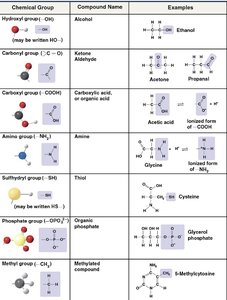
Hydroxyl: Makes molecules polar, helps dissolve in water.
Carbonyl: Makes molecules more polar and reactive; found in sugars (aldehyde or ketone).
Carboxyl: Acts as an acid, releases H+; found in fatty acids and amino acids.
Amino: Acts as a base, accepts H+; important in amino acids and proteins.
Sulfhydryl: Forms disulfide bonds, stabilizes protein shape.
Phosphate: Gives negative charge, important in energy transfer (ATP), found in DNA/RNA.
Methyl: Nonpolar, affects shape, activity, and gene expression.
Aldehyde vs. Ketone
Aldehyde: Carbonyl group at the end of the carbon skeleton; structure: R–C(=O)–H.
Ketone: Carbonyl group within the carbon skeleton; structure: R–C(=O)–R.
Example: Acetone is a ketone; propanal is an aldehyde.
