 Back
General Biology Study Guide: Chapters 1–5
Study Guide - Smart Notes
 Tailored notes based on your materials, expanded with key definitions, examples, and context.
Chapter 1: Evolution and the Themes of Biology
Unifying Themes in Biology
Biology is unified by several key themes that connect all living organisms and their processes.
Evolution: The process by which species change over time through natural selection and genetic variation.
Organization: Life is structured in a hierarchical manner, from atoms to the biosphere.
Information: Genetic information is stored in DNA and governs biological functions.
Energy and Matter: Organisms require energy and cycle matter to sustain life.
Interactions: Living things interact with each other and their environment.
Hierarchy of Structural Levels in Biological Organization
Biological organization ranges from the simplest to the most complex levels:
Atoms → Molecules → Organelles → Cells → Tissues → Organs → Organ Systems → Complex Organism → Population → Community → Ecosystem → Biosphere
Reverse: Biosphere → Ecosystem → Community → Population → Complex Organism → Organ System → Organs → Tissues → Cells → Organelles → Molecules → Atoms
Major Processes of an Ecosystem
Energy Flow: Sunlight is converted to chemical energy by producers, then transferred to consumers. Energy exits as heat.
Nutrient Cycling: Nutrients are recycled within the ecosystem, supporting ongoing life.
Feedback Regulation
Feedback regulation controls metabolic pathways by influencing the production of intermediates or products.
Negative Feedback: Later products inhibit earlier steps, slowing or stopping the pathway. Most biological feedback is negative.
Positive Feedback: Later products enhance earlier steps, speeding up the pathway.
Three Domains of Life
Archaea: Prokaryotes in extreme environments.
Bacteria: Other prokaryotes.
Eukarya: All eukaryotes, including Protista, Fungi, Plantae, and Animalia.
Relatedness of Living Organisms
All organisms use DNA as the genetic code for heritable information.
Structure and Function Relationship
Structure at each level of organization is correlated with function.
Chapter 2: The Chemical Context of Life
Major Elements in Living Organisms
Carbon (C), Hydrogen (H), Oxygen (O), Nitrogen (N)
Key Terms and Distinctions
Neutron: Neutral subatomic particle in the nucleus.
Proton: Positively charged subatomic particle in the nucleus; determines atomic number.
Atomic Number: Number of protons.
Mass Number: Sum of protons and neutrons.
Element: Substance that cannot be broken down by chemical reactions.
Compound: Substance of two or more elements in a fixed ratio.
Calculating Subatomic Particles
Mass number = protons + neutrons
Atomic number = protons (and electrons in neutral atoms)
Neutrons = mass number - atomic number
Isotopes
Isotopes have the same atomic number (protons) but different numbers of neutrons.
Chemical Bonds
Nonpolar Covalent: Equal sharing of electrons; hydrophobic.
Polar Covalent: Unequal sharing; hydrophilic.
Ionic: Transfer of electrons; electrostatic attraction between cations and anions.
Hydrogen Bonds
Formed by attraction between polar molecules; weaker than covalent or ionic bonds.
Cations and Anions
Cations: Formed by loss of electrons; positive charge.
Anions: Formed by gain of electrons; negative charge.
Valence Electrons
Determine reactivity and bonding capacity of atoms.
Covalent Bonds
Single: 2 electrons (1 pair)
Double: 4 electrons (2 pairs)
Triple: 6 electrons (3 pairs)
Chapter 3: Water and Life
Polarity of Water
Water is polar due to unequal sharing of electrons between oxygen and hydrogen.
Emergent Properties of Water
Cohesion and surface tension
Temperature moderation (high specific heat)
Expansion upon freezing
Versatility as a solvent
Acids, Bases, and pH
Acid: Donates H+ ions; lowers pH.
Base: Accepts H+ ions; raises pH.
pH:
pH Scale
Acidic: pH < 7
Neutral: pH = 7
Basic: pH > 7
Buffers
Maintain pH by donating or accepting H+ ions.
Hydrophobic vs. Hydrophilic Substances
Hydrophobic: Nonpolar, not soluble in water.
Hydrophilic: Polar, soluble in water.
Dissociation of Water
Concentration in pure water: ,
Acidification of Oceans and Arctic Climate
Ocean acidification lowers pH, harming marine life.
Arctic warming destroys ecosystems due to melting ice.
Chapter 4: Carbon and Molecular Diversity of Life
Organic Chemistry
Study of carbon-containing compounds.
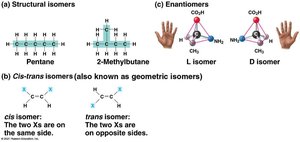
Types of Isomers
Isomers have the same molecular formula but different structures and properties.
Structural Isomers: Different covalent arrangements of atoms.
Enantiomers: Mirror images (left/right hand versions).
Cis-trans Isomers: Same covalent bonds, different spatial arrangements.
Major Functional Groups
Hydroxyl (-OH): Forms alcohols; polar, hydrophilic.
Carbonyl (-C=O): Forms ketones (internal carbon) and aldehydes (terminal carbon); polar, hydrophilic.
Carboxyl (-COOH): Forms acids; donates H+; polar, hydrophilic.
Amino (-NH2): Forms amines; bases; removes H+; can ionize.
Sulfhydryl (-SH): Forms thiols; stabilizes proteins; polar, hydrophilic.
Phosphate (-PO4): Forms organic phosphates; polar.
Methyl (-CH3): Nonpolar, hydrophobic.
Functional Groups in Amino Acids
Amino (-NH2) and Carboxyl (-COOH) groups are present in amino acids.
Carbon's Electron Configuration
Carbon has a valence of 4, allowing it to form up to 4 covalent bonds, enabling large, complex molecules.
Predominant Bond Type of Carbon
Covalent bonds
Function of ATP
ATP is the major chemical energy molecule used by cells.
Chapter 5: Structure and Function of Large Biological Molecules
Four Major Classes of Macromolecules
Carbohydrates
Lipids
Proteins
Nucleic Acids
Carbohydrates, proteins, and nucleic acids are polymers.
Monomers of Polymers
Carbohydrates: Monosaccharides
Proteins: Amino acids
Nucleic Acids: Nucleotides (nitrogenous base, pentose sugar, phosphate group)
Dehydration and Hydrolysis Reactions
Dehydration: Forms bonds between monomers, releasing water.
Hydrolysis: Breaks bonds by consuming water.
Covalent Linkages in Polymers
Carbohydrates: Glycosidic linkages
Proteins: Peptide bonds
Nucleic Acids: Phosphodiester linkages
Types of Saccharides
Monosaccharide: One sugar molecule (e.g., glucose)
Disaccharide: Two monosaccharides linked (e.g., sucrose)
Polysaccharide: Many monosaccharides linked (e.g., cellulose, starch, glycogen, chitin)
Types of Lipids
Saturated Fats: Maximum hydrogen, no double bonds; solid at room temperature; animal origin.
Unsaturated Fats: Fewer hydrogen, one or more double bonds; liquid at room temperature; plant origin.
Phospholipids: Major component of cell membranes.
Steroids: Four fused rings (e.g., cholesterol, testosterone, estrogen).
Energy Storage and Structural Molecules
Starch: Storage in plants
Cellulose: Structure in plant cell walls
Glycogen: Storage in animals
Protein Structure
Primary structure: Sequence of amino acids determined by DNA.
DNA vs. RNA and Base Pairing
Both are polynucleotides linked by phosphodiester bonds.
DNA: Double-stranded helix, deoxyribose sugar, bases A, G, T, C; antiparallel strands.
RNA: Single-stranded, ribose sugar, bases A, G, U, C (no T).
Base pairing: Purines (A, G) pair with pyrimidines (C, T/U); A=T (DNA), G=C.
Example: DNA sequence 5'-GCATTCATTAGCA-3' pairs with 3'-CGTAAGTAATCGT-5'. RNA sequence corresponding to DNA template: 3'-CGUAAGUAAUCGU-5'.
