 Back
General Biology Study Guide: Chapters 2-7 – Chemistry of Life, Macromolecules, and Cell Structure
Study Guide - Smart Notes
 Tailored notes based on your materials, expanded with key definitions, examples, and context.
Chemical Properties of Water
Emergent Properties of Water
Water exhibits four key emergent properties that are essential for life:
Cohesion and Adhesion: Water molecules stick to each other (cohesion) and to other surfaces (adhesion), enabling capillary action and transport in plants.
High Specific Heat: Water can absorb or release large amounts of heat with little temperature change, stabilizing environmental and biological temperatures.
Less Dense When Solid: Ice floats because hydrogen bonds create a lattice structure, making solid water less dense than liquid water.
Solvent Properties: Water's polarity allows it to dissolve many substances, facilitating biochemical reactions.
Bonds in Water
Water molecules are held together by polar covalent bonds within the molecule, and hydrogen bonds between molecules. The polarity arises because oxygen is more electronegative than hydrogen, creating partial charges.
Organic Molecules and Functional Groups
Isomers
Isomers are molecules with the same molecular formula but different arrangements of atoms. They are relevant to biology because structural differences can lead to different chemical properties and biological functions.
Functional Groups
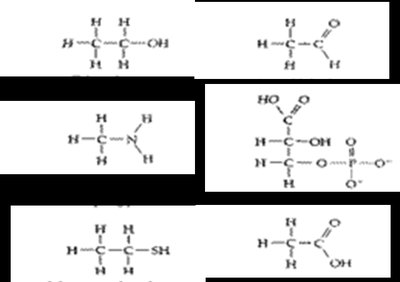
Functional groups are specific groups of atoms within molecules that determine the chemical properties and reactivity of those molecules. Common functional groups include:
Hydroxyl (-OH): Found in alcohols; increases solubility in water.
Carbonyl (C=O): Found in ketones and aldehydes; important in sugars.
Amino (-NH2): Found in amino acids; acts as a base.
Phosphate (-PO4): Found in nucleotides; involved in energy transfer.
Sulfhydryl (-SH): Found in some amino acids; forms disulfide bonds in proteins.
Carboxyl (-COOH): Found in amino acids and fatty acids; acts as an acid.
Macromolecules: Structure and Function
Polymer Formation and Breakdown
Polymers are formed by dehydration reactions (removal of water) and broken down by hydrolysis (addition of water).
Classes of Biological Molecules
Class | Monomers | Bonds | Examples | Key Features |
|---|---|---|---|---|
Lipids | Fatty acids, glycerol | Ester linkages | Fats, oils, phospholipids | Long-term energy, insulation, cell membranes |
Nucleic Acids | Nucleotides | Phosphodiester bonds | DNA, RNA | Store and transmit genetic information |
Carbohydrates | Monosaccharides | Glycosidic bonds | Glucose, starch, cellulose | Quick energy, energy storage, structural support |
Proteins | Amino acids | Peptide bonds | Enzymes, keratin | Structure, movement, transport, enzymes |
Cellulose vs. Starch
Cellulose is found in plant cell walls and provides structural support. Starch is found in plants (e.g., rice, potatoes) and stores energy. Humans can digest starch but not cellulose due to the lack of appropriate enzymes.
Saturated, Unsaturated, and Trans Fats
Saturated fats: Straight chains, single bonds, solid at room temperature.
Unsaturated fats: Bent chains, double bonds, liquid at room temperature.
Trans fats: Specific arrangement around double bonds, often artificially produced.
Phospholipids and Cell Membranes
Phospholipids are important in cell membranes due to their amphipathic nature: hydrophilic heads and hydrophobic tails form a bilayer. Fats cannot form bilayers because they lack hydrophilic heads.
Membrane Permeability
Unsaturated hydrocarbon chains increase membrane permeability.
Saturated chains decrease permeability due to tight packing.
Short chains increase permeability; long chains decrease it.
Protein Structure and Function
Levels of Protein Structure
Primary: Sequence of amino acids; peptide bonds.
Secondary: Alpha helices and beta sheets; hydrogen bonds.
Tertiary: 3D folding; hydrogen, ionic, disulfide bonds, hydrophobic interactions.
Quaternary: Multiple polypeptides; hydrogen, ionic, hydrophobic, sometimes disulfide bonds.
Organisms Containing Proteins
Proteins are found in all living organisms: bacteria, plants, animals, fungi.
Nucleic Acids
Nitrogenous Bases and Pairing
Adenine (A) pairs with Thymine (T) in DNA
Guanine (G) pairs with Cytosine (C)
Uracil (U) replaces thymine in RNA and pairs with adenine
Nucleotide Structure
Phosphate group
5-carbon sugar (ribose or deoxyribose)
Nitrogenous base
Bonds in Nucleic Acids
Nucleotides are linked by phosphodiester bonds.
Two DNA strands are held together by hydrogen bonds.
Lipids: Not True Polymers
Lipids are grouped together because they are hydrophobic and do not form true polymers.
Cholesterol
Cholesterol is important for maintaining membrane fluidity and is used to make steroid hormones.
Amino Acids
Amino acids differ by their R-group (side chain), which determines properties like polarity and acidity.
Macromolecule Identification
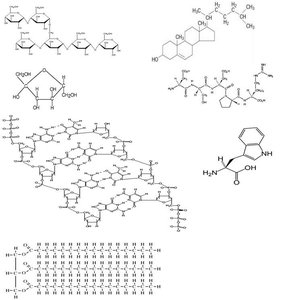
Macromolecules can be identified by their structure:
Carbohydrate: Polysaccharide, many sugar units
Protein: Peptide chain of amino acids
Nucleic acid: Nucleotide structure
Lipid: Triglyceride, phospholipid, steroid ring structure
Cell Membranes and Transport
Plasma Membrane Composition
Phospholipid bilayer
Proteins (transport, communication, support)
Cholesterol (regulates fluidity)
Carbohydrates (recognition, communication)
Semi-Permeable Membrane
The plasma membrane allows certain substances to pass through while blocking or limiting others.
Membrane Formation
Phospholipids form membranes due to their amphipathic nature. Fats cannot form bilayers because they lack hydrophilic heads.
Membrane Transport Categories
Passive transport: No energy required; includes diffusion and facilitated diffusion.
Active transport: Requires energy (ATP); moves substances against concentration gradient.
Osmosis
Osmosis is the movement of water from an area of low solute concentration to an area of high solute concentration.
Tonicity
Hypertonic: Water moves out; cell shrinks.
Hypotonic: Water moves in; cell swells.
Isotonic: Equal movement in and out; cell remains stable.
Channel vs. Carrier Proteins
Channel proteins: Allow substances to flow through like a doorway.
Carrier proteins: Bind to substances and change shape to move them across the membrane, like a revolving door.
Facilitated Diffusion vs. Active Transport
Facilitated diffusion: Passive transport, no ATP required, moves substances down concentration gradient.
Active transport: Requires ATP, moves substances against concentration gradient.
Cell Structure and Organelles
Prokaryotes vs. Eukaryotes
Feature | Prokaryotes | Eukaryotes |
|---|---|---|
Nucleus | No | Yes |
Membrane-bound organelles | No | Yes |
Examples | Bacteria | Plants, animals, fungi |
Ribosomes | Yes | Yes |
Organelle Functions
Ribosome: Protein synthesis
Endoplasmic Reticulum (ER): Smooth ER detoxifies; rough ER has bound ribosomes
Golgi Apparatus: Modifies, stores, ships proteins
Lysosomes: Digest macromolecules, phagocytosis, autophagy
Peroxisomes: Detoxify alcohol and toxic compounds
Mitochondria: Power plant, site of cellular respiration, double membrane
Chloroplasts: Site of photosynthesis, double membrane
Cytoskeleton Components
Microfilaments: Muscle contraction, cell division (cleavage furrow)
Intermediate filaments: Anchorage of nucleus, forms nuclear lamina
Microtubules: Motility, movement of organelles
Additional info: These notes expand on brief points from the original study guide, providing definitions, examples, and context for General Biology students.
