 Back
General Biology Study Guide: Foundations, Genetics, Evolution, and Population Biology
Study Guide - Smart Notes
 Tailored notes based on your materials, expanded with key definitions, examples, and context.
Introduction to Biology
Definition and Characteristics of Life
Biology is the scientific study of life and living organisms. It encompasses a wide range of fields, from molecular biology to ecology. Living organisms share several key characteristics:
Organization: Living things are composed of cells, the basic unit of life.
Metabolism: They obtain and use energy.
Homeostasis: They maintain stable internal conditions.
Growth and Development: Organisms grow and develop according to genetic instructions.
Reproduction: They produce offspring.
Response to Stimuli: Organisms respond to environmental changes.
Evolution: Populations change over time through adaptation.
Science and the Scientific Method
Science is a systematic approach to understanding the natural world through observation and experimentation. It is not based on opinion or belief, but on empirical evidence.
Scientific Facts: Statements supported by repeated observation.
Hypotheses: Testable explanations for observations.
Theories: Well-supported, broad explanations for phenomena.
Laws: Descriptions of observed phenomena, often mathematical.
The hypothetico-deductive method involves proposing a hypothesis, deducing predictions, and testing them against data.
Genetics and Chromosome Theory
Genetics and Chromosome Theory of Inheritance
Genetics is the study of heredity and variation in organisms. The chromosome theory of inheritance states that genes are located on chromosomes, and their movement during cell division explains Mendel's laws.
Gametes: Reproductive cells (egg, sperm) involved in inheritance.
Somatic Cells: Non-reproductive cells; do not contribute to inheritance.
Chargaff's Rules: In double-stranded DNA, the amount of adenine (A) equals thymine (T), and guanine (G) equals cytosine (C).
Key Contributors to Genetics
Gregor Mendel: Father of modern genetics; established laws of inheritance.
Sutton & Boveri: Demonstrated chromosomes carry genetic information.
Rosalind Franklin: Provided evidence for DNA's double helix structure.
Crick & Watson: Discovered the double helix structure of DNA.
Genotype vs. Phenotype
Genotype: The genetic makeup of an organism.
Phenotype: The observable traits of an organism.
Central Dogma of Molecular Biology
Francis Crick's Central Dogma describes the flow of genetic information:
Transcription: DNA is copied to RNA in the nucleus.
Translation: RNA is used to synthesize proteins outside the nucleus.
Genetic information flows from nucleic acids to proteins, but not in reverse.
Evolution of the Genetic Code
Evidence for the evolution of the genetic code includes its universality and minor variations among organisms, suggesting a common ancestry.
Genomics and Bioinformatics
Genomics and Bioinformatics
Genomics is the study of entire genomes, while bioinformatics uses computational tools to analyze genetic data.
Human Genome Project: Mapped the entire human genome, leading to advances in medicine and genetics.
Comparative Genomics: Compares genome size and gene number between prokaryotes and eukaryotes.
Evolution and Natural Selection
Modern Definition and Evidence
Evolution is the change in allele frequencies in a population over time. It is both a fact (observable changes) and a theory (explanation of mechanisms).
Uniformitarianism: The principle that current natural processes operated in the past, allowing scientists to interpret Earth's history.
Darwin's Four Postulates
Variation: Individuals differ in traits.
Inheritance: Some traits are heritable.
Overproduction: More offspring are produced than can survive.
Differential Survival and Reproduction: Individuals with advantageous traits are more likely to survive and reproduce.
Major Contributors to Evolutionary Theory
Charles Lyell: Popularized uniformitarianism.
Jean-Baptiste Lamarck: Proposed inheritance of acquired traits.
Charles Darwin: Developed the theory of evolution by natural selection.
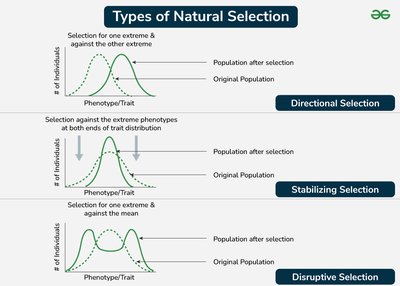
Types of Natural Selection
Natural selection can act in different ways to shape populations:
Directional Selection: Favors one extreme phenotype.
Stabilizing Selection: Favors intermediate phenotypes.
Disruptive Selection: Favors both extreme phenotypes.
Sexual Selection and Balancing Selection
Intrasexual Selection: Competition within one sex for mates.
Intersexual Selection: Mate choice by one sex based on traits.
Balancing Selection: Maintains genetic diversity (e.g., camouflage color variation).
Population Biology and Ecology
Population Size and Growth
Population size is influenced by resource availability, carrying capacity, predation, and disease.
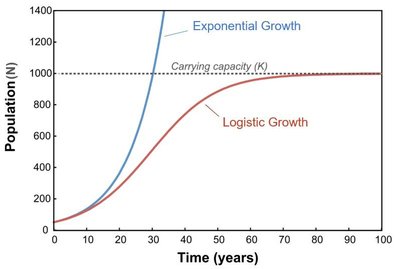
Carrying Capacity (K): Maximum population size the environment can support.
Exponential Growth: Population grows rapidly with unlimited resources.
Logistic Growth: Population growth slows as it approaches carrying capacity.
Growth curves illustrate these concepts:
Life History Strategies
K-selection: Long-lived, few offspring, high parental investment (e.g., humans).
r-selection: Short-lived, many offspring, low parental investment (e.g., insects).
Density-Dependent and Density-Independent Factors
Density-Dependent: Factors like competition, predation, and disease that intensify as population size increases.
Density-Independent: Factors like weather and natural disasters that affect populations regardless of size.
Survivorship Curves
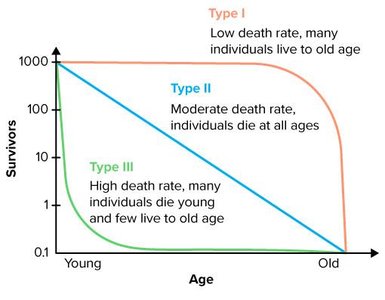
Survivorship curves describe patterns of mortality within populations:
Type I: Low death rate, most individuals live to old age (e.g., humans).
Type II: Moderate death rate, individuals die at all ages (e.g., birds).
Type III: High death rate, most individuals die young (e.g., many fish).
Speciation and Taxonomy
Species Concepts and Speciation
Biological Species Concept: Species are groups of interbreeding populations reproductively isolated from others.
Speciation: Formation of new species from ancestral populations.
Allopatric Speciation: Occurs due to geographic separation.
Sympatric Speciation: Occurs within the same geographic area.
Vicariance: Population split by a barrier.
Dispersal: Organisms cross barriers and colonize new areas.
Taxonomy and Binomial Nomenclature
Taxonomy is the science of naming, describing, and classifying organisms. Binomial nomenclature assigns each species a two-part Latin name (e.g., Aloe vera).
Phylogeny and Classification
Taxon, Clade, and Sister Taxa
Taxon: Any group of organisms in a classification system.
Clade: A group consisting of an ancestor and all its descendants.
Sister Taxa: Two groups that share an immediate common ancestor.
Homology vs. Homoplasy
Homology: Traits inherited from a common ancestor.
Homoplasy: Traits that arise independently (convergent evolution).
Monophyletic, Paraphyletic, and Polyphyletic Groups
Monophyletic: Includes a common ancestor and all descendants.
Paraphyletic: Includes a common ancestor and some descendants.
Polyphyletic: Includes unrelated organisms without a common ancestor.
Prokaryotes form paraphyletic groups.
Synapomorphy
A synapomorphy is a shared, derived trait inherited from a common ancestor.
Prokaryotes: Structure and Function
Classification and Metabolism
Shape: Cocci (spherical), bacilli (rod-shaped), spiral.
Gram Positive/Negative: Classification based on cell wall structure.
Metabolism: Aerobic vs. anaerobic; chemotroph vs. phototroph; autotroph vs. heterotroph.
Ecological Roles and Symbiosis
Prokaryotes play crucial roles in ecosystems, including nutrient cycling and symbiotic relationships.
Mutations and Evolutionary Processes
Types of Mutations
Silent Mutation: DNA change that does not alter the protein sequence.
Missense Mutation: DNA change that results in a different amino acid.
Convergent Evolution and Genetic Drift
Convergent Evolution: Similar traits in unrelated organisms due to similar selective pressures.
Genetic Drift: Random changes in allele frequencies over generations.
Summary Table: Types of Natural Selection
Type | Description | Effect on Population |
|---|---|---|
Directional | Favors one extreme phenotype | Population shifts toward one extreme |
Stabilizing | Favors intermediate phenotypes | Population becomes more uniform |
Disruptive | Favors both extremes | Population splits into two groups |
Summary Table: Survivorship Curves
Type | Description | Example |
|---|---|---|
I | Low death rate, most live to old age | Humans |
II | Moderate death rate, die at all ages | Birds |
III | High death rate, most die young | Fish |
Summary Table: Population Growth Models
Model | Description | Equation |
|---|---|---|
Exponential | Unlimited resources, rapid growth | |
Logistic | Growth slows near carrying capacity |
Additional info: Academic context and explanations have been expanded for clarity and completeness.
