 Back
General Biology Study Guide: Molecular Structure, Bonding, and Macromolecules
Study Guide - Smart Notes
 Tailored notes based on your materials, expanded with key definitions, examples, and context.
Q12. Which example shown (A–E) depicts the correct distribution of charge and hydrogen bonding between two water molecules?
Background
Topic: Water Structure and Hydrogen Bonding
This question tests your understanding of how water molecules interact through hydrogen bonds, and how partial charges are distributed in water due to its polar covalent bonds.
Key Terms and Concepts:
Hydrogen bond: A weak bond between a hydrogen atom (with partial positive charge) and an electronegative atom (like oxygen, with partial negative charge).
Partial charges: In water, oxygen is more electronegative, so it has a partial negative charge (), while hydrogens have partial positive charges ().
Polar molecule: Water is polar because of the uneven sharing of electrons between oxygen and hydrogen.
Step-by-Step Guidance
Examine each example (A–E) for the arrangement of water molecules and the indicated partial charges ( and ).
Recall that hydrogen bonds form between the hydrogen atom (with ) of one water molecule and the oxygen atom (with ) of another water molecule.
Check if the hydrogen bond (dotted line) is correctly shown between the hydrogen of one molecule and the oxygen of another.
Verify that the partial charges are correctly labeled: oxygen should have , and hydrogens should have .
Compare all examples and identify which one accurately represents both the charge distribution and the hydrogen bonding.
Try solving on your own before revealing the answer!
Final Answer: Example A
Example A correctly shows the partial negative charge on oxygen and partial positive charges on hydrogen, with the hydrogen bond formed between the hydrogen of one molecule and the oxygen of another.
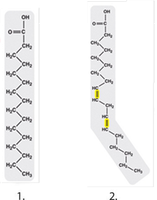
Q13. Would this pair of molecules form hydrogen bonds to one another?
Background
Topic: Hydrogen Bonding in Organic Molecules
This question tests your ability to recognize whether two molecules can form hydrogen bonds based on their structure and the presence of electronegative atoms bonded to hydrogen.
Key Terms and Concepts:
Hydrogen bond: Occurs when a hydrogen atom is covalently bonded to an electronegative atom (like O or N) and interacts with another electronegative atom.
Electronegativity: The tendency of an atom to attract electrons; O and N are highly electronegative.
Hydrophobic molecules: Molecules composed mostly of C and H are generally nonpolar and do not form hydrogen bonds.
Step-by-Step Guidance
Examine the molecular structures for the presence of O-H or N-H groups, which are necessary for hydrogen bonding.
Check if either molecule has a hydrogen atom directly bonded to an electronegative atom (O or N).
Determine if there are lone pairs on O or N that could accept a hydrogen bond.
Assess whether the molecules are mostly composed of C and H, which are nonpolar and do not participate in hydrogen bonding.
Try solving on your own before revealing the answer!
Final Answer: No
These molecules are hydrocarbons and lack O-H or N-H groups, so they cannot form hydrogen bonds with each other.
Q14. Of the three molecules shown, predict which one would be the most soluble in blood (an aqueous, water-based solution).
Background
Topic: Solubility of Biological Molecules
This question tests your understanding of how molecular structure affects solubility in water, which is important for biological function.
Key Terms and Concepts:
Solubility: The ability of a substance to dissolve in a solvent (here, water).
Hydrophilic: Molecules with polar groups (like -OH, -NH2, -COOH) are water-soluble.
Hydrophobic: Molecules with mostly nonpolar groups (like hydrocarbon chains or rings) are not water-soluble.
Step-by-Step Guidance
Examine the three molecular structures for the presence of polar functional groups (such as -OH, -NH2, -COOH).
Identify which molecule has the most polar groups, making it more likely to interact with water molecules.
Compare the hydrocarbon content of each molecule; more hydrocarbon means less solubility in water.
Consider the biological context: amino acids (like serine and phenylalanine) are generally more soluble than drugs with large hydrophobic regions.
Try solving on your own before revealing the answer!
Final Answer: Phenylalanine
Phenylalanine, an amino acid, has both polar and nonpolar regions, but its polar groups make it more soluble in blood compared to ibuprofen.
Q32. Which of the following statements about dehydration reactions is false?
Background
Topic: Dehydration Reactions in Macromolecule Synthesis
This question tests your understanding of how dehydration reactions are involved in forming biological macromolecules and what happens during these reactions.
Key Terms and Concepts:
Dehydration reaction: A chemical reaction in which two molecules are joined by removing a molecule of water.
Macromolecule synthesis: Proteins, polysaccharides, and nucleic acids are formed by dehydration reactions.
Covalent bond: The bond formed between monomers during dehydration.
Step-by-Step Guidance
Review the definition of a dehydration reaction: it joins two molecules by removing water.
Consider the role of dehydration reactions in protein and polysaccharide synthesis.
Recall that dehydration reactions produce water as a byproduct, not consume it.
Evaluate each statement for accuracy based on the above concepts.
Try solving on your own before revealing the answer!
Final Answer: They consume water as a reactant.
This statement is false. Dehydration reactions produce water as a product, not as a reactant.
Q33. In the following structure, what is the linkage between the two monosaccharide units?
Background
Topic: Glycosidic Linkages in Carbohydrates
This question tests your ability to identify the type of bond that connects two monosaccharides in a disaccharide.
Key Terms and Concepts:
Glycosidic bond: A covalent bond formed between two monosaccharides by a dehydration reaction.
Alpha () and beta () linkages: Refers to the orientation of the glycosidic bond.
Peptide bond: Not relevant for carbohydrates; this is for proteins.
Step-by-Step Guidance
Examine the structure for the bond connecting the two sugar rings.
Identify the atoms involved in the linkage (usually between C1 of one sugar and C4 of another).
Determine if the bond is an or glycosidic bond based on the orientation.
Recall that glycosidic bonds are formed by dehydration reactions.
Try solving on your own before revealing the answer!
Final Answer: $\beta$1 → 4 glycosidic bond
The bond shown is a $\beta$1 → 4 glycosidic bond, which is common in cellulose and some disaccharides.
