 Back
General Biology Study Guide: Nature of Science & Evolution
Study Guide - Smart Notes
 Tailored notes based on your materials, expanded with key definitions, examples, and context.
Q1. What is the difference between a hypothesis and a scientific theory?
Background
Topic: Nature of Science
This question tests your understanding of scientific terminology and the distinction between two foundational concepts in science: hypothesis and theory.
Key Terms:
Hypothesis: A proposed explanation for a phenomenon, which can be tested through experiments or observations.
Scientific Theory: A well-substantiated explanation of some aspect of the natural world, based on a body of evidence and repeatedly tested and confirmed.
Step-by-Step Guidance
Consider what a hypothesis is: it is often an initial, testable statement about a specific question or observation.
Think about how a scientific theory is developed: it arises after many hypotheses have been tested and supported by evidence.
Reflect on the level of evidence and acceptance in the scientific community for each term.
Try solving on your own before revealing the answer!
Final Answer:
A hypothesis is a testable statement or prediction about a specific phenomenon, while a scientific theory is a comprehensive explanation supported by a large body of evidence and repeated testing. Theories are broader and more established than hypotheses.
Q2. Arrange the following terms in the order of the scientific method: Test, Question, Observation, Prediction, Hypothesis
Background
Topic: Scientific Method
This question assesses your understanding of the logical sequence scientists use to investigate questions and phenomena.
Key Terms:
Observation: Gathering information about the natural world.
Question: Formulating a question based on observations.
Hypothesis: Proposing a possible explanation or answer.
Prediction: Making a specific forecast based on the hypothesis.
Test: Conducting experiments or observations to check the prediction.
Step-by-Step Guidance
Start by identifying which step comes first: scientists usually begin with observations.
Next, think about how observations lead to questions about what is happening.
After forming a question, a hypothesis is proposed as a possible answer.
Predictions are made based on the hypothesis.
Finally, tests are conducted to evaluate the predictions.
Try solving on your own before revealing the answer!
Final Answer:
The correct order is: Observation → Question → Hypothesis → Prediction → Test.
Q3. Which of the following is true about hypotheses?
Background
Topic: Nature of Science
This question tests your ability to identify the correct characteristics of a scientific hypothesis.
Key Terms:
Hypothesis: A testable statement that proposes a possible explanation for an observation.
Independent Variable: The variable that is manipulated in an experiment.
Dependent Variable: The variable that is measured in an experiment.
Step-by-Step Guidance
Review each answer choice and consider whether it matches the definition and purpose of a hypothesis.
Recall that a hypothesis is a potential answer to a scientific question and must be testable.
Think about whether a hypothesis must always include information about variables or experiments.
Eliminate choices that do not fit the scientific definition.
Try solving on your own before revealing the answer!
Final Answer:
d) A hypothesis is a potential answer to a question.
This is the most accurate description of a hypothesis in scientific practice.
Q4. What is the difference between inductive and deductive reasoning?
Background
Topic: Scientific Reasoning
This question tests your understanding of two fundamental approaches to reasoning in science.
Key Terms:
Inductive Reasoning: Making generalizations based on specific observations.
Deductive Reasoning: Making predictions based on general principles or theories.
Step-by-Step Guidance
Think about how inductive reasoning starts with specific data and builds up to a general conclusion.
Consider how deductive reasoning starts with a general principle and applies it to specific cases.
Reflect on examples of each type of reasoning in scientific practice.
Try solving on your own before revealing the answer!
Final Answer:
Inductive reasoning involves making generalizations from specific observations, while deductive reasoning involves applying general principles to make predictions about specific cases.
Q5. True or False: Inductive reasoning is used to develop predictions and tests from hypotheses.
Background
Topic: Scientific Reasoning
This question tests your understanding of the role of inductive reasoning in the scientific method.
Key Terms:
Inductive Reasoning: Building general concepts from specific observations.
Prediction: A specific statement about what will happen in an experiment.
Step-by-Step Guidance
Recall the definition of inductive reasoning.
Think about whether predictions are made from general concepts or from specific hypotheses.
Consider whether inductive or deductive reasoning is used to move from hypothesis to prediction.
Try solving on your own before revealing the answer!
Final Answer:
False. Deductive reasoning is used to develop predictions and tests from hypotheses, not inductive reasoning.
Q6. True or False: Inductive reasoning creates a general concept or hypothesis from many different types of evidence and observations.
Background
Topic: Scientific Reasoning
This question tests your understanding of how inductive reasoning is used in science.
Key Terms:
Inductive Reasoning: Making generalizations from specific evidence.
Hypothesis: A general concept or explanation based on evidence.
Step-by-Step Guidance
Recall the definition of inductive reasoning.
Think about whether inductive reasoning is used to create general concepts from specific evidence.
Consider examples where scientists use observations to form hypotheses.
Try solving on your own before revealing the answer!
Final Answer:
True. Inductive reasoning is used to create general concepts or hypotheses from multiple observations and evidence.
Q7. What is the main difference between an observational test and an experimental test?
Background
Topic: Types of Scientific Tests
This question tests your understanding of how scientists investigate questions using different methods.
Key Terms:
Observational Test: Collecting data without manipulating variables.
Experimental Test: Manipulating variables to observe effects.
Step-by-Step Guidance
Think about whether variables are manipulated in each type of test.
Consider how observational tests rely on natural variation, while experimental tests involve controlled changes.
Reflect on the strengths and limitations of each approach.
Try solving on your own before revealing the answer!
Final Answer:
An observational test involves collecting data without manipulating variables, while an experimental test involves actively changing variables to observe their effects.
Q8. Is an experimental test or an observational test better at determining causation?
Background
Topic: Types of Scientific Tests
This question tests your understanding of how causation is established in science.
Key Terms:
Causation: The relationship where one event causes another.
Experimental Test: Manipulating variables to determine cause and effect.
Observational Test: Observing natural variation without manipulation.
Step-by-Step Guidance
Recall that causation requires evidence that one variable directly affects another.
Think about which type of test allows for manipulation and control of variables.
Consider the limitations of observational tests in establishing causation.
Try solving on your own before revealing the answer!
Final Answer:
Experimental tests are better at determining causation because they involve manipulating variables and controlling conditions to observe direct effects.
Q9. Ice cream consumption is strongly correlated with the number of drowning deaths by month. Does ice cream cause people to drown more frequently? What is one potential confounding factor that should be controlled for in this analysis?
Background
Topic: Correlation vs. Causation
This question tests your understanding of confounding factors and the difference between correlation and causation.
Key Terms:
Correlation: A relationship between two variables.
Causation: One variable directly causes a change in another.
Confounding Factor: An outside variable that affects both variables being studied.
Step-by-Step Guidance
Consider whether correlation implies causation in this scenario.
Think about other factors that could influence both ice cream consumption and drowning deaths.
Identify a variable that could be responsible for the observed correlation.
Try solving on your own before revealing the answer!
Final Answer:
No, ice cream does not cause people to drown more frequently. A potential confounding factor is temperature or season; warmer months lead to more swimming and more ice cream consumption.
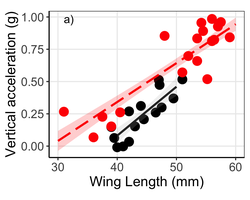
Q10. In the following figure, what are the independent and dependent variables? Note: Red circles show data from birds experimentally exposed to predation risk. Black circles show data from control birds that were not exposed to any additional predation risk.
Background
Topic: Experimental Design
This question tests your ability to interpret scientific graphs and identify variables in an experiment.
Key Terms:
Independent Variable: The variable that is manipulated or categorized (e.g., wing length).
Dependent Variable: The variable that is measured (e.g., vertical acceleration).
Step-by-Step Guidance
Examine the axes of the graph: the x-axis typically represents the independent variable, and the y-axis represents the dependent variable.
Identify what is being manipulated or categorized (wing length) and what is being measured (vertical acceleration).
Consider the experimental groups: birds exposed to predation risk (red) and control birds (black).
Try solving on your own before revealing the answer!
Final Answer:
The independent variable is wing length (mm), and the dependent variable is vertical acceleration (g).
The graph shows how vertical acceleration changes with wing length for birds under different experimental conditions.
