 Back
General Biology Study Guide: The Chemical Context of Life
Study Guide - Smart Notes
 Tailored notes based on your materials, expanded with key definitions, examples, and context.
Q1. What does it mean that biology is multidisciplinary?
Background
Topic: Interdisciplinary Nature of Biology
This question is testing your understanding of how biology integrates concepts from other scientific fields such as chemistry, physics, and mathematics.
Key Terms:
Multidisciplinary: Involving multiple academic disciplines.
Biology: The study of living organisms.
Step-by-Step Guidance
Consider how biological processes often require knowledge from chemistry (e.g., molecular interactions), physics (e.g., energy transfer), and math (e.g., statistics).
Think about examples where biology overlaps with other fields, such as biochemistry or biophysics.
Reflect on why understanding these connections is important for studying life.
Try solving on your own before revealing the answer!
Final Answer:
Biology is multidisciplinary because it draws on principles and methods from chemistry, physics, mathematics, and other sciences to understand living systems. For example, understanding cellular respiration requires knowledge of chemical reactions and energy transfer.
Q2. Define and apply the terms: matter, elements, molecules, compounds.
Background
Topic: Basic Chemistry Concepts in Biology
This question is testing your ability to define fundamental chemical terms and apply them to biological examples.
Key Terms:
Matter: Anything that has mass and takes up space.
Element: A substance that cannot be broken down into simpler substances by chemical means.
Molecule: Two or more atoms bonded together.
Compound: A substance made of two or more different elements bonded together.
Step-by-Step Guidance
Write a clear definition for each term.
Think of a biological example for each term (e.g., water as a compound).
Apply the definitions to real-life biological scenarios.
Try solving on your own before revealing the answer!
Final Answer:
Matter: Anything that occupies space and has mass (e.g., cells).
Element: Pure substance consisting of one type of atom (e.g., oxygen).
Molecule: Two or more atoms bonded together (e.g., O2).
Compound: Substance made of two or more elements (e.g., H2O).
Q3. Identify the major elements that make up life and trace elements.
Background
Topic: Elements Essential for Life
This question is testing your knowledge of which elements are most abundant in living organisms and which are needed in smaller amounts (trace elements).
Key Terms:
Major elements: Elements that make up most of living matter (e.g., carbon, hydrogen, oxygen, nitrogen).
Trace elements: Elements required in small amounts (e.g., iron, iodine).
Step-by-Step Guidance
List the four major elements found in living organisms.
Identify examples of trace elements and their biological roles.
Consider why trace elements are important despite their low abundance.
Try solving on your own before revealing the answer!
Final Answer:
Major elements: Carbon (C), Hydrogen (H), Oxygen (O), Nitrogen (N).
Trace elements: Iron (Fe), Iodine (I), Zinc (Zn). Trace elements are essential for processes like enzyme function and hormone production.
Q4. Identify subatomic particles of an atom and their properties.
Background
Topic: Atomic Structure
This question is testing your understanding of the basic components of atoms and their characteristics.
Key Terms:
Proton: Positively charged particle in the nucleus.
Neutron: Neutral particle in the nucleus.
Electron: Negatively charged particle orbiting the nucleus.
Step-by-Step Guidance
List the three main subatomic particles.
Describe their charge and location within the atom.
Explain how these particles determine atomic properties.
Try solving on your own before revealing the answer!
Final Answer:
Protons: Positive charge, located in the nucleus.
Neutrons: No charge, located in the nucleus.
Electrons: Negative charge, orbit the nucleus.
Q5. What is the difference between atomic mass and atomic number? What is a Dalton?
Background
Topic: Atomic Properties
This question is testing your understanding of how atoms are characterized and measured.
Key Terms:
Atomic number: Number of protons in an atom.
Atomic mass: Sum of protons and neutrons.
Dalton: Unit of atomic mass (also called atomic mass unit, amu).
Step-by-Step Guidance
Define atomic number and atomic mass.
Explain how to calculate atomic mass using protons and neutrons.
Describe what a Dalton is and why it is used.
Try solving on your own before revealing the answer!
Final Answer:
Atomic number: Number of protons in the nucleus.
Atomic mass: Total number of protons and neutrons.
Dalton: Standard unit for measuring atomic mass, approximately equal to the mass of one proton or neutron.
Q6. What are isotopes, cations, and anions?
Background
Topic: Variations in Atomic Structure
This question is testing your understanding of how atoms can differ and how ions are formed.
Key Terms:
Isotope: Atoms of the same element with different numbers of neutrons.
Cation: Positively charged ion.
Anion: Negatively charged ion.
Step-by-Step Guidance
Define isotope and give an example.
Explain how cations and anions are formed.
Describe the importance of ions in biological systems.
Try solving on your own before revealing the answer!
Final Answer:
Isotope: Atoms with the same number of protons but different numbers of neutrons (e.g., Carbon-12 and Carbon-14).
Cation: Ion with a positive charge (e.g., Na+).
Anion: Ion with a negative charge (e.g., Cl-).
Q7. How do valence electrons determine the chemical properties of an element?
Background
Topic: Electron Configuration and Reactivity
This question is testing your understanding of how the outermost electrons influence chemical behavior.
Key Terms:
Valence electrons: Electrons in the outermost shell.
Chemical properties: How an element reacts with others.
Step-by-Step Guidance
Identify the location of valence electrons in an atom.
Explain how the number of valence electrons affects bonding and reactivity.
Consider examples of elements with different numbers of valence electrons.
Try solving on your own before revealing the answer!
Final Answer:
Valence electrons are found in the outermost shell and determine how an element interacts with others. Elements with full valence shells are inert, while those with incomplete shells are reactive.
Q8. What is electronegativity and what makes an atom inert?
Background
Topic: Chemical Bonding and Reactivity
This question is testing your understanding of how atoms attract electrons and why some atoms do not react.
Key Terms:
Electronegativity: Ability of an atom to attract electrons.
Inert: Not reactive, usually due to a full valence shell.
Step-by-Step Guidance
Define electronegativity and explain its role in chemical bonding.
Describe what makes an atom inert (e.g., noble gases).
Compare reactive and inert elements based on their electron configuration.
Try solving on your own before revealing the answer!
Final Answer:
Electronegativity is the tendency of an atom to attract electrons in a bond. Atoms are inert when their valence shell is full, making them stable and unreactive (e.g., helium, neon).
Q9. Describe covalent, ionic, and hydrogen bonds. What is the difference between polar and non-polar bonds?
Background
Topic: Types of Chemical Bonds
This question is testing your understanding of how atoms bond and the differences between bond types.
Key Terms:
Covalent bond: Sharing of electrons between atoms.
Ionic bond: Transfer of electrons from one atom to another.
Hydrogen bond: Attraction between a hydrogen atom and an electronegative atom.
Polar bond: Unequal sharing of electrons.
Non-polar bond: Equal sharing of electrons.
Step-by-Step Guidance
Define each type of bond and give examples.
Explain how electron sharing or transfer creates these bonds.
Describe the difference between polar and non-polar covalent bonds.
Try solving on your own before revealing the answer!
Final Answer:
Covalent bonds involve sharing electrons (e.g., H2O). Ionic bonds involve transfer of electrons (e.g., NaCl). Hydrogen bonds are weak attractions (e.g., between water molecules). Polar bonds have unequal sharing (e.g., water), non-polar bonds have equal sharing (e.g., O2).
Q10. What are the emergent properties of water and why does water have them?
Background
Topic: Properties of Water
This question is testing your understanding of how water's structure leads to unique properties important for life.
Key Terms:
Emergent properties: Characteristics that arise from the arrangement and interaction of parts.
Hydrogen bonding: Responsible for water's properties.
Step-by-Step Guidance
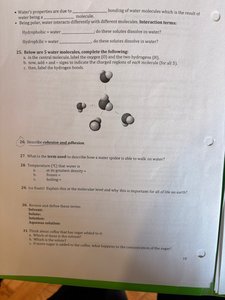
List the main emergent properties of water (e.g., cohesion, adhesion, high specific heat).
Explain how hydrogen bonding leads to these properties.
Consider examples of how these properties benefit living organisms.
Try solving on your own before revealing the answer!
Final Answer:
Water's emergent properties include cohesion, adhesion, high specific heat, evaporative cooling, and ice floating. These arise from hydrogen bonding between water molecules.
Q11. Apply the concepts of cohesion and adhesion.
Background
Topic: Water's Interactions
This question is testing your ability to distinguish between cohesion (water molecules sticking to each other) and adhesion (water molecules sticking to other surfaces).
Key Terms:
Cohesion: Attraction between like molecules.
Adhesion: Attraction between different molecules.
Step-by-Step Guidance
Define cohesion and adhesion.
Think of examples in nature (e.g., water transport in plants).
Explain how these properties are important for biological processes.
Try solving on your own before revealing the answer!
Final Answer:
Cohesion allows water molecules to stick together, important for surface tension. Adhesion helps water stick to plant cell walls, aiding in water transport.
Q12. What is surface tension and what causes it?
Background
Topic: Water's Physical Properties
This question is testing your understanding of how water molecules interact at the surface.
Key Terms:
Surface tension: The invisible film at the surface of water.
Hydrogen bonding: Causes surface tension.
Step-by-Step Guidance
Define surface tension.
Explain how hydrogen bonds create a strong surface layer.
Consider examples (e.g., insects walking on water).
Try solving on your own before revealing the answer!
Final Answer:
Surface tension is the result of hydrogen bonds between water molecules at the surface, creating a strong layer that can support light objects.
Q13. Why does ice float and what does this allow for?
Background
Topic: Water's Density and Life
This question is testing your understanding of the molecular structure of ice and its ecological importance.
Key Terms:
Ice: Solid form of water.
Density: Mass per unit volume.
Step-by-Step Guidance
Explain how hydrogen bonds arrange water molecules in ice.
Describe why ice is less dense than liquid water.
Consider the ecological consequences of ice floating.
Try solving on your own before revealing the answer!
Final Answer:
Ice floats because its molecules are arranged in a lattice, making it less dense than liquid water. This allows aquatic life to survive under ice in winter.
Q14. What is a hydration shell and why does it occur?
Background
Topic: Water as a Solvent
This question is testing your understanding of how water interacts with ions and polar molecules.
Key Terms:
Hydration shell: Layer of water molecules surrounding a dissolved ion.
Solvent: Substance that dissolves other substances.
Step-by-Step Guidance
Define hydration shell.
Explain how water's polarity allows it to surround ions.
Consider examples (e.g., salt dissolving in water).
Try solving on your own before revealing the answer!
Final Answer:
A hydration shell forms when water molecules surround ions or polar molecules, stabilizing them in solution due to water's polarity.
Q15. Hydrophobic vs. hydrophilic – what do these terms mean and give examples of each.
Background
Topic: Water Interactions
This question is testing your understanding of how substances interact with water.
Key Terms:
Hydrophobic: Repels water.
Hydrophilic: Attracts water.
Step-by-Step Guidance
Define hydrophobic and hydrophilic.
Give examples of each (e.g., oil vs. salt).
Explain why these properties are important in biology.
Try solving on your own before revealing the answer!
Final Answer:
Hydrophobic substances repel water (e.g., oils), while hydrophilic substances attract water (e.g., salts, sugars).
Q16. pH and the pH scale; what differences in pH mean in terms of H+ concentration.
Background
Topic: Acids, Bases, and pH
This question is testing your understanding of how pH relates to hydrogen ion concentration.
Key Terms:
pH: Measure of hydrogen ion concentration.
Acid: Increases H+ concentration.
Base: Decreases H+ concentration.
Step-by-Step Guidance
Define pH and explain the pH scale (0-14).
Describe how changes in pH reflect changes in H+ concentration.
Consider examples of acidic and basic solutions.
Try solving on your own before revealing the answer!
Final Answer:
Lower pH means higher H+ concentration (acidic), higher pH means lower H+ concentration (basic).
Q17. What are buffers and why are they important?
Background
Topic: Regulation of pH
This question is testing your understanding of how organisms maintain stable internal conditions.
Key Terms:
Buffer: Substance that minimizes changes in pH.
Step-by-Step Guidance
Define buffer and explain its function.
Describe how buffers work in biological systems.
Consider examples (e.g., blood buffer system).
Try solving on your own before revealing the answer!
Final Answer:
Buffers help maintain stable pH by absorbing excess H+ or OH-. They are crucial for homeostasis in living organisms.
