Back
General Biology Study Notes: Chemistry, Biomolecules, and Cell Structure
Study Guide - Smart Notes
 Tailored notes based on your materials, expanded with key definitions, examples, and context.
Introduction to Biology
Defining Life
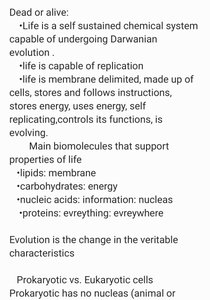
Life is a self-sustained chemical system capable of undergoing Darwinian evolution. - Replication: Life is capable of replication. - Membrane Delimitation: Life is membrane-delimited, made up of cells, stores and follows instructions, stores energy, uses energy, self-replicates, controls its functions, and evolves.
Evolution
Evolution is the change in the veritable characteristics of organisms over time.
Cell Components
Prokaryotic vs. Eukaryotic Cells
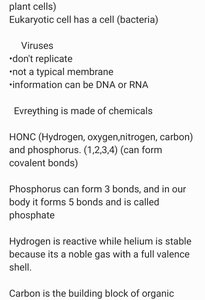
Cells are the basic units of life, classified as prokaryotic or eukaryotic. - Prokaryotic cells: Lack a nucleus (e.g., bacteria). - Eukaryotic cells: Have a nucleus (e.g., animal and plant cells).
Viruses
Viruses are not considered living because: - They do not replicate independently. - They lack a typical membrane. - Their genetic information can be DNA or RNA.
Chemistry of Life
Elements and Chemical Bonds
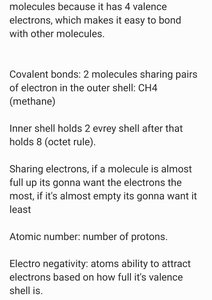
Everything is made of chemicals. - HONC: Hydrogen, Oxygen, Nitrogen, Carbon are essential elements. - Phosphorus: Can form 3 bonds, but in the body forms 5 bonds (phosphate). - Hydrogen: Reactive due to incomplete valence shell; helium is stable due to a full valence shell. - Carbon: Building block of organic molecules, forms 4 bonds due to 4 valence electrons.
Covalent Bonds
Covalent bonds involve sharing pairs of electrons in the outer shell. - Example: CH4 (methane) - Octet Rule: Inner shell holds 2 electrons; outer shell holds 8.
Atomic Structure
- Atomic number: Number of protons in an atom. - Electronegativity: Ability of atoms to attract electrons based on valence shell fullness.
Types of Chemical Bonds
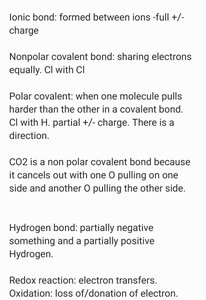
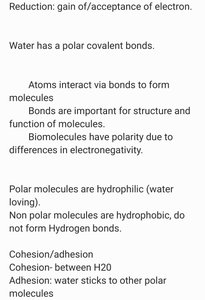
- Ionic bond: Formed between ions with full positive/negative charges. - Nonpolar covalent bond: Electrons shared equally (e.g., Cl with Cl). - Polar covalent bond: One atom pulls harder (e.g., Cl with H). - Hydrogen bond: Partially negative atom interacts with partially positive hydrogen. - Redox reaction: Electron transfers; oxidation is loss/donation, reduction is gain/acceptance.
Water
Properties of Water
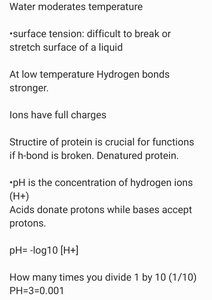
Water has polar covalent bonds. - Cohesion: Water molecules stick to each other. - Adhesion: Water sticks to other polar molecules. - Surface tension: Difficult to break/stretch surface of a liquid. - Temperature moderation: Water moderates temperature due to hydrogen bonding.
Polarity and Hydrophilicity
- Polar molecules: Hydrophilic (water-loving). - Nonpolar molecules: Hydrophobic, do not form hydrogen bonds.
Biomolecules
Main Biomolecules Supporting Life
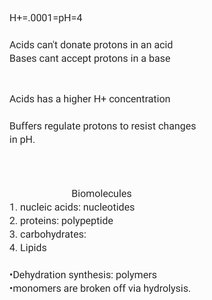
Biomolecules are essential for life and include: - Lipids: Membrane structure. - Carbohydrates: Energy storage. - Nucleic acids: Information storage (nucleus). - Proteins: Diverse functions everywhere.
Monomers and Polymers
- Dehydration synthesis: Forms polymers from monomers. - Hydrolysis: Breaks polymers into monomers.
Functional Groups
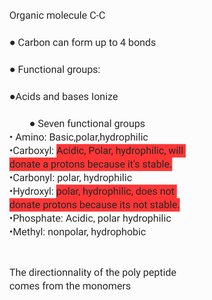
Organic molecules contain functional groups that determine their properties. - Amino: Basic, polar, hydrophilic. - Carboxyl: Acidic, polar, hydrophilic, donates protons. - Carbonyl: Polar, hydrophilic. - Hydroxyl: Polar, hydrophilic, does not donate protons. - Phosphate: Acidic, polar, hydrophilic. - Methyl: Nonpolar, hydrophobic.
Protein Structure
Levels of Protein Structure
- Levels of Protein Structure (expanded) 🧬
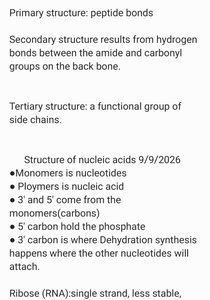
Primary structure: peptide bonds linking amino acids (the specific amino acid sequence).
Secondary structure: hydrogen bonds between amino and carbonyl groups along the backbone.
Tertiary structure: interactions among side-chain functional groups (R groups). These interactions depend on the properties of functional groups found in organic molecules:
Polar / hydrophilic groups (ex: amino, carboxyl, carbonyl, hydroxyl, phosphate) can participate in interactions like hydrogen bonding.
Nonpolar / hydrophobic groups (ex: methyl) tend to avoid water and can drive folding as parts of a protein “hide” from water.
Nucleic Acids
Structure of Nucleic Acids
- Monomers: Nucleotides. - Polymers: Nucleic acids. - 3' and 5' carbons: Indicate directionality; 5' holds phosphate, 3' is site of dehydration synthesis.
DNA vs. RNA
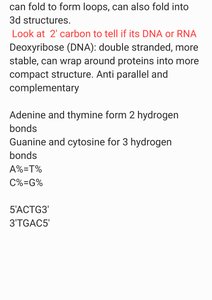
- Ribose (RNA): Single strand, less stable, can fold into loops and 3D structures. - Deoxyribose (DNA): Double strand, more stable, anti-parallel and complementary. - 2' carbon: Used to distinguish DNA from RNA.
Base Pairing
- Adenine (A) and Thymine (T): Form 2 hydrogen bonds. - Guanine (G) and Cytosine (C): Form 3 hydrogen bonds. - Base pairing: A=T, C≡G.
Acids, Bases, and pH
pH and Proton Concentration
- pH: Concentration of hydrogen ions (H+). - Acids: Donate protons, have higher H+ concentration. - Bases: Accept protons. - Buffers: Regulate protons to resist changes in pH.
Summary Table: Types of Chemical Bonds
Bond Type | Description | Example |
|---|---|---|
Ionic | Formed between ions with full +/- charge | Na Cl |
Nonpolar Covalent | Electrons shared equally | Cl2 |
Polar Covalent | Electrons shared unequally | H2O |
Hydrogen Bond | Partially negative atom interacts with partially positive H | Between water molecules |
Summary Table: Biomolecules and Their Functions
Biomolecule | Main Function |
|---|---|
Lipids | Membrane structure |
Carbohydrates | Energy storage |
Nucleic Acids | Information storage |
Proteins | Diverse functions |
Summary Table: Functional Groups