 Back
General Biology Study Notes: Foundations, Chemistry, Cells, and Biomolecules
Study Guide - Smart Notes
 Tailored notes based on your materials, expanded with key definitions, examples, and context.
Introduction to Biology
Characteristics of Life
Biology is the scientific study of life, encompassing a wide range of living organisms and their interactions. All living things share certain characteristics that distinguish them from non-living matter.
Order: Living organisms exhibit complex organization and structure.
Regulation: Homeostasis maintains internal conditions within certain limits.
Growth and Development: Organisms grow and develop according to inherited instructions.
Energy Processing: Organisms obtain and use energy for metabolic activities.
Response to Environment: Living things respond to stimuli from their surroundings.
Reproduction: Organisms reproduce, passing genetic material to offspring.
Evolutionary Adaptation: Populations evolve over generations through natural selection.
Levels of Biological Organization
Biological systems are organized hierarchically, from atoms to the biosphere.
Atoms & Molecules → Organelles → Cells → Tissues → Organs → Organisms → Populations → Communities → Ecosystems → Biosphere
Domains of Life
All life is classified into three domains based on cellular structure and genetics.
Bacteria: Prokaryotic, unicellular organisms.
Archaea: Prokaryotic, often found in extreme environments.
Eukarya: Eukaryotic, includes protists, fungi, plants, and animals.
Chemical Context of Life
Elements and Compounds
Life is composed primarily of a few key elements, with compounds formed by their combinations.
Elements: Substances that cannot be broken down by chemical means (e.g., C, H, O, N).
Compounds: Substances formed by two or more elements in fixed ratios.
Atoms and Atomic Structure
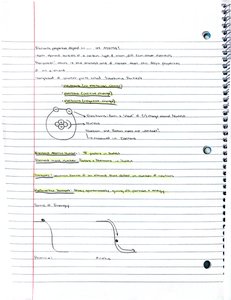
Atoms are the basic units of matter, consisting of protons, neutrons, and electrons.
Protons: Positively charged particles in the nucleus.
Neutrons: Neutral particles in the nucleus.
Electrons: Negatively charged particles orbiting the nucleus.
Isotopes
Isotopes are variants of elements with different numbers of neutrons.
Example: Carbon-12, Carbon-13, Carbon-14.
Electron Configuration and Chemical Bonds
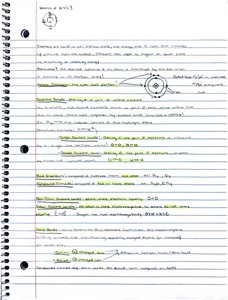
Electron arrangement determines how atoms interact and form bonds.
Covalent Bonds: Atoms share electrons.
Ionic Bonds: Atoms transfer electrons, forming charged ions.
Hydrogen Bonds: Weak attractions between partially charged atoms.
Properties of Water
Water is essential for life due to its unique chemical properties.
Cohesion: Water molecules stick together.
Adhesion: Water molecules stick to other substances.
High Specific Heat: Water resists temperature changes.
Solvent Properties: Water dissolves many substances.
Carbon and Molecular Diversity of Life
Carbon Chemistry
Carbon atoms form the backbone of biological molecules due to their versatility in bonding.
Four Valence Electrons: Allows formation of up to four covalent bonds.
Hydrocarbons: Molecules consisting only of carbon and hydrogen.
Functional Groups
Functional groups are specific groups of atoms that confer distinct properties to organic molecules.
Hydroxyl (-OH): Alcohols, increases solubility.
Carbonyl (C=O): Found in ketones and aldehydes.
Carboxyl (-COOH): Acids, donates H+.
Amino (-NH2): Bases, accepts H+.
Sulfhydryl (-SH): Stabilizes protein structure.
Phosphate (-PO4): Energy transfer (ATP).
Methyl (-CH3): Affects gene expression.
Biomolecules
Macromolecules
Biological macromolecules are large, complex molecules essential for life.
Carbohydrates: Energy storage and structural support.
Lipids: Energy storage, membrane structure, signaling.
Proteins: Enzymes, structural support, transport, signaling.
Nucleic Acids: Information storage and transfer (DNA, RNA).
ATP (Adenosine Triphosphate)
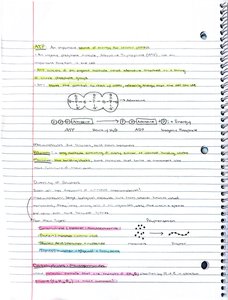
ATP is the primary energy carrier in cells, enabling metabolic processes.
Structure: Adenine, ribose, three phosphate groups.
Function: Releases energy when phosphate bonds are broken.
Cell Structure and Function
Prokaryotic vs. Eukaryotic Cells
Cells are classified as prokaryotic or eukaryotic based on their internal structure.
Prokaryotic Cells: Lack a nucleus and membrane-bound organelles; found in Bacteria and Archaea.
Eukaryotic Cells: Have a nucleus and membrane-bound organelles; found in Eukarya.

Cell Organelles
Eukaryotic cells contain specialized organelles that perform distinct functions.
Nucleus: Contains genetic material (DNA).
Mitochondria: Site of cellular respiration and energy production.
Chloroplasts: Site of photosynthesis in plants.
Endoplasmic Reticulum: Protein and lipid synthesis.
Golgi Apparatus: Modifies, sorts, and packages proteins.
Lysosomes: Digestion and waste removal.
Ribosomes: Protein synthesis.
Cell Membrane Structure
The cell membrane is a phospholipid bilayer with embedded proteins, controlling the movement of substances in and out of the cell.
Phospholipids: Form the basic structure.
Proteins: Transport, signaling, and structural support.
Carbohydrates: Cell recognition and signaling.
Viruses
Structure and Function
Viruses are non-cellular entities that infect living cells and replicate using host machinery.
Bacteriophage: Virus that infects bacteria.
Enveloped Virus: Virus with a lipid envelope surrounding the capsid.

Key Terms
Homeostasis: Maintenance of stable internal conditions.
Metabolism: All chemical reactions in an organism.
Genome: Complete set of genetic material.
Evolution: Change in populations over time.
Additional info:
Some diagrams and tables were recreated for clarity and completeness.
Scientific context was expanded for self-contained explanations.
