 Back
General Biology Study Notes: Foundations of Life, Genetics, Evolution, and Phylogeny
Study Guide - Smart Notes
 Tailored notes based on your materials, expanded with key definitions, examples, and context.
Biology: The Study of Life
Fundamental Characteristics of Life
Biology seeks to unify our understanding of the diversity of life by identifying the fundamental characteristics shared by all organisms. These characteristics are:
Cells: All life forms are composed of membrane-bound units called cells, which regulate the passage of materials between the interior and exterior environments.
Replication: Organisms replicate themselves, ensuring the continuity of life.
Information: Organisms process information encoded in genes and respond to environmental signals to maintain homeostasis.
Energy: All organisms must acquire and use energy to sustain life processes.
Evolution: Populations of organisms are products of evolution and continue to evolve over time.
Cell Theory
The cell theory states that all organisms are made of cells and all cells come from preexisting cells. This principle is foundational to understanding biological structure and function.
Central Dogma of Molecular Biology
The central dogma describes the flow of genetic information:
DNA is a double-helix structure composed of four building blocks: adenine (A), thymine (T), cytosine (C), and guanine (G).
DNA codes for RNA, and RNA codes for proteins.
Mendelian Genetics and Inheritance
Traits and Mendel's Experiments
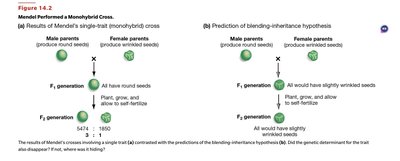
A trait is any observable characteristic of an individual, ranging from physical features to molecular properties. Mendel investigated the patterns of trait transmission from parents to offspring using garden peas.
Blending Inheritance Hypothesis: Proposed that offspring traits are intermediate between parents.
Inheritance of Acquired Characters: Suggested traits modified through use are passed to offspring.
Particulate Inheritance: Mendel's experiments supported the idea that hereditary determinants maintain their integrity across generations.
Monohybrid Cross and Segregation Principle
Mendel's monohybrid cross demonstrated that traits do not blend but segregate according to specific ratios.
Principle of Segregation: Two members of each gene pair segregate into different gamete cells during egg and sperm formation.
Dominant and Recessive Alleles: Dominant alleles mask the effect of recessive alleles in heterozygous individuals.
Punnett Square: Used to predict the outcome of genetic crosses.
Key Terms in Mendelian Genetics
Allele: Variant form of a gene.
Genotype: Combination of alleles in an individual.
Phenotype: Observable characteristics resulting from genotype.
Homozygous: Two identical alleles for a gene (e.g., RR or rr).
Heterozygous: Two different alleles for a gene (e.g., Rr).
Evolution by Natural Selection
Historical Perspectives
Early theories of evolution included typological thinking (Plato), scale of nature (Aristotle), and change through time (Lamarck). Darwin and Wallace introduced the concept of evolution by natural selection, emphasizing population thinking and variation among individuals.
Darwin's Four Postulates
Variation exists among individuals in a population.
Some trait differences are heritable.
Survival and reproductive success are highly variable.
The subset of individuals that survive and reproduce is not random.
Fitness and Adaptation
Biological Fitness: Ability to produce surviving, fertile offspring relative to others.
Adaptation: Heritable trait that increases fitness in a particular environment.
Selection: Differential reproduction as a result of heritable variation.
Population Genetics and Hardy-Weinberg Equilibrium
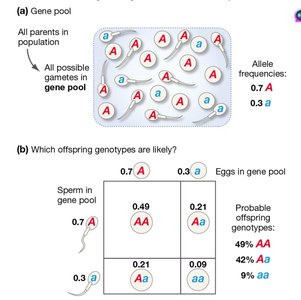
Gene Pool and Allele Frequencies
The gene pool is the collection of all alleles from all gametes produced in a generation. Hardy-Weinberg equilibrium describes the expected frequencies of genotypes in a population under certain assumptions.
Allele Frequencies: Represented as p (dominant) and q (recessive).
Genotype Frequencies: (homozygous dominant), (heterozygous), (homozygous recessive).
Hardy-Weinberg Assumptions
Random mating
No natural selection
No genetic drift
No gene flow
No mutation
If these conditions are met, allele frequencies do not change over time, indicating no evolution.
Speciation and Evolutionary Processes
Species Concepts
Biological Species Concept: Based on reproductive isolation.
Morphospecies Concept: Based on morphological differences.
Phylogenetic Species Concept: Based on evolutionary history and monophyletic groups.
Mechanisms of Speciation
Allopatric Speciation: Begins with geographic isolation (dispersal or vicariance).
Sympatric Speciation: Occurs within the same geographic area, often due to disruptive selection or polyploidy.
Outcomes of Secondary Contact
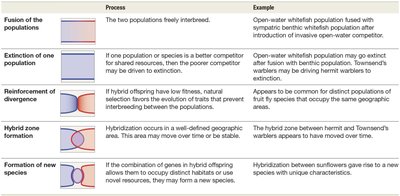
When populations that have diverged come into contact again, several outcomes are possible:
Process | Example |
|---|---|
Fusion of the populations | Open-water whitefish population fused with sympatric benthic whitefish population after introduction of invasive open-water competitor. |
Extinction of one population | Open-water whitefish population may go extinct after fusion with benthic population. Townsend's warblers may be driving hermit warblers to extinction. |
Reinforcement of divergence | Appears to be common for distinct populations of fly species that occupy the same geographic area. |
Hybrid zone formation | The hybrid zone between hermit and Townsend's warblers appears to have moved over time. |
Formation of new species | Hybridization between sunflowers gives rise to a new species with unique characteristics. |
Phylogenies and the History of Life
Phylogenetic Trees
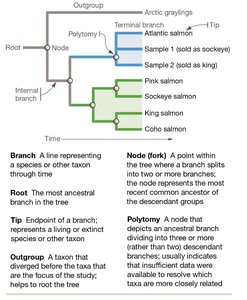
A phylogeny is the branching evolutionary history of species or other groups of organisms. Phylogenetic trees are diagrams that represent these relationships.
Branch: Represents a species or taxon through time.
Root: The most ancestral branch in the tree.
Tip: Endpoint of a branch, representing a living or extinct species.
Node (fork): Point where a branch splits into two or more branches, representing the most recent common ancestor.
Polytomy: Depicts an ancestral branch dividing into three or more descendant branches.
Outgroup: A taxon that diverged before the taxa that are the focus of the tree.
Fossil Record and Dating Methods
Fossil Record: Total collection of fossils found throughout the world.
Radiometric Dating: Uses half-lives of radioactive elements to date fossils.
Stratigraphic Dating: Establishes timelines based on rock layers.
Molecular Clock: Uses rates of neutral mutations to estimate divergence times.
Adaptive Radiation and Extinction
Adaptive Radiation: Rapid production of many descendant species from a single lineage, each adapted to different ecological niches.
Mass Extinction: Rapid extinction of a large number of species.
Background Extinction: Lower, average rate of extinction when mass extinction is not occurring.
Major Events in Earth's History
Earth formed: 4.6 billion years ago
Life first appeared: 3.5 billion years ago
Eukaryotic life: 2 billion years ago
Complex multicellular life: 600 million years ago
Vertebrates: 500 million years ago
First land plants: Paleozoic era
Dominant land plants, insects, reptiles: Paleozoic era
Dinosaurs, mammals: Mesozoic era
Primates, hominids, Homo sapiens: Cenozoic era
Additional info: These notes expand on brief points from the original materials, providing definitions, examples, and context for key concepts in general biology. The included images directly reinforce explanations of Mendelian genetics, Hardy-Weinberg equilibrium, speciation outcomes, and phylogenetic tree structure.
