 Back
General Biology Study Notes: Introduction to Biology and the Scientific Method
Study Guide - Smart Notes
 Tailored notes based on your materials, expanded with key definitions, examples, and context.
Biology: The Study of Life
What is Biology?
Biology is the scientific study of life and living organisms. It encompasses a wide range of topics, from the molecular mechanisms within cells to the interactions of organisms with their environment. The field seeks to understand the fundamental characteristics that define living things and the processes that sustain life.
Living things are characterized by five main features: cellular organization, replication/reproduction, information processing, energy acquisition and use, and evolution.
Cell: The basic unit of life, bounded by a plasma membrane and containing concentrated chemicals in an aqueous solution.
Replication/Reproduction: All living things reproduce, passing on genetic information to their offspring.
Information: Living organisms store and process information, primarily in the form of DNA.
Energy: Organisms acquire and use energy to maintain cellular functions.
Evolution: Populations of organisms change over time, leading to diversity and adaptation.
Cell Theory
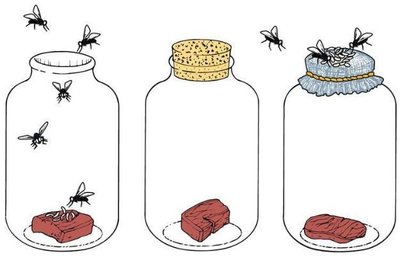
The cell theory is a fundamental concept in biology, stating that all living organisms are composed of cells and that all cells arise from preexisting cells. This theory was supported by experiments such as those conducted by Louis Pasteur, which disproved spontaneous generation.
History: Early microscopes allowed scientists like Hooke and Leeuwenhoek to observe cells and unicellular organisms.
Pasteur's Experiment: Demonstrated that new cells do not spontaneously arise in sterilized broth unless exposed to preexisting cells.
The Scientific Method
Nature of Science
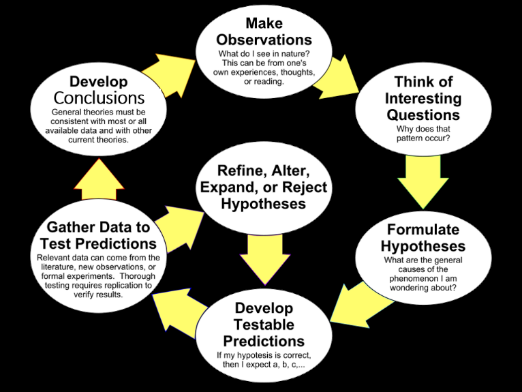
Science is a systematic approach to understanding the natural world. Scientific knowledge is always evolving, and new evidence can lead to changes in previously accepted ideas. The scientific method is a cyclical process involving observation, hypothesis formation, prediction, testing, and analysis.
Hypothesis: A tentative explanation for an observation, must be testable and falsifiable.
Theory: A well-supported explanation that unifies results from many experiments and hypotheses.
Law: A statement of repeated observations, often mathematical, without an explanation.
Steps of the Scientific Method
The scientific method involves several key steps:
Observation: Noticing phenomena or patterns in nature.
Question: Asking questions about the observations.
Hypothesis: Proposing a testable explanation.
Prediction: Stating what will happen if the hypothesis is correct.
Testing: Conducting experiments to test the prediction.
Analysis/Conclusion: Interpreting results and modifying the hypothesis if necessary.
Experimental Design
Strong experimental design is crucial for reliable scientific results. Key elements include control groups, randomization, and the elimination of confounding variables.
Control Group: A group that does not receive the treatment, used for comparison.
Placebo: A substance with no effect, used to control for psychological effects.
Blind/Double-Blind Experiments: Subjects and/or experimenters do not know which group receives the treatment, reducing bias.
Confounding Variables: Factors other than the independent variable that may affect the outcome.
Sample Size: Larger sample sizes increase confidence in results.
Statistics: Used to determine the significance of results.
Characteristics of Life
Defining Life
All living things share certain characteristics that distinguish them from non-living matter:
Cellular Organization: All living things are composed of one or more cells.
Replication/Reproduction: Living things reproduce, ensuring the continuation of their species.
Information Processing: Organisms store and process genetic information.
Energy Acquisition and Use: Living things obtain and use energy for growth and maintenance.
Evolution: Populations evolve over time, adapting to their environment.
Information: Chromosome Theory and Central Dogma
Chromosome Theory of Inheritance
The chromosome theory of inheritance states that genes are located on chromosomes, which are composed of DNA and proteins. DNA is the hereditary material, and genes are segments of DNA that code for cell products.
Gregor Mendel: Predicted the existence of genes.
Walter Sutton & Theodor Boveri: Demonstrated that hereditary information is encoded in chromosomes.
Watson & Crick: Identified DNA as the genetic material.
The Central Dogma of Biology
The central dogma describes the flow of genetic information within a biological system:
Replication: DNA is copied by DNA polymerase for cell division.
Transcription: Information is transferred from DNA to RNA by RNA polymerase.
Translation: Ribosomes synthesize proteins from RNA.
Central Dogma Equation:
Energy in Biological Systems
Energy Acquisition and Use
Cells require energy to maintain their functions. Energy can be obtained from sunlight, organic molecules, or reduced inorganic molecules. The universal energy molecule in cells is ATP (adenosine triphosphate).
ATP: Energy is released upon cleavage of phosphoanhydride bonds.
Photosynthesis: Plants, algae, and some bacteria convert sunlight into chemical energy.
Cellular Respiration: Organisms convert organic molecules into usable energy.
Evolution and Natural Selection
Mechanisms of Evolution
Evolution is the process by which populations of organisms change over time. Natural selection is a primary mechanism driving evolution, favoring traits that increase fitness.
Population: The smallest unit that can undergo evolution.
Fitness: The ability of an individual to produce offspring.
Adaptation: A trait that increases fitness in a particular environment.
Phylogeny: The genealogical relationships between organisms, depicted in phylogenetic trees.
Domains of Life
The tree of life distinguishes three major domains:
Bacteria: Prokaryotes without a nucleus.
Archaea: Prokaryotes without a nucleus, distinct from bacteria.
Eukarya: Eukaryotes with a nucleus.
Table: Comparison of Domains of Life
Domain | Nucleus | Cell Type |
|---|---|---|
Bacteria | No | Prokaryotic |
Archaea | No | Prokaryotic |
Eukarya | Yes | Eukaryotic |
Additional info: The notes above expand on brief points from the original materials, providing definitions, examples, and context for each concept. The scientific method and characteristics of life are foundational to all subsequent chapters in General Biology.
