 Back
General Biology Unit 1: Foundations of Life, Chemistry, and Macromolecules
Study Guide - Smart Notes
 Tailored notes based on your materials, expanded with key definitions, examples, and context.
Characteristics of Life
Defining Biology and Life
Biology is the scientific study of life. All living organisms, despite their diversity, share several fundamental characteristics that distinguish them from non-living matter.
Organization: Living things are highly organized, from molecules to cells, tissues, organs, and organ systems. The cell is the basic unit of life.
Energy Use: Organisms acquire and use energy. For example, plants convert solar energy into chemical energy, which animals then consume.
Homeostasis: The maintenance of a stable internal environment (e.g., human body temperature regulation).
Reproduction: Organisms reproduce either asexually (clones) or sexually (genetic diversity).
Evolution: Populations of organisms evolve over generations due to changes in genetic information.
The Chemical Context of Life
Atoms and Elements
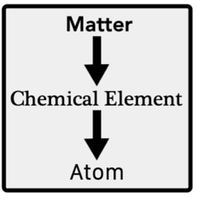
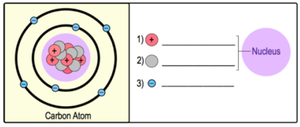
Chemistry underpins all biological processes. Atoms are the smallest units of matter, composed of subatomic particles: protons, neutrons, and electrons.
Protons: Positively charged particles found in the nucleus.
Neutrons: Neutral particles also in the nucleus.
Electrons: Negatively charged particles orbiting the nucleus.
The number of protons defines the atomic number and thus the element. The sum of protons and neutrons gives the mass number. Elements are pure substances that cannot be broken down further by chemical means.
Isotopes
Isotopes are atoms of the same element with different numbers of neutrons. For example, carbon has isotopes 12C, 13C, and 14C. Some isotopes are unstable (radioactive) and decay, emitting radiation. Radioactive isotopes have applications in medicine, such as in diagnostic imaging.
Chemical Bonds and Interactions
Types of Chemical Bonds
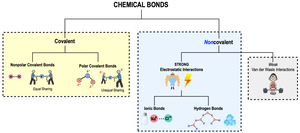
Atoms form bonds to achieve stable electron configurations, especially in their outermost (valence) shells. The main types of bonds in biology are ionic, covalent, and hydrogen bonds.
Ionic Bonds: Formed when electrons are transferred from one atom to another, creating charged ions that attract each other (e.g., NaCl formation).
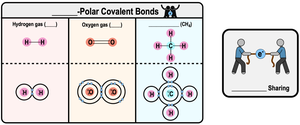
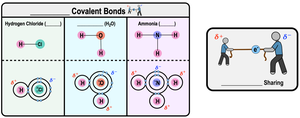
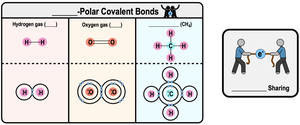
Covalent Bonds: Formed when atoms share pairs of electrons. Can be single, double, or triple bonds depending on the number of shared pairs.
Hydrogen Bonds: Weak attractions between a hydrogen atom in one molecule and an electronegative atom (like oxygen or nitrogen) in another.
Electronegativity and Bond Polarity
Electronegativity is an atom's ability to attract electrons in a bond. When atoms share electrons equally, the bond is nonpolar covalent. When sharing is unequal, the bond is polar covalent, resulting in partial charges on the molecule (e.g., water).
Properties of Water
Hydrogen Bonding and Water's Unique Properties
Water's polarity and ability to form hydrogen bonds give it several life-sustaining properties:
Cohesion: Water molecules stick to each other, creating surface tension.
Adhesion: Water molecules stick to other surfaces.
High Specific Heat: Water resists temperature changes, helping organisms maintain stable internal temperatures.
Ice Floats: Solid water is less dense than liquid water, insulating aquatic life in winter.
Solvent Properties: Water dissolves many substances, facilitating chemical reactions in cells.
Acids, Bases, and pH
pH Scale and Buffers
Water can dissociate into hydrogen ions (H+) and hydroxide ions (OH-). The pH scale measures the concentration of H+ ions in a solution:
Acid: Substance that increases H+ concentration (pH < 7).
Base: Substance that decreases H+ concentration (pH > 7).
Buffer: Chemical that stabilizes pH by absorbing or releasing H+ ions.
Macromolecules: The Molecules of Life
Classes of Biological Macromolecules
Living organisms are built from four major classes of macromolecules: carbohydrates, proteins, nucleic acids, and lipids. Most are polymers made from repeating monomer units.
Carbohydrates: Monomer = monosaccharide (e.g., glucose); polymer = polysaccharide (e.g., starch, cellulose).
Proteins: Monomer = amino acid; polymer = polypeptide/protein.
Nucleic Acids: Monomer = nucleotide; polymer = DNA or RNA.
Lipids: Not true polymers, but include fats, phospholipids, and steroids.
Carbohydrates
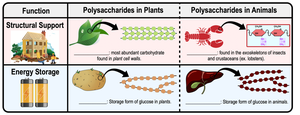
Carbohydrates serve as energy sources and structural materials. They are classified by the number of sugar units:
Monosaccharides: Simple sugars (e.g., glucose, fructose).
Disaccharides: Two monosaccharides joined (e.g., sucrose, lactose).
Polysaccharides: Long chains (e.g., starch, glycogen, cellulose, chitin).
Proteins
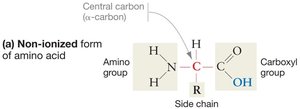
Proteins are polymers of amino acids. Each amino acid contains an amino group, a carboxyl group, a hydrogen atom, and a variable R group attached to a central carbon.
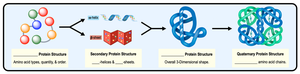
Primary Structure: Sequence of amino acids.
Secondary Structure: Alpha helices and beta sheets formed by hydrogen bonding.
Tertiary Structure: Overall 3D shape of a single polypeptide.
Quaternary Structure: Association of multiple polypeptide chains.
Summary Table: Key Biological Concepts
Concept | Definition | Example |
|---|---|---|
Atom | Smallest unit of matter | Carbon atom |
Element | Substance made of one type of atom | Oxygen (O2) |
Molecule | Two or more atoms bonded together | Water (H2O) |
Isotope | Atoms of same element, different neutrons | 14C (radioactive carbon) |
Ionic Bond | Transfer of electrons, attraction of ions | NaCl |
Covalent Bond | Sharing of electrons | H2O |
Hydrogen Bond | Weak attraction between polar molecules | Between water molecules |
Monomer | Single subunit | Glucose |
Polymer | Chain of monomers | Starch |
