 Back
General Biology Unit 1: Practice Questions and Step-by-Step Guidance
Study Guide - Smart Notes
 Tailored notes based on your materials, expanded with key definitions, examples, and context.
Q1. All of the gray squirrels that inhabit an oak forest describes a/an:
Background
Topic: Levels of Biological Organization
This question tests your understanding of how organisms are grouped in ecology, specifically the definitions of population, community, ecosystem, and biosphere.
Key Terms:
Population: All members of a single species living in a specific area.
Community: All populations of different species living and interacting in an area.
Ecosystem: All living things plus the physical environment in a given area.
Biosphere: All ecosystems on Earth.
Step-by-Step Guidance
Identify the subject: "gray squirrels" refers to a single species.
Consider the location: "oak forest" is a specific area.
Recall definitions: Which term describes all individuals of one species in one area?
Compare with other options: Community includes multiple species, ecosystem includes abiotic factors, biosphere is global.
Try solving on your own before revealing the answer!
Final Answer: d) population
All gray squirrels in an oak forest are a population because they are the same species in a specific area.
Q2. The idea that form and function are related would NOT be exemplified by which of the following examples?
Background
Topic: Structure and Function in Biology
This question tests your ability to recognize examples where the physical structure of an organism or cell relates to its function.
Key Terms:
Form: The physical shape or structure.
Function: The role or activity performed by the structure.
Step-by-Step Guidance
Read each example and identify the structure described.
Determine if the structure enhances the function (e.g., absorption, dispersal, movement).
Look for an example where the structure does NOT relate to the function.
Compare all options to see which one does not fit the form-function relationship.
Try solving on your own before revealing the answer!
Final Answer: e) none of the above
All examples listed demonstrate a relationship between form and function.
Q3. In the process of science, which of these is tested?
Background
Topic: Scientific Method
This question tests your understanding of the steps in the scientific method, specifically what is tested during experimentation.
Key Terms:
Hypothesis: A testable statement or prediction.
Observation: Information gathered using senses or instruments.
Control group: The group in an experiment that does not receive the experimental treatment.
Step-by-Step Guidance
Recall the scientific method: observation, hypothesis, experiment, result.
Identify which step involves testing.
Consider what is being tested during an experiment (prediction, explanation, or observation?).
Review the options and match them to the step where testing occurs.
Try solving on your own before revealing the answer!
Final Answer: C) a hypothesis
In science, hypotheses are tested through experimentation.
Q4. Titanium has an atomic number of 22. How many protons, neutrons, and electrons are in an isotope of titanium with mass number of 48?
Background
Topic: Atomic Structure and Isotopes
This question tests your understanding of how to determine the number of protons, neutrons, and electrons in an atom and its isotopes.
Key Terms and Formulas:
Atomic number: Number of protons.
Mass number: Number of protons + neutrons.
Electrons: Equal to protons in a neutral atom.
Formula:
Step-by-Step Guidance
Identify the atomic number: Titanium has 22 protons.
Calculate neutrons: Subtract atomic number from mass number ().
Electrons: In a neutral atom, electrons equal protons.
Check the answer choices for the correct combination.
Try solving on your own before revealing the answer!
Final Answer: a) p = 22, n = 26, e = 22
22 protons, 26 neutrons, and 22 electrons are present in this titanium isotope.
Q5. What do elements with atomic numbers 6, 14, and 22 have in common?
Background
Topic: Periodic Table and Chemical Properties
This question tests your understanding of how atomic number relates to electron configuration and chemical bonding.
Key Terms:
Valence electrons: Electrons in the outermost shell, important for bonding.
Covalent bonds: Bonds formed by sharing electrons.
Step-by-Step Guidance
Identify the elements: 6 (Carbon), 14 (Silicon), 22 (Titanium).
Determine their group in the periodic table.
Check if they have the same number of valence electrons.
Consider how this affects their bonding properties.
Try solving on your own before revealing the answer!
Final Answer: c) same number of valence electrons and will form the same number of covalent bonds
These elements are in the same group and have similar bonding properties.
Q6. What type of bond is very prevalent in lipids and gives lipids their properties?
Background
Topic: Chemical Bonds in Biological Molecules
This question tests your understanding of the types of bonds found in lipids and how they affect lipid properties.
Key Terms:
Nonpolar covalent bond: Electrons are shared equally, resulting in hydrophobic molecules.
Polar covalent bond: Electrons are shared unequally, resulting in partial charges.
Step-by-Step Guidance
Recall the structure of lipids: long hydrocarbon chains.
Identify the type of bond between carbon and hydrogen in these chains.
Consider how this bond affects solubility and other properties.
Match the bond type to the answer choices.
Try solving on your own before revealing the answer!
Final Answer: b) nonpolar covalent
Nonpolar covalent bonds make lipids hydrophobic and give them their characteristic properties.
Q7. Knowing the atomic mass of an element allows inferences about which of the following?
Background
Topic: Atomic Structure
This question tests your understanding of what atomic mass represents and what information it provides about an atom.
Key Terms:
Atomic mass: The sum of protons and neutrons in an atom.
Protons: Positively charged particles in the nucleus.
Neutrons: Neutral particles in the nucleus.
Step-by-Step Guidance
Recall the definition of atomic mass.
Determine which answer choices relate to protons and neutrons.
Eliminate options that refer to electrons.
Choose the option that best matches the definition.
Try solving on your own before revealing the answer!
Final Answer: C) the number of protons plus neutrons in the element
Atomic mass is the sum of protons and neutrons.
Q8. The atomic number of nitrogen is 7. Nitrogen-15 has a greater mass number than nitrogen-14 because the atomic nucleus of nitrogen-15 contains _____.
Background
Topic: Isotopes
This question tests your understanding of isotopes and how mass number is determined.
Key Terms:
Isotope: Atoms of the same element with different numbers of neutrons.
Mass number: Protons + neutrons.
Step-by-Step Guidance
Recall that nitrogen always has 7 protons.
Compare nitrogen-14 and nitrogen-15: the difference is in the number of neutrons.
Calculate neutrons for nitrogen-15 ().
Identify which answer choice matches this calculation.
Try solving on your own before revealing the answer!
Final Answer: B) 8 neutrons
Nitrogen-15 has 8 neutrons, which is one more than nitrogen-14.
Q9. Water molecules are attracted to one another by _____.
Background
Topic: Chemical Bonds in Water
This question tests your understanding of the type of bond responsible for water's unique properties.
Key Terms:
Hydrogen bond: Weak attraction between the hydrogen atom of one molecule and the electronegative atom of another.
Polar covalent bond: Bond within a water molecule, not between molecules.
Step-by-Step Guidance
Recall the structure of water: H2O is polar.
Identify the bond between water molecules (not within).
Match the correct bond type to the answer choices.
Eliminate options that refer to bonds within the molecule.
Try solving on your own before revealing the answer!
Final Answer: C) hydrogen bonds
Hydrogen bonds are responsible for water's cohesion and other properties.
Q10. How many electrons are involved in a single covalent bond?
Background
Topic: Chemical Bonding
This question tests your understanding of covalent bonds and electron sharing.
Key Terms:
Covalent bond: A bond formed by sharing electrons between atoms.
Step-by-Step Guidance
Recall the definition of a single covalent bond.
Determine how many electrons are shared in a single bond.
Match this to the answer choices.
Eliminate options that refer to more than one bond.
Try solving on your own before revealing the answer!
Final Answer: B) two
A single covalent bond involves two electrons, one from each atom.
Q11. Water shows high cohesion and surface tension and can absorb large amounts of heat because of large numbers of which of the following bonds between water molecules?
Background
Topic: Properties of Water
This question tests your understanding of the molecular interactions responsible for water's unique properties.
Key Terms:
Cohesion: Attraction between molecules of the same substance.
Surface tension: The effect of cohesion at the surface of a liquid.
Hydrogen bond: Weak bond between molecules.
Step-by-Step Guidance
Recall which bond is responsible for water's cohesion and surface tension.
Identify the bond type between water molecules.
Eliminate options that refer to bonds within the molecule.
Match the correct bond type to the answer choices.
Try solving on your own before revealing the answer!
Final Answer: d) hydrogen bonds
Hydrogen bonds between water molecules are responsible for these properties.
Q12. Water has an unusually high specific heat. What does this mean?
Background
Topic: Properties of Water
This question tests your understanding of specific heat and its implications for water.
Key Terms:
Specific heat: The amount of heat required to raise the temperature of 1 gram of a substance by 1 degree Celsius.
Step-by-Step Guidance
Recall the definition of specific heat.
Consider what it means for water to have a high specific heat.
Identify which answer choice best describes this property.
Eliminate options that do not relate to heat absorption.
Try solving on your own before revealing the answer!
Final Answer: b) More heat is required to raise the temperature of water.
Water's high specific heat means it resists temperature changes.
Q13. Research indicates that ibuprofen, a drug used to relieve inflammation and pain, is a mixture of two enantiomers; that is, molecules that _____.
Background
Topic: Isomers and Enantiomers
This question tests your understanding of enantiomers and their properties.
Key Terms:
Enantiomers: Molecules that are mirror images of each other.
Isomers: Molecules with the same formula but different structures.
Step-by-Step Guidance
Recall the definition of enantiomers.
Compare enantiomers to other types of isomers.
Identify which answer choice matches the definition.
Eliminate options that refer to structural or geometric isomers.
Try solving on your own before revealing the answer!
Final Answer: B) are mirror images of each other
Enantiomers are non-superimposable mirror images.
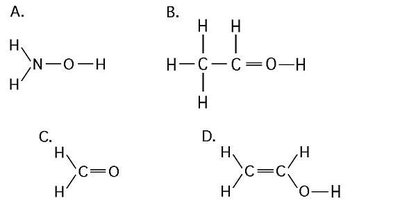
Q14. Which of the structures illustrated above is an impossible covalently bonded molecule?
Background
Topic: Covalent Bonding and Molecular Structure
This question tests your ability to recognize valid and invalid covalent bonding based on the number of bonds each atom can form.
Key Terms:
Covalent bond: A bond formed by sharing electrons.
Valence: The number of bonds an atom can form based on its outer electrons.
Step-by-Step Guidance
Examine each structure and count the number of bonds for each atom.
Recall typical bonding patterns: Carbon (4), Nitrogen (3), Oxygen (2), Hydrogen (1).
Identify any atom that exceeds its normal bonding capacity.
Compare each option to see which is impossible based on these rules.
Try solving on your own before revealing the answer!
Final Answer: B) B
Structure B has a carbon atom with five bonds, which is not possible for carbon.
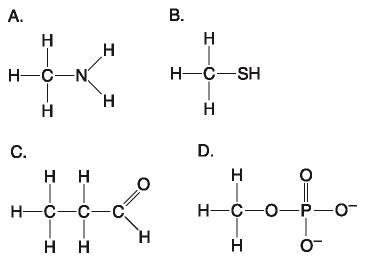
Q15. Which molecule shown above contains an amino functional group, but is NOT an amino acid?
Background
Topic: Functional Groups in Organic Molecules
This question tests your ability to identify functional groups and distinguish between amino acids and other molecules.
Key Terms:
Amino group: functional group.
Amino acid: Contains both an amino group and a carboxyl group ().
Step-by-Step Guidance
Examine each molecule for the presence of an amino group ().
Check if the molecule also contains a carboxyl group ().
Identify the molecule that has an amino group but lacks a carboxyl group.
Compare each option to see which fits the criteria.
Try solving on your own before revealing the answer!
Final Answer: A) A
Molecule A contains an amino group but does not have a carboxyl group, so it is not an amino acid.
Q16. Which of the following is the best explanation for why vegetable oil is a liquid at room temperature while animal fats are solid?
Background
Topic: Lipid Structure and Properties
This question tests your understanding of the differences between saturated and unsaturated fats.
Key Terms:
Saturated fat: No double bonds, solid at room temperature.
Unsaturated fat: Contains double bonds, liquid at room temperature.
Step-by-Step Guidance
Recall the structural differences between vegetable oil and animal fat.
Identify the role of double bonds in fatty acid chains.
Consider how double bonds affect the physical state at room temperature.
Match the explanation to the answer choices.
Try solving on your own before revealing the answer!
Final Answer: A) Vegetable oil has more double bonds than animal fats.
Double bonds cause kinks in the chains, preventing tight packing and making oils liquid.
Q17. A polysaccharide you are studying is found to contain unbranched β glucose molecules and cannot be digested by humans. Which polysaccharide are you studying?
Background
Topic: Carbohydrates and Polysaccharides
This question tests your understanding of the structure and digestibility of different polysaccharides.
Key Terms:
Cellulose: Unbranched β glucose polymer, indigestible by humans.
Starch: Branched or unbranched α glucose polymer, digestible by humans.
Step-by-Step Guidance
Recall the types of glucose linkages in polysaccharides.
Identify which polysaccharide is unbranched and contains β glucose.
Consider which polysaccharide cannot be digested by humans.
Match the description to the answer choices.
Try solving on your own before revealing the answer!
Final Answer: a) cellulose
Cellulose is composed of unbranched β glucose and is indigestible by humans.
Q18. Lipids cannot be considered polymers because
Background
Topic: Biological Macromolecules
This question tests your understanding of the definition of polymers and the structure of lipids.
Key Terms:
Polymer: A molecule made of repeating monomer units.
Lipid: Not made of repeating monomers.
Step-by-Step Guidance
Recall the definition of a polymer.
Consider the structure of lipids (e.g., triglycerides).
Identify why lipids do not fit the polymer definition.
Match the explanation to the answer choices.
Try solving on your own before revealing the answer!
Final Answer: e) they are not composed of monomer subunits.
Lipids are not polymers because they are not made of repeating monomers.
Q19. How does RNA differ from DNA?
Background
Topic: Nucleic Acids
This question tests your understanding of the structural and functional differences between RNA and DNA.
Key Terms:
DNA: Double-stranded, contains thymine, encodes hereditary information.
RNA: Single-stranded, contains uracil, involved in protein synthesis.
Step-by-Step Guidance
Recall the structural differences between DNA and RNA.
Identify the functional differences.
Check which answer choices are correct.
Determine if all differences listed are true.
Try solving on your own before revealing the answer!
Final Answer: d) all of the above
All listed differences are correct: DNA encodes hereditary information, forms duplexes, and contains thymine; RNA does not.
