 Back
Genes, Genetic Code, Central Dogma, and Mutations: Study Notes
Study Guide - Smart Notes
 Tailored notes based on your materials, expanded with key definitions, examples, and context.
Genes and Their Molecular Function
Definition and Role of Genes
Genes are fundamental units of heredity, composed of DNA sequences that encode instructions for synthesizing proteins or functional RNA molecules. The molecular function of a gene is to direct the production of a specific protein or RNA, which in turn determines cellular structure and function.
Gene: A segment of DNA that codes for a functional product, typically a protein.
One gene-one enzyme (protein) hypothesis: Each gene encodes a single enzyme or protein, though exceptions exist.
Example: The gene for hemoglobin encodes the protein responsible for oxygen transport in blood.
The Central Dogma of Molecular Biology
Flow of Genetic Information
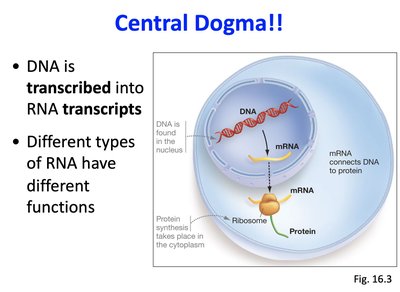
The Central Dogma describes the directional flow of genetic information within a cell: DNA is transcribed into RNA, which is then translated into protein. This process is fundamental to all living organisms.
Transcription: The process by which DNA is copied into messenger RNA (mRNA).
Translation: The process by which mRNA is decoded to synthesize proteins.
Different types of RNA: mRNA (messenger), tRNA (transfer), rRNA (ribosomal) each have distinct functions in protein synthesis.
The Genetic Code
Properties and Function
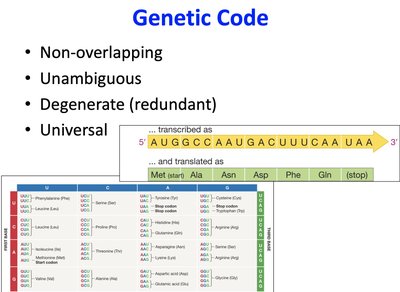
The genetic code is the set of rules by which information encoded in DNA or RNA sequences is translated into proteins. It is nearly universal among organisms and consists of codons—three-nucleotide sequences that specify amino acids.
Non-overlapping: Each nucleotide is part of only one codon.
Unambiguous: Each codon specifies only one amino acid.
Degenerate (redundant): Multiple codons can code for the same amino acid.
Universal: The code is conserved across most species.
Example: The codon AUG codes for methionine (start codon).
Transcription
Mechanism and Template Usage
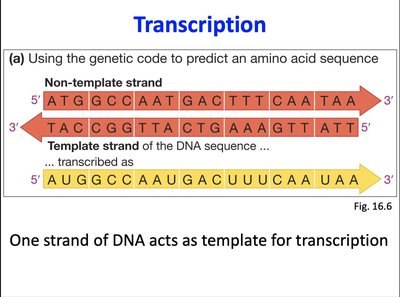
Transcription is the process by which a single strand of DNA serves as a template for the synthesis of RNA. The template strand is used to generate a complementary RNA sequence, which is then processed and translated.
Template strand: The DNA strand used to synthesize RNA.
Non-template strand: The DNA strand not used for transcription.
Example: If the template DNA sequence is TAC, the RNA sequence will be AUG.
DNA Mutations
Types and Effects of Mutations
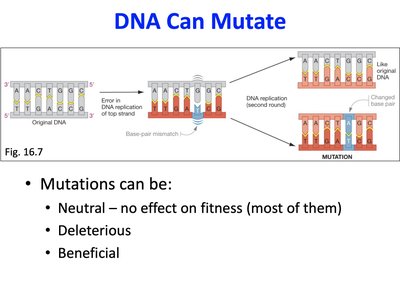
Mutations are changes in the DNA sequence that can occur during replication or due to environmental factors. They can be neutral, deleterious, or beneficial, affecting the organism's fitness and phenotype.
Point mutation: A change in a single nucleotide pair.
Neutral mutation: No effect on fitness.
Deleterious mutation: Harmful effect on fitness.
Beneficial mutation: Improves fitness.
Example: Sickle cell anemia is caused by a single base pair change in the hemoglobin gene.
Mutation Rates
Frequency and Impact in Populations
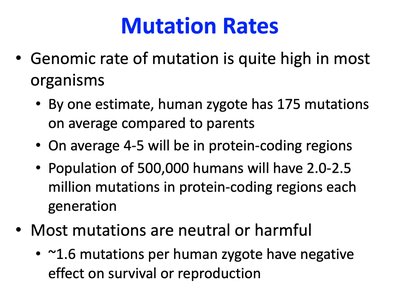
Mutation rates are relatively high in most organisms, with the majority being neutral or harmful. In humans, each zygote acquires numerous mutations, some of which may affect protein-coding regions and influence survival or reproduction.
Genomic mutation rate: Average number of mutations per zygote is about 175.
Protein-coding mutations: 4-5 per zygote on average.
Population impact: Large populations accumulate millions of mutations per generation.
Most mutations: Neutral or harmful; few are beneficial.
Case Study: Sickle Cell Anemia and Malaria
Genetic Mutation and Disease Resistance
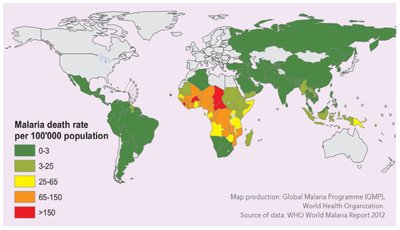
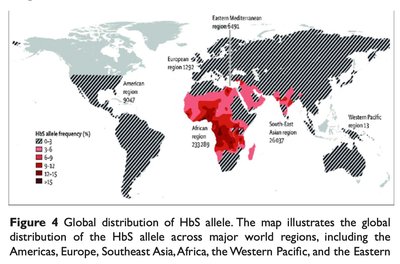
Sickle cell anemia is caused by a point mutation in the hemoglobin gene (HBB), resulting in abnormal hemoglobin (HbS). This mutation confers resistance to malaria, explaining its prevalence in regions with high malaria rates.
HBB gene: Encodes the beta chain of hemoglobin.
HbAA: Normal hemoglobin genotype.
HbSS: Sickle cell genotype caused by Glu6Val mutation.
Distribution: HbS allele is common in regions with high malaria incidence.
Example: Individuals with HbAS (heterozygous) have increased resistance to malaria.
Summary Table: Types of Mutations and Their Effects
Type of Mutation | Effect on Fitness | Example |
|---|---|---|
Neutral | No effect | Silent mutation in non-coding region |
Deleterious | Harmful | Sickle cell anemia (HbSS) |
Beneficial | Improves fitness | HbAS genotype confers malaria resistance |
Key Equations
Transcription and Translation
The process of transcription and translation can be summarized as:
Transcription:
Translation:
For a codon sequence:
Additional info: Academic context was added to clarify the molecular basis of gene function, mutation rates, and the relationship between sickle cell anemia and malaria resistance.
