 Back
Genetic Control of Cancer: Mechanisms and Factors
Study Guide - Smart Notes
 Tailored notes based on your materials, expanded with key definitions, examples, and context.
Genetic Control of Cancer
Concept: Cancer Results from Genetic Changes Affecting Cell Cycle Control
Cancer is a disease characterized by uncontrolled cell growth and division, resulting from genetic mutations that disrupt normal cell cycle regulation. These mutations can affect genes responsible for promoting or inhibiting cell division.
Proto-oncogenes: Normal genes that promote cell growth and division. When mutated, they become oncogenes.
Oncogenes: Mutated proto-oncogenes that cause excessive cell division and can lead to cancer.
Tumor-suppressor genes: Genes such as p53 that help prevent uncontrolled cell growth by repairing DNA or initiating apoptosis in damaged cells.
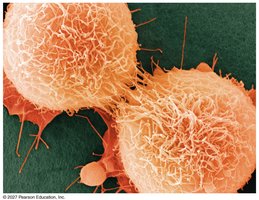
Electron micrograph of dividing cancer cells. Cancer cells often exhibit abnormal shapes and uncontrolled division, as seen in this image.
Ras Mutations
The Ras gene encodes a G protein involved in cell signaling. Mutations in Ras can produce a hyperactive protein, leading to increased cell division and contributing to cancer development.
Hyperactive Ras protein: Causes persistent signaling for cell division.
Result: Increased risk of tumor formation.
p53 Mutations
The p53 gene is a crucial tumor-suppressor. Mutations in p53 result in a missing or nonfunctional protein, allowing damaged cells to divide unchecked.
p53 gene mutations: Lead to loss of cell cycle control.
Damaged cell divides: Increases risk of cancer.
Summary of Mutation Effects
Mutations in proto-oncogenes, oncogenes, and tumor-suppressor genes disrupt normal cell cycle regulation, leading to uncontrolled cell proliferation and cancer.
The Multistep Model of Cancer Development
Cancer typically develops through the accumulation of multiple genetic mutations over time. The risk of cancer increases with age due to the gradual build-up of these mutations.
Multiple mutations: Required for cancer to develop.
Characteristics: At least one active oncogene and several mutated tumor-suppressor genes are usually present in cancer cells.
Breast Cancer
Breast cancer is a heterogeneous disease, meaning it consists of several distinct subtypes. Despite these differences, all subtypes are classified under the same disease name.
Subtypes: At least four major subtypes exist.
Shared disease name: All are referred to as breast cancer.
Inherited Predisposition and Other Factors Contributing to Cancer
Genetic predisposition plays a significant role in cancer risk. Individuals may inherit oncogenes or mutant alleles of tumor-suppressor genes, increasing their likelihood of developing certain cancers.
Inherited oncogenes: Can directly increase cancer risk.
Mutant tumor-suppressor alleles: Examples include adenomatous polyposis coli (colorectal cancer) and BRCA1 or BRCA2 (breast cancers).
The Role of Viruses in Cancer
Some viruses, known as tumor viruses, can cause cancer by introducing oncogenes or disrupting tumor-suppressor genes. Human papillomavirus (HPV) is a notable example, responsible for almost all cases of cervical cancer.
HPV: Infects 1 in 4 people and is linked to cervical cancer.
Other tumor viruses: Can contribute to cancer development in various tissues.
Additional info:
Mutations in cell cycle control genes are central to cancer biology. The multistep model explains why cancer incidence increases with age, as more mutations accumulate over time. Inherited mutations in genes like BRCA1 and BRCA2 are important in genetic counseling and risk assessment for breast and ovarian cancers.
