 Back
BackGenetic Engineering: DNA Cloning, PCR, Sequencing, and Gene Editing
Study Guide - Smart Notes
 Tailored notes based on your materials, expanded with key definitions, examples, and context.
Genetic Engineering and the Molecular Basis of Inheritance
Introduction to Genetic Engineering
Genetic engineering is the direct manipulation of genes for practical purposes. The discovery of DNA's double helix structure and the principle of complementary base pairing laid the foundation for modern genetic engineering techniques. These methods have revolutionized fields such as agriculture, medicine, and biological research.
DNA Cloning: Making Multiple Copies of a Gene
Principles and Process of DNA Cloning
DNA cloning is the process of making multiple identical copies of a specific DNA segment. This is essential because naturally occurring DNA molecules are long and contain many genes, with only a small proportion being coding sequences. Cloning allows scientists to isolate and amplify specific genes for study or application.
Plasmids: Small, circular DNA molecules in bacteria that replicate independently of the bacterial chromosome. Plasmids are commonly used as cloning vectors.
Recombinant DNA: DNA molecules formed by combining DNA from different sources, often different species.
Cloning Vector: A DNA molecule (often a plasmid) that can carry foreign DNA into a host cell and replicate there.
Gene Cloning: The production of multiple copies of a single gene, often for research or practical applications.
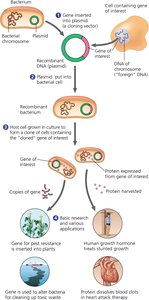
Applications: Cloned genes can be used for basic research, to confer new traits (e.g., pest resistance in crops), or to produce medically important proteins (e.g., human growth hormone).
Restriction Enzymes and Recombinant DNA Technology
Restriction Enzymes: Cutting DNA at Specific Sites
Restriction enzymes (restriction endonucleases) are proteins that cut DNA at specific nucleotide sequences called restriction sites. These enzymes are naturally found in bacteria, where they protect against foreign DNA.
Each restriction enzyme recognizes a specific, usually palindromic, DNA sequence.
Cutting produces restriction fragments, often with single-stranded overhangs called sticky ends that can base pair with complementary sequences.
Bacterial DNA is protected from its own restriction enzymes by methylation of the recognition sites.
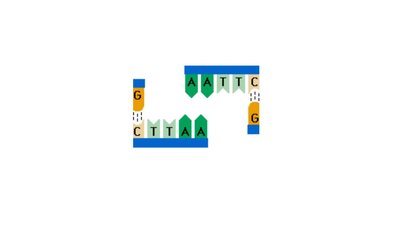
Creating Recombinant DNA Molecules
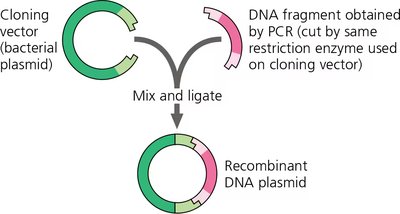
To create recombinant DNA, restriction enzymes cut both the plasmid vector and the foreign DNA at compatible sites. The sticky ends of the DNA fragments can hybridize, and the enzyme DNA ligase seals the sugar-phosphate backbone, forming a stable recombinant plasmid.
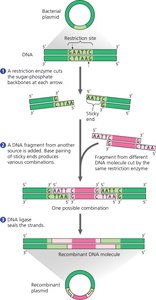
Researchers can verify recombinant plasmids by cutting them with the same restriction enzyme and analyzing the fragments using gel electrophoresis.
Gel Electrophoresis: Separating DNA Fragments
Principle and Application
Gel electrophoresis separates DNA fragments by size using an electric field. DNA samples are loaded into wells in an agarose gel, and an electric current causes the negatively charged DNA to migrate toward the positive electrode. Shorter fragments move faster and farther than longer ones.
Used to analyze restriction fragments, verify cloning results, and compare DNA samples.
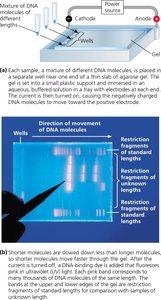
Amplifying DNA: The Polymerase Chain Reaction (PCR)
PCR: Rapid and Specific DNA Amplification
The polymerase chain reaction (PCR) is a technique for amplifying a specific DNA segment from a complex mixture. It requires sequence information to design primers that flank the target region.
Denaturation: Heating separates the DNA strands.
Annealing: Cooling allows primers to hybridize to complementary sequences at the ends of the target DNA.
Extension: A heat-stable DNA polymerase (e.g., Taq polymerase) synthesizes new DNA strands from the primers.
Each cycle doubles the number of target DNA molecules: after n cycles.
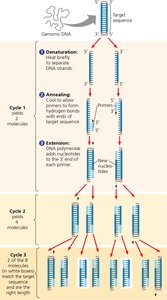
PCR is used for cloning, diagnostics, forensics, and research. It can amplify DNA from ancient samples, trace evidence, or pathogens.
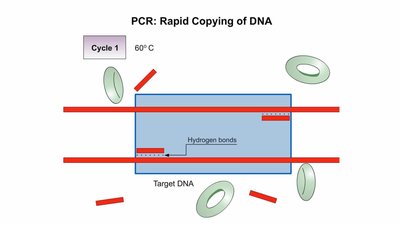
Combining PCR and Cloning
PCR products can be engineered with restriction sites for insertion into plasmid vectors, facilitating cloning and further analysis.
DNA Sequencing: Determining the Order of Nucleotides
Sanger Sequencing and Next-Generation Methods
DNA sequencing determines the precise order of nucleotides in a DNA molecule. The classic Sanger method uses dideoxynucleotides to terminate DNA synthesis at specific bases, generating fragments that can be separated and read.
Next-generation sequencing (NGS) technologies allow millions of DNA fragments to be sequenced in parallel, greatly increasing speed and reducing cost. In NGS, DNA polymerase synthesizes new strands, and each incorporated nucleotide is detected electronically or optically.
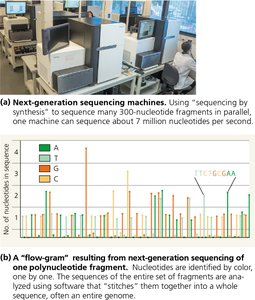
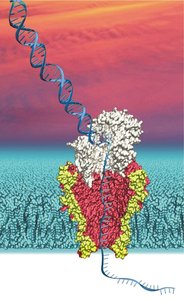
Third-generation sequencing methods, such as nanopore sequencing, read long DNA molecules directly as they pass through a protein pore, detecting changes in electrical current.
Gene Editing: The CRISPR-Cas9 System
CRISPR-Cas9: Precision Genome Editing
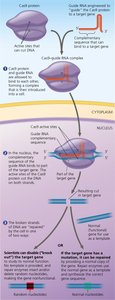
The CRISPR-Cas9 system is a revolutionary tool for editing genes in living cells. Cas9 is a nuclease guided by a customizable RNA molecule to a specific DNA sequence, where it introduces a double-strand break.
The cell's repair machinery can introduce mutations (gene knockout) or use a supplied template to correct or alter the gene (gene editing).
Applications include basic research, gene therapy, and controlling disease vectors.
Base editing is a related technique that chemically modifies specific DNA bases without cutting both strands, reducing the risk of off-target effects.
Applications and Ethical Considerations
Medical, Agricultural, and Research Uses
Production of therapeutic proteins (e.g., insulin, growth hormone)
Development of genetically modified organisms (GMOs) for agriculture
Gene therapy for genetic diseases (e.g., sickle-cell disease, beta-thalassemia)
Forensic analysis and evolutionary studies (e.g., PCR amplification of ancient DNA)

Ethical considerations are critical as gene editing technologies advance, especially regarding human applications and ecological impacts (e.g., gene drives in wild populations).
Summary Table: Key Techniques in Genetic Engineering
Technique | Main Purpose | Key Enzyme/Component | Application Example |
|---|---|---|---|
DNA Cloning | Amplify specific genes | Restriction enzymes, DNA ligase | Production of GMOs, protein drugs |
PCR | Rapid DNA amplification | Taq polymerase, primers | Forensics, diagnostics, research |
Gel Electrophoresis | Separate DNA fragments by size | Electric field, agarose gel | DNA analysis, verification |
DNA Sequencing | Determine nucleotide order | DNA polymerase, dideoxynucleotides | Genomics, mutation detection |
CRISPR-Cas9 | Gene editing | Cas9 nuclease, guide RNA | Gene therapy, research |
Concept Integration: The Role of Complementary Base Pairing
Cloning: Sticky ends hybridize via complementary base pairing.
PCR: Primers anneal to complementary sequences flanking the target DNA.
Sequencing: New strands are synthesized using complementary base pairing.
CRISPR: Guide RNA binds to complementary DNA sequence to direct Cas9.
Additional info: This guide integrates foundational concepts from molecular biology and genetics, providing context for the practical applications and ethical considerations of genetic engineering.
