 Back
Genetic Interactions and Their Impact on Phenotype: Study Notes for General Biology
Study Guide - Smart Notes
 Tailored notes based on your materials, expanded with key definitions, examples, and context.
Genetics and the MAO(A) Gene
MAO(A) Gene and Polymorphism
The Monoamine oxidase A (MAO-A) gene is located on the X chromosome and is responsible for the breakdown of monoamines such as dopamine, serotonin, and noradrenaline. Polymorphisms in the MAO(A) gene, particularly the MAO(A)-uVNTR (upstream variable number of tandem repeats) in the promoter region, are associated with behavioral traits including aggression and antisocial behavior.
Polymorphism: Variation in the DNA sequence at a specific locus, often resulting in different phenotypes.
MAO(A)-uVNTR: A polymorphic region that can affect the expression level of the MAO-A enzyme.
Reduced enzyme levels: Certain polymorphisms lead to lower MAO-A activity, which is linked to increased aggression.
Epigenetic methylation: Methylation of the MAO(A) gene locus can be correlated with trauma-related adult aggression.
Example: Male children with childhood trauma are more susceptible to aggression due to sex-specific effects of MAO(A) gene polymorphism.
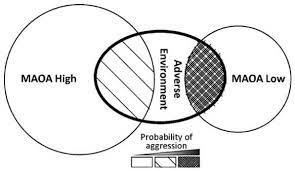
Additional info: The diagram illustrates how both MAO-A genotype and adverse environment interact to increase the probability of aggression.
Genotype, Phenotype, and Environment
Partitioning Phenotypic Variation
The phenotype of an organism is determined by the interaction between its genotype and the environment. This relationship is often summarized by the equation:
P: Phenotype (observable traits)
G: Genotype (genetic makeup)
E: Environment (external factors)
G × E: Interaction between genes and environment
Example: A person with a genetic predisposition for aggression may not exhibit aggressive behavior if raised in a nurturing environment.
Genetic Interactions: Intra-genic and Inter-genic
Allelic Interactions (Intra-genic)
Alleles of a gene interact to contribute to the phenotype. These interactions can be classified as additive, non-additive (dominance), duplicate, expanded, lethal, and pleiotropic.
Additive: Both alleles contribute to the phenotype, and their effects sum up.
Non-additive (Dominance): One allele masks the effect of the other.
Duplicate: Phenotypic value depends on the number of gene duplications.
Expanded: Phenotypic value depends on the number of expanded trinucleotide repeats.
Lethal: Certain allele combinations can be lethal.
Pleiotropic: One gene affects multiple traits.
Additive Interactions
In additive interactions, both alleles are fully expressed in the phenotype. The combined effect is the sum of each allele's effect.
Example: Blood groups (A, B) and flower color in Mirabilis jalapa (red, pink, white).
Additional info: The image shows how different allele combinations produce red, pink, or white flowers.
Non-additive Interactions (Dominance)
Dominance occurs when one allele masks the effect of another. Complete dominance means the heterozygote expresses the dominant phenotype.
Example: Freckles, sweet pea flower color.
Additional info: The image illustrates a dominant trait (freckles) in humans.
Molecular Basis of Dominance
Dominance at the molecular level can be explained by the concept of haplosufficiency, where one functional allele is sufficient for normal function. Mutations can lead to haploinsufficiency or dominant negative effects.
Haplosufficiency: One allele produces enough product for normal function.
Haploinsufficiency: Both alleles are required for normal function; loss of one leads to a mutant phenotype.
Dominant negative: Mutant allele disrupts the function of the normal allele.
Additional info: The image shows normal and mutant phenotypes based on allele dosage.
Duplicate Genes
Phenotypic value can depend on the number of gene duplications. For example, the Glo1 gene is associated with anxiety-related disorders, and increased gene copies can increase susceptibility.
Example: Eye phenotype in Drosophila depends on the number and location of duplicated genes.
Additional info: The image shows how gene duplication affects eye development in fruit flies.
Expanded Repeats
Some genetic disorders are caused by expanded trinucleotide repeats within a gene. The severity of the phenotype depends on the number of repeats.
Example: Huntington Disease is caused by expanded CAG repeats in the Huntingtin (HTT) gene.
Application: The number of repeats can increase with each generation, leading to earlier onset and more severe symptoms.
Gene-Environment Interaction
Impact of Environment on Genotype Expression
The environment can modulate the expression of genetic traits. For example, individuals with a genetic predisposition for aggression may not exhibit aggressive behavior if raised in a positive environment.
Example: James Fallon, who has a genetic profile associated with psychopathy, did not develop antisocial behavior due to a nurturing upbringing.

Additional info: The image reinforces the importance of environment in shaping phenotype.
Summary Table: Types of Intra-genic Interactions
Type | Description | Example |
|---|---|---|
Additive | Both alleles contribute equally | Blood groups, flower color |
Non-additive (Dominance) | One allele masks the other | Freckles, sweet pea |
Duplicate | Phenotype depends on gene copy number | Glo1 gene, Drosophila eye |
Expanded | Phenotype depends on repeat number | Huntington Disease |
Lethal | Certain combinations are lethal | Not specified |
Pleiotropic | One gene affects multiple traits | Not specified |
Additional info: Table summarizes intra-genic interactions and their effects on phenotype.
