 Back
BackGenetic Variation and Its Role in Evolution
Study Guide - Smart Notes
 Tailored notes based on your materials, expanded with key definitions, examples, and context.
Genetic Variation and Evolution
Introduction to Genetic Variation
Genetic variation is the foundation of evolutionary processes. It refers to differences in DNA sequences among individuals within a population, which can lead to variations in traits. Charles Darwin recognized the importance of heritable variation for evolution, although the molecular mechanisms were not understood in his time.
Inherited Traits: Traits passed from parents to offspring through genetic material.
Evolutionary Change: Differences in inherited traits can lead to evolutionary changes in populations over generations.
Mechanism: Natural selection acts on heritable variation, favoring traits that enhance survival and reproduction.
Phenotypic and Genetic Variation
Phenotypic variation is observable in characteristics such as facial features, height, and blood type. This variation often reflects underlying genetic differences, known as genetic variation. Genetic variation arises from differences in DNA sequences among individuals.
Phenotypic Variation: Observable traits that can be influenced by both genetic and environmental factors.
Genetic Variation: Differences in the genetic code (DNA sequences) among individuals.
Example: Blood groups (A, B, AB, O) are determined by genetic differences.
Examples of Genetic Variation in Populations
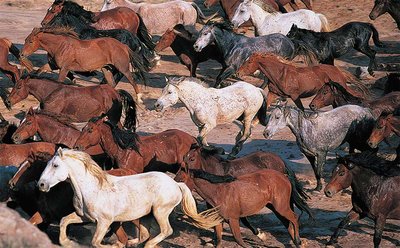
Genetic variation is evident in natural populations, such as the diversity of coat colors in horses. This variation is influenced by multiple genes and environmental factors, resulting in a continuum of phenotypes.
Polygenic Traits: Traits influenced by multiple genes, often showing continuous variation (e.g., coat color in horses).
Environmental Influence: Environmental factors can modify the expression of genetic traits.
Molecular Basis of Genetic Variation
Genetic variation at the molecular level is caused by differences in DNA sequences, such as base-pair substitutions, insertions, and deletions. Not all genetic changes affect the phenotype; some are silent mutations that do not alter the encoded protein.
Base-Pair Substitution: Replacement of one nucleotide pair with another.
Insertion/Deletion: Addition or loss of nucleotide pairs in a gene.
Silent Mutation: A mutation that does not change the amino acid sequence of a protein.

Environmentally Induced Phenotypic Variation
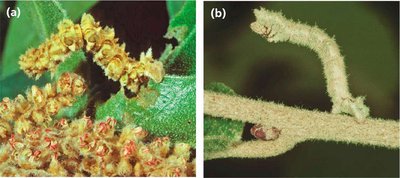
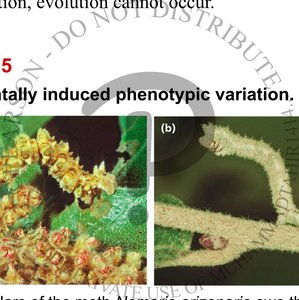
Some phenotypic variation is not heritable but is induced by environmental factors. For example, the color of certain caterpillars can change depending on their diet or surroundings, providing camouflage against predators.
Environmental Effects: Environmental conditions can influence the phenotype expressed by a genotype.
Example: Caterpillars of the same species may resemble different objects (e.g., flowers or twigs) depending on their environment.
Sources of Genetic Variation
Formation of New Alleles
New alleles arise through mutations, which are changes in the nucleotide sequence of DNA. Mutations can occur due to errors in DNA replication, exposure to mutagens, or other factors. While many mutations are neutral or harmful, some can be beneficial and contribute to evolutionary adaptation.
Mutation: Any change in the DNA sequence of an organism.
Types of Mutations: Point mutations, insertions, deletions, duplications, and chromosomal rearrangements.
Effect: Mutations can create new genetic variants (alleles) in a population.
Altering Gene Number or Position
Large-scale genetic changes, such as duplications or rearrangements of genes, can also contribute to genetic variation. These changes may be harmful, neutral, or beneficial, depending on their effects on gene function and organismal fitness.
Gene Duplication: The creation of extra copies of a gene, which can evolve new functions.
Chromosomal Rearrangement: Structural changes in chromosomes that can affect gene expression.
Example: The proliferation of olfactory receptor genes in mammals has enhanced their sense of smell.
Rapid Reproduction and Mutation Rates
Organisms with short generation times, such as viruses, can accumulate genetic variation rapidly due to frequent mutations. For example, HIV has a high mutation rate, which contributes to its rapid evolution and resistance to treatments.
Generation Time: The time between the birth of an organism and the production of its offspring.
Mutation Rate: The frequency at which mutations occur in a genome.
Example: High mutation rates in RNA viruses like HIV facilitate rapid adaptation.
Sexual Reproduction and Genetic Shuffling
Sexual reproduction increases genetic variation by shuffling alleles during meiosis and fertilization. Mechanisms such as crossing over, independent assortment of chromosomes, and random fertilization ensure that each offspring has a unique genetic makeup.
Crossing Over: Exchange of genetic material between homologous chromosomes during meiosis.
Independent Assortment: Random distribution of maternal and paternal chromosomes to gametes.
Random Fertilization: Any sperm can fertilize any egg, increasing genetic diversity.
Summary Table: Sources of Genetic Variation
Source | Description | Example |
|---|---|---|
Mutation | Change in DNA sequence | Point mutation in a gene |
Gene Duplication | Extra copies of genes | Olfactory receptor genes in mammals |
Chromosomal Rearrangement | Structural changes in chromosomes | Inversions, translocations |
Sexual Reproduction | Shuffling of alleles during meiosis and fertilization | Crossing over, independent assortment |
