 Back
Genetic Variation, Microevolution, and Hardy-Weinberg Equilibrium
Study Guide - Smart Notes
 Tailored notes based on your materials, expanded with key definitions, examples, and context.
Microevolution and Genetic Variation
Definition and Mechanisms
Microevolution refers to changes in allele frequencies within a population over generations. These changes are driven by three main mechanisms:
Natural selection: The process by which certain traits become more common in a population because they confer a survival or reproductive advantage.
Genetic drift: Random changes in allele frequencies, especially in small populations.
Gene flow: The movement of alleles between populations due to migration.
Only natural selection consistently leads to adaptive evolution, where traits that improve fitness become more common.
Alleles and Genetic Variation
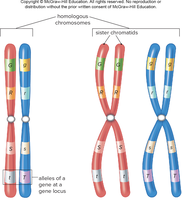
An allele is an alternative form of a gene. Genetic variation is essential for evolution, as it provides the raw material for natural selection to act upon.
Genetic variation: Differences in genes or other DNA segments among individuals.
Phenotype: The observable traits of an organism, resulting from the interaction of genotype and environment.
Sources and Types of Genetic Variation
Heritable Traits and Mendelian Genetics
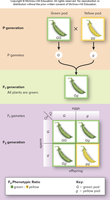
Variation in heritable traits is a prerequisite for evolution by natural selection. Gregor Mendel’s work on pea plants demonstrated the existence of discrete heritable units (genes).
Single-Gene vs. Multigenic Traits
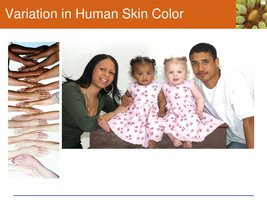
Some phenotypic differences are determined by a single gene and can be classified on an "either-or" basis, such as free or attached earlobes. Multigenic traits are influenced by two or more genes and vary along a continuum, such as height or skin color.
Single-gene traits: Examples include earlobe attachment and tongue rolling.
Multigenic traits: Examples include height, weight, and skin color.
Measuring Genetic Variation
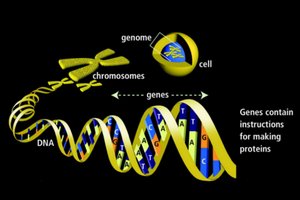
Genetic variation can be measured as gene variability or nucleotide variability:
Gene variability: Average heterozygosity measures the average percent of loci that are heterozygous in a population.
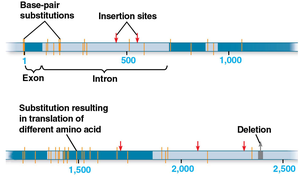
Nucleotide variability: Measured by comparing DNA sequences of individuals; most differences occur in noncoding regions (introns).
Nonheritable Variation
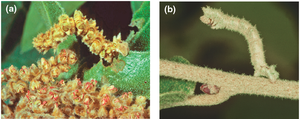
Some phenotypic variation is due to environmental influences rather than genetic differences. Only genetically determined variation can have evolutionary consequences.
Formation of New Alleles
Mutation
New alleles arise by mutation, a change in the nucleotide sequence of DNA. A point mutation is a change in a single nucleotide. Only mutations in cells that produce gametes can be passed to offspring.
Effects of mutations: Can be negative, neutral, or positive. Mutations in noncoding regions are often neutral.
Mutation rates: Low in animals and plants, higher in viruses due to short generation times.
Sexual Reproduction and Genetic Variation
In sexually reproducing organisms, most genetic variation results from recombination of alleles. Three mechanisms shuffle alleles:
Crossing over
Independent assortment
Fertilization
Gene Pools and Allele Frequencies
Population and Gene Pool
A population is a localized group of individuals capable of interbreeding. A gene pool consists of all the alleles for all loci in a population. A locus is "fixed" if all individuals are homozygous for the same allele.
The Hardy-Weinberg Principle
Hardy-Weinberg Equation
The Hardy-Weinberg equation is used to test whether a population is in equilibrium or evolving. For diploid organisms, the total number of alleles at a locus is the total number of individuals times 2.
Allele frequency calculation: For dominant alleles: two alleles for each homozygous dominant individual, one for each heterozygous individual.
Hardy-Weinberg Equation
The equation is:
Where:
p: Frequency of the dominant allele
q: Frequency of the recessive allele
p^2: Frequency of homozygous dominant genotype
2pq: Frequency of heterozygous genotype
q^2: Frequency of homozygous recessive genotype
Conditions for Hardy-Weinberg Equilibrium
For a population to be in Hardy-Weinberg equilibrium, the following conditions must be met:
No mutations
Random mating
No natural selection
Extremely large population size
No gene flow
Applying the Hardy-Weinberg Equation
The equation can be used to determine the percentage of a population carrying a specific allele. For example, the occurrence of phenylketonuria (PKU) in the U.S. is 1 per 10,000 births:
Frequency of carriers: (about 2%)
Example: Wildflower Population
Consider a population of wildflowers (n=500; 1000 alleles) with incomplete dominance for color:
320 red flowers (CRCR)
160 pink flowers (CRCW)
20 white flowers (CWCW)
Calculate the number of copies of each allele:
CR = (320 × 2) + 160 = 800
CW = (20 × 2) + 160 = 200
Calculate the frequency of each allele:
The sum of alleles is always 1:
Genotype frequencies:
CRCR:
CRCW:
CWCW:
These frequencies can be confirmed using a Punnett square.
Summary Table: Hardy-Weinberg Principle
Condition | Effect on Equilibrium |
|---|---|
No mutations | Maintains allele frequencies |
Random mating | Ensures equal mixing of alleles |
No natural selection | No differential survival or reproduction |
Large population size | Reduces impact of genetic drift |
No gene flow | Prevents introduction/removal of alleles |
Additional info: These notes expand on the original slides and brief points, providing definitions, examples, and equations for clarity and completeness. All images included are directly relevant to the explanation of the adjacent paragraph.
