 Back
Genetics & Inheritance: Mendelian and Non-Mendelian Patterns
Study Guide - Smart Notes
 Tailored notes based on your materials, expanded with key definitions, examples, and context.
Genetics & Inheritance
Early Views of Inheritance
Before the advent of modern genetics, the blending hypothesis was widely accepted, suggesting that parental traits mixed to produce intermediate offspring. This was disproven by Gregor Mendel, who demonstrated that traits are inherited as discrete units, now known as genes.
Mendel and His Pea Plant Experiments
Gregor Mendel's experiments with pea plants established the foundation of classical genetics. He selected pea plants for their short life cycle, numerous offspring, and controllable mating.
Characters vs. Traits: Characters are heritable features (e.g., flower color), while traits are specific variants (e.g., purple or white).
P Generation: True-breeding plants with distinct traits were crossed.
F₁ Generation: All offspring displayed the dominant trait (purple flowers).
F₂ Generation: The recessive trait reappeared in a 3:1 ratio, leading to Mendel’s laws.
Mendel’s Laws of Inheritance
Law of Segregation: Two alleles for a character segregate during gamete formation, explaining the reappearance of recessive traits.
Law of Independent Assortment: Alleles for different traits assort independently during gamete formation, true for genes on different chromosomes or far apart on the same chromosome.
Key Concepts from Mendel’s Work
Alleles: Alternate versions of a gene (e.g., purple vs. white flower color).
Inheritance: Each parent contributes one allele per gene, resulting in diploid offspring.
Dominance: Dominant alleles mask recessive alleles in the phenotype.
Homozygous: Two identical alleles (e.g., rr for attached earlobes).
Heterozygous: Two different alleles (e.g., Rr for unattached earlobe).
Tools for Predicting Inheritance
Punnett Square: A grid to visualize allele combinations and predict offspring genotypes and phenotypes.
Test Cross: Used to determine the genotype of an individual with a dominant phenotype by crossing with a homozygous recessive.
Monohybrid Cross: Tracks inheritance of a single trait.
Dihybrid Cross: Tracks inheritance of two traits simultaneously.
Probability: Calculated using the multiplication rule (for independent events) and addition rule (for mutually exclusive events).
Beyond Mendel: Variations in Dominance
Incomplete Dominance: Heterozygotes display an intermediate phenotype (e.g., pink snapdragons from red and white parents).
Codominance: Both alleles are fully expressed (e.g., AB blood type).
Other Genetic Variations
Multiple Alleles: More than two alleles exist for some genes (e.g., ABO blood group).
Pleiotropy: One gene affects multiple traits (e.g., sickle-cell disease).
Epistasis: One gene’s expression is affected by another gene (e.g., Labrador retriever coat color).
Polygenic Inheritance: Multiple genes contribute to a single trait (e.g., human height).
Environmental Influence: Phenotype is affected by genotype and environment (e.g., hydrangea flower color varies with soil pH).
Human Genetics & Pedigrees
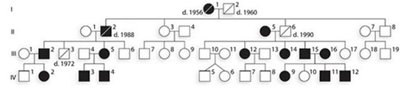
Human genetics is studied using pedigrees, which are family tree charts that track traits across generations. Pedigrees help identify inheritance patterns and predict genetic risks.
Genetic Disorders
Recessive Disorders: Require two recessive alleles (e.g., albinism). Carriers are heterozygous and do not show the trait but can pass it on.
Dominant Disorders: Require only one dominant allele (e.g., Huntington's disease).
Multifactorial Disorders: Influenced by both genetic and environmental factors (e.g., heart disease).
Genetic Testing & Counseling
Carrier Testing: Identifies heterozygous carriers for recessive disorders.
Prenatal Tests: Amniocentesis and Chorionic Villus Sampling (CVS) detect genetic abnormalities in fetuses.
Genetic Counseling: Helps families understand genetic risks and interpret test results.
Pedigree Analysis: Werner’s Syndrome Example
Pedigrees can be used to determine the inheritance mechanism of rare disorders. For Werner’s Syndrome, analysis shows autosomal recessive inheritance, as affected children can have unaffected parents and carriers are possible.
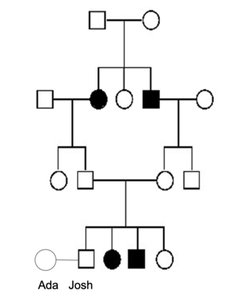
Carrier Probability: If an individual cannot be homozygous recessive, the probability of being a carrier is calculated based on possible genotypes. For Josh, the probability is .
Disease Probability: If both parents are carriers, the probability of having an affected child is .
Summary Table: Types of Genetic Inheritance
Inheritance Type | Key Features | Example |
|---|---|---|
Autosomal Dominant | One allele needed; appears in every generation | Huntington's disease |
Autosomal Recessive | Two alleles needed; can skip generations | Albinism, Werner's Syndrome |
X-linked Dominant | Rare; affects both sexes, but females more | Rett syndrome |
X-linked Recessive | More common in males; can skip generations | Hemophilia |
Key Equations
Multiplication Rule: Probability of independent events:
Addition Rule: Probability of mutually exclusive events:
Additional info: Pedigree charts are essential for visualizing inheritance patterns and calculating genetic probabilities. Genetic counseling integrates pedigree analysis and probability to inform families about risks.
