 Back
Genetics & Inheritance: Mendelian and Non-Mendelian Patterns
Study Guide - Smart Notes
 Tailored notes based on your materials, expanded with key definitions, examples, and context.
Genetics & Inheritance: Introduction & Terminology
Overview of Genetics and Inheritance
Genetics is the scientific study of genes and how they are transmitted from one generation to the next. Inheritance refers to the process by which genetic information is passed from parents to offspring. Each individual inherits one complete set of genes from each parent, and variations in these genes account for the diversity observed within populations.
DNA Organization and Chromosomes
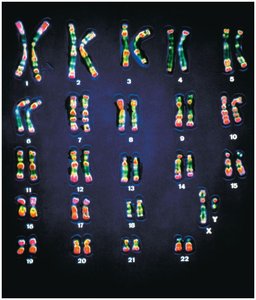
In humans, DNA is organized into 23 pairs of chromosomes: 22 pairs of autosomes and 1 pair of sex chromosomes (X and Y). Autosomes are identical in length and shape, while the X and Y chromosomes differ, with the Y chromosome being smaller.
Homologous Chromosomes and Alleles
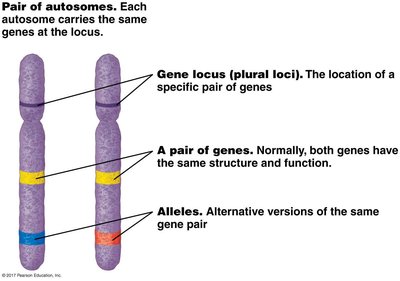
Homologous chromosomes are pairs that look alike and carry the same genes at corresponding loci (locations). However, the specific versions of these genes, called alleles, may differ. These differences can result in variations in protein structure and function, leading to different traits.
Types of Alleles
Homozygous: Two identical alleles for a gene (e.g., AA or aa).
Heterozygous: Two different alleles for a gene (e.g., Aa).
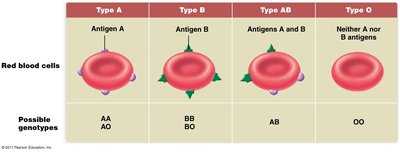
Some genes have more than two possible alleles (e.g., blood types: A, B, O), but each individual inherits only two alleles per gene.
Genotype vs. Phenotype
Genotype: The complete set of genes and alleles an individual possesses.
Phenotype: The observable physical and functional traits, such as eye color, height, or blood type. Phenotype is determined by genotype and can also be influenced by environmental factors.
Dominant and Recessive Alleles
Dominant allele: Expresses its phenotype even if only one copy is present (represented by a capital letter, e.g., AA or Aa).
Recessive allele: Expresses its phenotype only when two copies are present (represented by a lowercase letter, e.g., aa).
Dominance does not imply higher frequency in the population.
Mendelian Genetics
Gregor Mendel and His Experiments
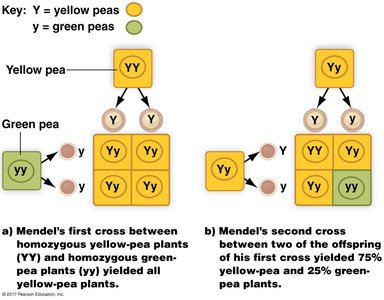
Gregor Mendel, known as the "Father of Genetics," conducted experiments with pea plants to understand inheritance. He performed monohybrid crosses to predict trait expression and established foundational laws of inheritance.
Results of Mendel's Crosses
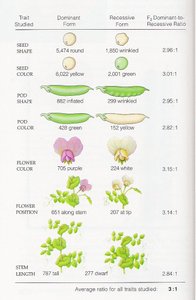
Mendel studied several traits in pea plants, such as seed shape, color, pod shape, flower color, and stem length. He consistently observed a 3:1 ratio of dominant to recessive phenotypes in the F2 generation.
Mendel’s First Law: Law of Segregation
The Law of Segregation states that when gametes are formed, the two alleles for each gene separate so that each gamete receives only one allele. This process occurs during meiosis.
Punnett Squares and Monohybrid Crosses
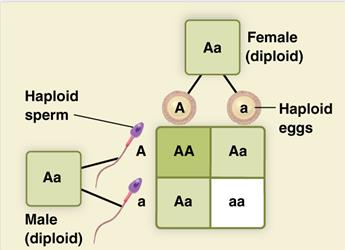
Punnett squares are tools used to predict inheritance patterns and the probability of specific genotypes and phenotypes in offspring. They can be used to combine alleles from two parents and calculate ratios, fractions, or percentages of possible outcomes.
Genetics & Inheritance: Dihybrid Crosses & Pedigree Charts
Two-Trait (Dihybrid) Crosses
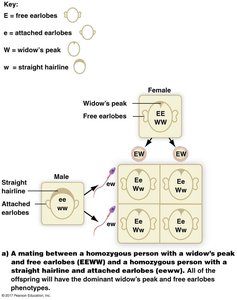
Dihybrid crosses follow the inheritance of two genes simultaneously. These crosses help determine whether genes are inherited together or independently. For example, widow’s peak (dominant) and free earlobes (dominant) can be tracked in a cross between homozygous individuals.
Dihybrid Crosses with Heterozygous Individuals
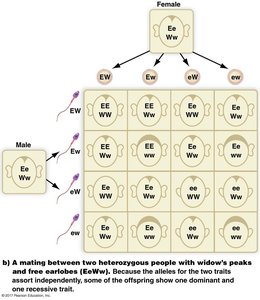
When both parents are heterozygous for two traits, the offspring display a variety of genotype and phenotype combinations due to the independent assortment of alleles.
Predicting Outcomes in Dihybrid Crosses
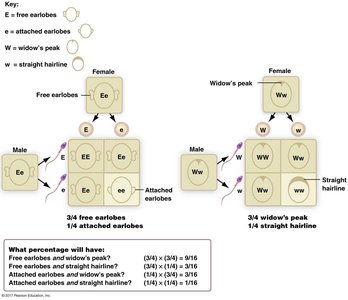
Results can be predicted using large Punnett squares or by multiplying the probabilities from individual monohybrid crosses. The classic phenotypic ratio for a dihybrid cross is 9:3:3:1.
Mendel’s Second Law: Law of Independent Assortment
The Law of Independent Assortment states that alleles of different genes are distributed independently to gametes during meiosis. This is true only for genes located on different chromosomes or far apart on the same chromosome.
Non-Mendelian Inheritance Patterns
Incomplete Dominance
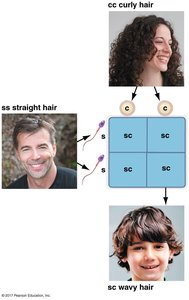
In incomplete dominance, the heterozygous phenotype is intermediate between the two homozygous phenotypes. For example, crossing curly-haired (cc) and straight-haired (ss) individuals results in wavy-haired (sc) offspring.
Co-dominance
In co-dominance, both alleles in a heterozygote are fully expressed, resulting in a phenotype that shows both traits equally. Human blood types (A, B, AB, O) are a classic example, where A and B are co-dominant and O is recessive.
Polygenic Inheritance
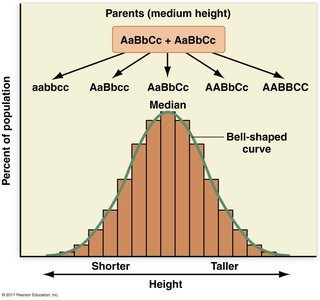
Polygenic inheritance occurs when multiple genes influence a single trait, resulting in a continuous range of phenotypes. Examples include human height, skin color, and eye color. These traits often display a bell-shaped distribution in the population.
Environmental Influences and Epigenetics
Phenotype is influenced by both genetic and environmental factors. Diet, exercise, and exposure to environmental agents can affect traits such as height and disease susceptibility. Epigenetics studies heritable changes in gene expression that do not involve changes to the DNA sequence, such as DNA methylation and histone modification.
Linked Alleles
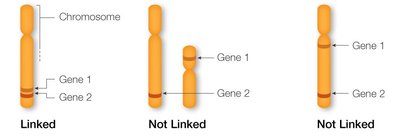
Linked alleles are genes located close together on the same chromosome and tend to be inherited together. However, crossing-over during meiosis can separate linked genes, especially if they are far apart on the chromosome.
Genetic Pedigrees
Pedigree charts are used to track the inheritance of traits across generations. Standardized symbols represent individuals, their relationships, and whether they express a particular trait. Pedigrees are valuable for analyzing inheritance patterns and predicting genetic risks.
Summary Table: Key Mendelian and Non-Mendelian Patterns
Pattern | Description | Example |
|---|---|---|
Complete Dominance | Dominant allele masks recessive allele | Pea plant flower color (purple vs. white) |
Incomplete Dominance | Heterozygote shows intermediate phenotype | Wavy hair (sc) from curly (cc) and straight (ss) |
Co-dominance | Both alleles expressed equally | AB blood type |
Polygenic Inheritance | Multiple genes influence one trait | Height, skin color |
Linked Genes | Genes inherited together due to proximity | Eye color and hair color (sometimes) |
