 Back
Genetics and Patterns of Inheritance: Mendelian and Non-Mendelian Principles
Study Guide - Smart Notes
 Tailored notes based on your materials, expanded with key definitions, examples, and context.
Genetics: Foundations and Principles
Introduction to Genetics
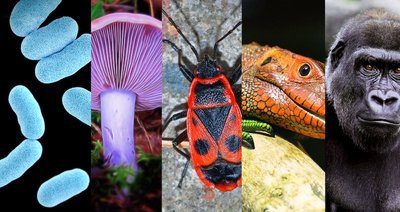
Genetics is the study of heredity and variation in living organisms. It explains how traits are passed from parents to offspring and why individuals differ. Understanding genetics is fundamental for biology, agriculture, medicine, and biotechnology.
Inheritance: The process by which genetic information is transmitted from parents to offspring.
Genotype: The genetic makeup of an organism, determined by the sequence of DNA bases.
Phenotype: The observable traits of an organism, resulting from the interaction of genotype and environment.
Alleles: Different versions of a gene, inherited from each parent.
DNA Replication and the Central Dogma
DNA Replication
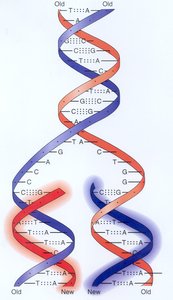
DNA replication is the process by which a cell makes an exact copy of its DNA, ensuring genetic continuity during cell division. The double helix unwinds, and each strand serves as a template for the synthesis of a new complementary strand.
Base Pairing: Adenine (A) pairs with Thymine (T); Cytosine (C) pairs with Guanine (G).
Enzymes: DNA polymerases add nucleotides to the growing strand.
Semiconservative Model: Each new DNA molecule contains one old and one new strand.
The Central Dogma of Molecular Biology
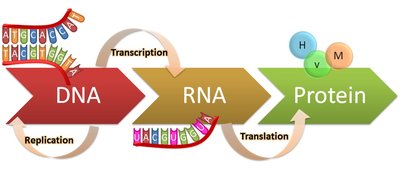
The central dogma describes the flow of genetic information in cells: DNA is transcribed into RNA, which is then translated into protein. This process is fundamental to gene expression and cellular function.
Transcription: DNA is used as a template to synthesize RNA.
Translation: RNA directs the synthesis of proteins by specifying the sequence of amino acids.
Mutation: Changes in DNA sequence can lead to altered RNA and non-functional proteins.
Linking Genotype to Phenotype
Genotype, Phenotype, and Environment
An organism's genotype determines the proteins it produces, which in turn shape its phenotype. However, environmental factors also influence phenotype, leading to variation among individuals.
Genotype (G): Genetic information inherited from parents.
Environment (E): External factors such as diet, lifestyle, and exposure to toxins.
G x E Interaction: Phenotype is the result of both genotype and environmental influences.

Mendelian Genetics
Gregor Mendel and His Experiments
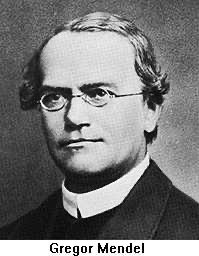
Gregor Mendel, an Austrian monk, is considered the father of genetics. He used pea plants to study inheritance patterns, leading to the formulation of Mendel's Laws.
Model Organism: Pea plants were ideal due to their distinct traits and ease of breeding.
True-breeding: Plants that consistently produce offspring with the same traits.
F1 and F2 Generations: F1 is the first filial generation (children), F2 is the second (grandchildren).
Mendel's Laws of Inheritance
Mendel formulated three fundamental laws based on his experiments:
Law of Dominance: In heterozygotes, one allele is dominant and masks the effect of the recessive allele.
Law of Segregation: Each parent passes one allele for each gene to their offspring; alleles separate during gamete formation.
Law of Independent Assortment: Alleles of different genes are distributed independently into gametes.


Model Organism: Garden Pea
The garden pea served as the first model organism in genetics, allowing Mendel to observe clear patterns of inheritance.
Polymorphic Traits: Traits that appear in multiple forms (e.g., flower color, seed shape).
Application: Conclusions from peas can be applied to other species.

Non-Mendelian Patterns of Inheritance
Exceptions to Mendel's Laws
Not all traits follow Mendel's laws. Non-Mendelian inheritance includes patterns such as incomplete dominance, codominance, multiple alleles, polygenic traits, linked genes, and sex-linked genes.
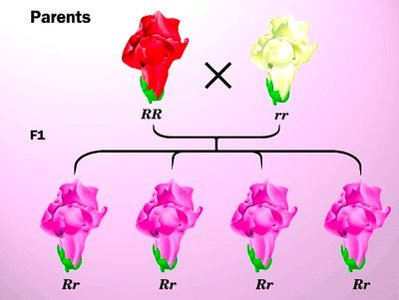
Incomplete Dominance: Heterozygotes show an intermediate phenotype.
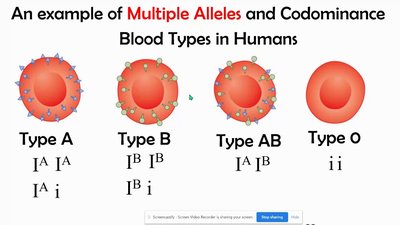
Codominance: Both alleles are expressed equally (e.g., blood types).
Multiple Alleles: More than two alleles exist for a gene in a population.
Polygenic Traits: Traits controlled by multiple genes, often showing continuous variation.
Linked Genes: Genes located close together on a chromosome tend to be inherited together.
Sex-linked Genes: Genes located on sex chromosomes show unique inheritance patterns.
Polygenic Traits and Quantitative Genetics
Polygenic traits are influenced by two or more genes and often by environmental factors. They display a phenotypic continuum rather than discrete categories.
Example: Human skin color and eye color are polygenic traits.
Quantitative Genetics: The study of traits that show continuous variation.
Genetic Recombination and Meiosis
Genetic Recombination
Sexual reproduction leads to genetic diversity through recombination, crossing over, and random assortment during meiosis.
Crossing Over: Exchange of genetic material between homologous chromosomes.
Random Assortment: Homologous chromosomes are randomly distributed into gametes.
Mutation: Changes in DNA sequence introduce new genetic variation.
Meiosis vs. Mitosis
Meiosis produces genetically unique gametes, while mitosis produces genetically identical somatic cells.
Somatic Cells: Produced by mitosis; diploid and genetically identical.
Gametes: Produced by meiosis; haploid and genetically unique.
Summary Table: Mendelian vs. Non-Mendelian Inheritance
Pattern | Description | Example |
|---|---|---|
Mendelian | Traits follow Mendel's laws (dominance, segregation, independent assortment) | Purple vs. white flower color in peas |
Incomplete Dominance | Heterozygotes show intermediate phenotype | Pink flowers from red and white parents |
Codominance | Both alleles expressed equally | AB blood type in humans |
Multiple Alleles | More than two alleles for a gene | Blood types (A, B, O) |
Polygenic Traits | Trait controlled by multiple genes | Skin color, eye color |
Linked Genes | Genes inherited together due to proximity | Gene clusters on chromosomes |
Sex-linked Genes | Genes on sex chromosomes | Color blindness, hemophilia |
Conclusion
Genetics is a foundational discipline in biology, explaining how traits are inherited and why variation exists. Mendelian principles provide a basis for understanding inheritance, while non-Mendelian patterns reveal the complexity of genetic traits. Genetic recombination and meiosis ensure diversity in sexually reproducing organisms, and environmental factors further shape phenotypes.
