 Back
Genetics and Statistical Analysis in General Biology
Study Guide - Smart Notes
 Tailored notes based on your materials, expanded with key definitions, examples, and context.
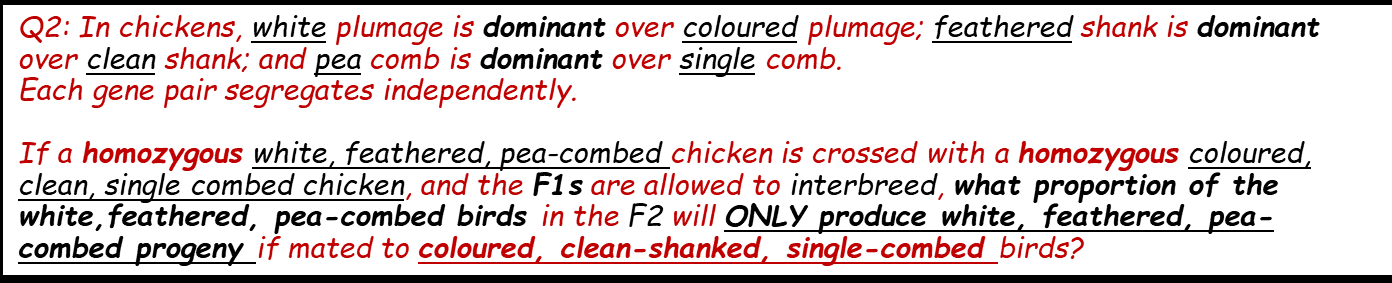
Q2. In chickens, white plumage is dominant over coloured plumage; feathered shank is dominant over clean shank; and pea comb is dominant over single comb. Each gene pair segregates independently. If a homozygous white, feathered, pea-combed chicken is crossed with a homozygous coloured, clean, single combed chicken, and the F1s are allowed to interbreed, what proportion of the white, feathered, pea-combed birds in the F2 will ONLY produce white, feathered, pea-combed progeny if mated to coloured, clean-shanked, single-combed birds?
Background
Topic: Mendelian Genetics, Dihybrid and Trihybrid Crosses
This question tests your understanding of independent assortment, dominance, and how to predict genotypic and phenotypic ratios in multi-gene crosses. It also asks you to apply these concepts to determine which F2 individuals are true-breeding for all dominant traits.
Key Terms and Formulas
Dominant allele: An allele that masks the effect of a recessive allele (e.g., W1 for white plumage).
Recessive allele: An allele whose effect is masked by a dominant allele (e.g., w2 for coloured plumage).
Independent assortment: Genes for different traits segregate independently during gamete formation.
Genotype: The genetic makeup (e.g., W1W1 F1F1 P1P1).
Phenotype: The observable traits (e.g., white, feathered, pea-combed).
Probability of genotype in F2: For each gene, the probability of being homozygous dominant is in a typical F1 self-cross.
Step-by-Step Guidance
Identify the parental genotypes: Homozygous dominant (W1W1 F1F1 P1P1) crossed with homozygous recessive (w2w2 f2f2 p2p2).
Determine the F1 genotype: All F1 offspring will be heterozygous for each gene (W1w2 F1f2 P1p2).
Set up the F1 intercross: F1 x F1 (W1w2 F1f2 P1p2 x W1w2 F1f2 P1p2).
For each gene, calculate the probability that an F2 individual is homozygous dominant (e.g., W1W1, F1F1, P1P1). For a single gene, this is .
Since the genes assort independently, multiply the probabilities for all three genes to find the proportion of F2 individuals that are homozygous dominant for all traits.
Try solving on your own before revealing the answer!
Final Answer: 1/64
For each gene, the probability of being homozygous dominant in the F2 is . Since there are three independent genes, multiply: .
This means only 1 out of 64 white, feathered, pea-combed F2 birds will be true-breeding for all dominant traits and will only produce white, feathered, pea-combed progeny when mated to a coloured, clean-shanked, single-combed bird.
