 Back
Genetics: Foundations, Experiments, and Molecular Mechanisms
Study Guide - Smart Notes
 Tailored notes based on your materials, expanded with key definitions, examples, and context.
Genetics: The Study of Heredity
Introduction to Genetics
Genetics is a fundamental branch of biology that investigates the mechanisms of heredity and the impact of genetic changes on organisms. It is central to understanding cellular and organismal physiology, and influences fields such as development, ecology, physiology, behavior, neuroscience, and medicine.
Genetics: The study of genes, genetic variation, and heredity in living organisms.
Genome: The complete set of genetic material in an organism.
Heredity: The transmission of genetic traits from parents to offspring.
Application: Genetic analysis is used to study diseases, traits, and evolutionary processes.
Properties of Genetic Material
Requirements for Genetic Material
The genetic material must possess several key properties to fulfill its biological role:
Information Storage: Must be sufficiently complex to encode the structure, function, development, and reproduction of an organism.
Replication: Must accurately replicate itself so daughter cells inherit identical information.
Mutation: Must be mutable, allowing for rare mutations that introduce genetic variation and drive evolution.
Localization: Must be localized to the nucleus and be a component of chromosomes.
Stability: Must be present in a stable form within cells.
Chromosomes and Inheritance
Evidence for Chromosomal Role in Heredity
Chromosomes are structures within cells that contain DNA and protein. Key evidence for their role in inheritance includes:
Nuclei of male and female reproductive cells fuse during fertilization.
Chromosomes split and each daughter cell receives an identical set.
Chromosome number is species-specific but consistent within a species.
Discovery of DNA as Genetic Material
Griffith’s Transformation Experiment
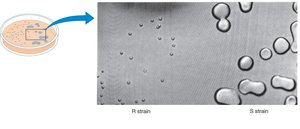
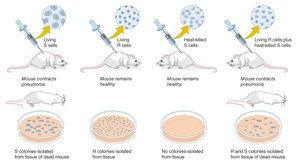
Griffith’s experiment demonstrated that a "transforming principle" could transfer virulence from dead bacteria to living bacteria, suggesting the existence of a hereditary molecule.
S strain (smooth, virulent): Kills mice.
R strain (rough, avirulent): Mice survive.
Mixing dead S strain with live R strain killed mice, indicating transfer of genetic information.
Avery, McCarty, and MacLeod Experiment
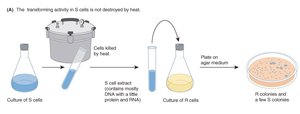
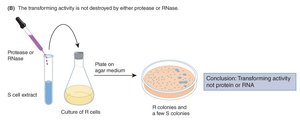
This experiment identified DNA as the transforming principle by selectively destroying DNA, RNA, and protein in bacterial extracts.
Protease: Destroys protein, transformation still occurs.
RNase: Destroys RNA, transformation still occurs.
DNase: Destroys DNA, transformation does not occur.
Conclusion: DNA is the hereditary molecule.
Hershey-Chase Blender Experiment
Hershey and Chase used radioactive labeling to show that DNA, not protein, is responsible for bacteriophage infection of bacteria.
32P labels DNA (not protein).
35S labels protein (not DNA).
After infection, only DNA entered the bacterial cells, confirming DNA as the genetic material.
The Structure and Replication of DNA
The DNA Double Helix
DNA is composed of two antiparallel strands forming a double helix, with complementary base pairing (A:T and G:C).
Antiparallel: Strands run in opposite directions.
Base Pairing: Adenine pairs with Thymine, Guanine pairs with Cytosine.
DNA Replication
DNA replication is the process by which DNA makes a copy of itself during cell division. It ensures genetic continuity between generations.
Semiconservative replication: Each new DNA molecule contains one old strand and one new strand.
Enzymes: DNA polymerases catalyze the synthesis of new DNA strands.
Mutations and Genetic Variation
Definition and Types of Mutations
Mutations are heritable changes in genetic material and are the source of variation in populations, providing the raw material for natural selection.
Allele: Alternative forms of a gene.
Wild type: The most prevalent allele in a population.
Mutant: An allele that differs from the wild type.
Phenotype: The observable traits of an organism.
Genotype: The genetic composition of an organism.
Mutations in Biochemical Pathways
Mutations can block metabolic pathways, leading to diseases such as alkaptonuria and phenylketonuria. Enzymes, coded by genes, catalyze biochemical reactions, and metabolites are the molecules acted upon.
Prototrophs: Can grow without supplemental nutrients.
Auxotrophs: Require specific nutrients for growth.
Complete medium: Contains all nutrients.
Minimal medium: Contains only essential nutrients for wild type growth.
One Gene – One Enzyme Hypothesis
Beadle and Tatum’s Neurospora Experiments
Beadle and Tatum demonstrated that each gene encodes a specific enzyme by generating mutants in Neurospora that could not grow on minimal media unless supplemented with specific nutrients.
Mutants were analyzed to determine which metabolite they could not synthesize.
Helped establish the concept that genes code for enzymes.
Complementation Analysis
Determining Genetic Relationships
Complementation analysis is used to determine if two mutations with the same phenotype are in the same gene or in different genes.
Cross two mutants and observe the phenotype.
If mutant phenotype persists, mutations are in the same gene.
If wild type phenotype appears, mutations are in different genes.
The Central Dogma of Molecular Biology
Flow of Genetic Information
The central dogma describes the flow of genetic information in cells: DNA is transcribed into RNA, which is then translated into protein.
Transcription: DNA → RNA
Translation: RNA → Protein
Proteins: Provide structure and catalyze cellular reactions.
Genetic Code
The genetic code is a set of rules by which information encoded in DNA or RNA is translated into proteins. It is composed of triplet codons, each specifying an amino acid.
Example: AUG codes for methionine (start codon).
Mutations: Can alter amino acid sequence, e.g., missense mutations substitute one amino acid for another.
Genes and Traits
Pleiotropy and Polygenic Traits
Most traits are influenced by multiple genes and environmental factors. One gene can affect multiple traits (pleiotropy), and any trait can be affected by more than one gene (polygenic).
Pleiotropy: One gene, multiple traits.
Polygenic: Multiple genes, one trait.
Environmental influence: Traits are shaped by both genes and environment.
The Three Domains of Life
Classification of Living Organisms
All living organisms are classified into three domains based on cellular structure and molecular characteristics:
Prokarya: Bacteria and cyanobacteria.
Archaea: Microorganisms distinct from bacteria, often living in extreme environments.
Eukarya: Organisms with cells containing nuclei, mitochondria, and internal membranes.
Molecular Similarity
All living things share fundamental molecular similarities, such as the use of DNA, RNA, and proteins for information storage and cellular function.
Universal genetic code: All life uses the same basic code for translating DNA into proteins.
Summary Table: Key Experiments in Genetics
Experiment | Purpose | Key Finding |
|---|---|---|
Griffith's Transformation | Test for hereditary molecule | Transforming principle exists |
Avery, McCarty, MacLeod | Identify transforming principle | DNA is hereditary molecule |
Hershey-Chase | DNA vs. protein in phage infection | DNA enters cell, directs infection |
