 Back
Genetics: From Genes to Traits – Study Notes
Study Guide - Smart Notes
 Tailored notes based on your materials, expanded with key definitions, examples, and context.
Genetics: From Genes to Traits
Introduction to Genetics
Genetics is the study of how traits are inherited from one generation to the next through genes. It explores the structure and function of genes, how genetic information is passed on, and how it manifests as observable characteristics in organisms.
Foundations of Genetics
Homologous Chromosomes
Homologous chromosomes are pairs of chromosomes, one inherited from each parent, that carry the same genes at corresponding loci but may have different versions (alleles) of those genes.
Homologous Chromosomes: Chromosome pairs with the same gene sequence, each from a different parent.
Locus: The specific physical location of a gene on a chromosome.
Alleles: Different forms of the same gene found at the same locus on homologous chromosomes.
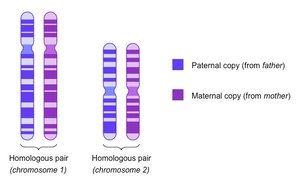
Genes and Alleles
A gene is a segment of DNA that contains instructions for a specific trait or protein. Alleles are alternative versions of a gene that may produce different traits.
Gene: DNA segment coding for a trait or protein.
Allele: Variant form of a gene (e.g., F for freckles, f for no freckles).
Locus: The gene's position on a chromosome.
Genotype and Phenotype
Definitions and Examples
The genotype is the genetic makeup of an individual for a specific gene, while the phenotype is the observable trait resulting from the genotype.
Genotype: The combination of alleles (e.g., FF, Ff, ff).
Phenotype: The physical expression of the genotype (e.g., having freckles or not).
Example: If F = freckles and f = no freckles, then FF and Ff genotypes result in freckles, while ff results in no freckles.
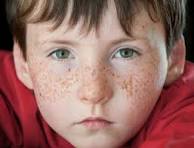
Homozygous vs. Heterozygous
An individual is homozygous if both alleles for a gene are the same (FF or ff), and heterozygous if the alleles are different (Ff).
Homozygous dominant: FF (shows dominant trait)
Homozygous recessive: ff (shows recessive trait)
Heterozygous: Ff (shows dominant trait if dominance is complete)
Meiosis and Inheritance
Role of Meiosis
Meiosis is the process by which gametes (egg and sperm) are formed, reducing the chromosome number by half and ensuring that each gamete carries only one allele for each gene. This separation of alleles occurs during Anaphase II of meiosis.
Meiosis: Separates homologous chromosomes and alleles, producing haploid gametes.
Fertilization: Restores the diploid number and pairs alleles in the offspring.
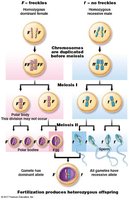
Punnett Squares and Genetic Crosses
Monohybrid Crosses
Punnett squares are tools used to predict the possible genotypes and phenotypes of offspring from a genetic cross. A monohybrid cross examines the inheritance of a single trait.
Example Cross: FF (freckles) x ff (no freckles)
All offspring: Ff (heterozygous, freckles phenotype)
Parent 1 | Parent 2 | Offspring Genotype | Offspring Phenotype |
|---|---|---|---|
FF | ff | Ff | Freckles |
Monohybrid Cross Between Heterozygotes
When both parents are heterozygous (Ff x Ff), the Punnett square predicts a 3:1 phenotypic ratio (freckles: no freckles).
Genotype | Probability | Phenotype |
|---|---|---|
FF | 1/4 | Freckles |
Ff | 2/4 | Freckles |
ff | 1/4 | No freckles |
Genotypic ratio: 1:2:1 Phenotypic ratio: 3:1
Dihybrid Crosses and Independent Assortment
Principle of Independent Assortment
When following two traits, alleles for different genes assort independently during gamete formation if the genes are on different chromosomes. This is illustrated by a dihybrid cross (e.g., FfWw x FfWw for freckles and widow’s peak).
Possible gametes: FW, Fw, fW, fw
Phenotypic ratio: 9:3:3:1 (when both parents are heterozygous for both traits)
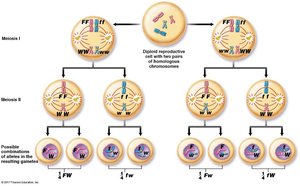
Phenotype | Proportion |
|---|---|
Freckles + widow’s peak | 9/16 |
Freckles + straight hairline | 3/16 |
No freckles + widow’s peak | 3/16 |
No freckles + straight hairline | 1/16 |
Pedigrees
Pedigree Analysis
Pedigrees are diagrams that track the inheritance of traits through families. They help identify whether a trait is dominant or recessive and can be used to infer genotypes based on observed phenotypes.
Symbols: Squares represent males, circles represent females; shaded symbols indicate affected individuals.
Dominant inheritance: Trait appears in every generation.
Recessive inheritance: Trait can skip generations.
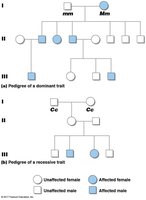
Punnett Squares vs. Pedigrees
Punnett Squares: Used when parental genotypes are known to predict possible offspring genotypes and phenotypes.
Pedigrees: Used to infer possible genotypes from observed family phenotypes.
Beyond Mendelian Genetics
Complex Patterns of Inheritance
Not all traits follow simple Mendelian dominant-recessive patterns. Some traits show intermediate or combined phenotypes, are influenced by multiple genes, or are affected by gene location on sex chromosomes.
Codominance: Both alleles are fully expressed in heterozygotes (e.g., ABO blood types: IAIB genotype results in both A and B antigens).
Multiple alleles: More than two alleles exist in the population for a gene (e.g., IA, IB, i for blood type).
Pleiotropy: One gene affects multiple traits.
Polygenic inheritance: Multiple genes contribute to a single trait.
Example: ABO blood group system in humans demonstrates codominance and multiple alleles.
